Humbucker vs Single Coil: What Actually Changes, and Which One You Want
Berklee-trained guitarist and former gear buyer Julian Reyes explains humbuckers and single coils: how hum cancellation really works, why humbuckers sound darker, output and resistance numbers, P-90s, coil splitting, noiseless pickups, bass configurations, and how to choose.
Updated
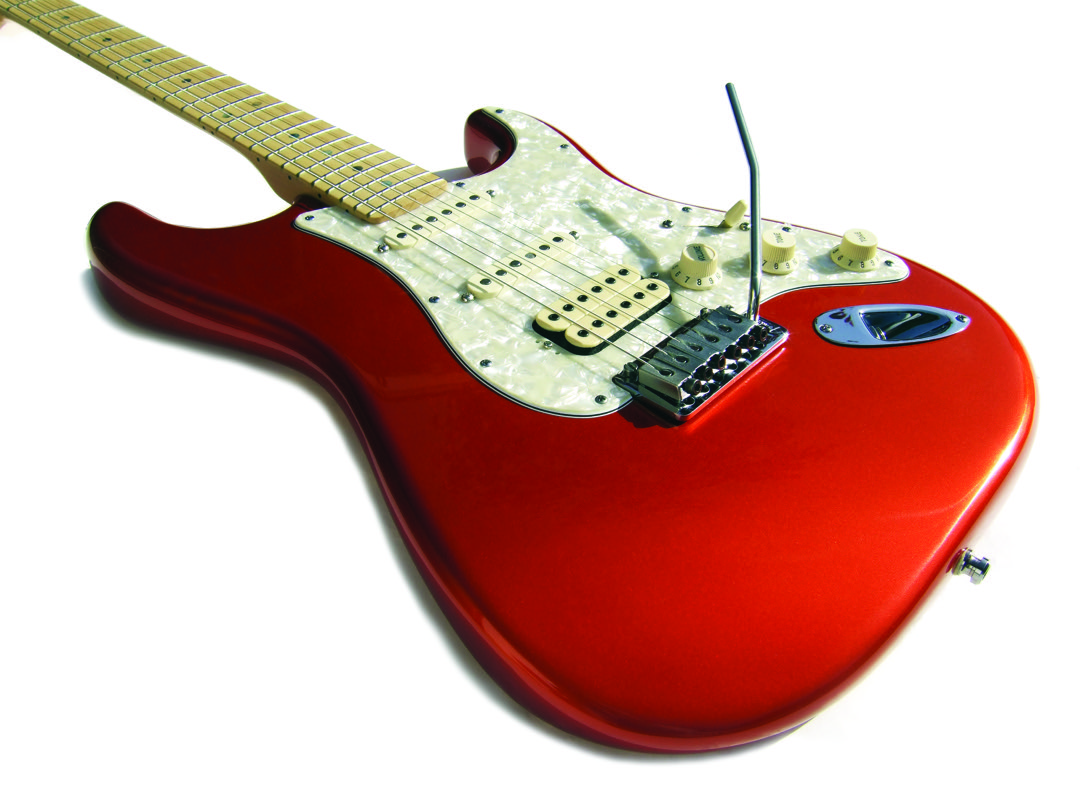
Ask ten guitarists what separates a humbucker from a single coil and you will get ten versions of the same two sentences: humbuckers are fat and quiet, single coils are bright and buzzy. That is true, and it explains almost nothing. It does not tell you why a humbucker is darker, which is not obvious and has very little to do with cancelling hum. It does not tell you why a split humbucker disappoints people. And it does not tell you that the single largest tonal difference between two pickups in the same guitar is often not their type at all.
I spent years on the buying side of a music retail counter and years teaching before that, and the pickup question comes up constantly, usually attached to a plan to spend money. So this guide covers what physically differs between the two designs, what each difference does to the sound in terms you can hear, where P-90s and coil splits and noiseless pickups actually land, and the two free adjustments that change your tone more than a swap will.
The Short Answer
A single coil is one coil of wire around six magnets. A humbucker is two of those coils wound in opposite directions, with opposite magnetic polarity, wired in series. That reversal cancels electrical hum and, as a side effect, roughly doubles the output and pushes the pickup’s resonant peak down by an octave or more.
In sound: single coils are brighter, more detailed and better at letting you hear the individual notes inside a chord, and they hum. Humbuckers are louder, thicker through the midrange, smoother on top and silent, and they can sound congested under heavy distortion with big open chords.
If you play country, funk, surf, blues, or most kinds of jangly clean guitar, you want single coils. If you play rock, hard rock, metal, or straight-ahead jazz on an archtop, you want humbuckers. If you want one guitar that does a serviceable job at both, an HSS layout with two single coils and a bridge humbucker is the reason that configuration exists.
What a Single Coil Actually Is
Take six magnetised rods of alnico, an alloy of aluminium, nickel and cobalt, and stand them in a row inside a small plastic bobbin. Wind roughly seven to eight thousand turns of enamelled copper wire around the bobbin, using wire so fine it is about the thickness of a human hair, and you have a Fender-style single coil.
The magnets create a field. A steel string sitting in that field becomes magnetised itself, and when you pluck it, its motion disturbs the field. A changing magnetic field through a coil of wire induces a voltage across that coil. That voltage, measured in hundreds of millivolts at most, is your guitar signal.
The design has one unavoidable flaw. A coil of wire is an excellent antenna, and it cannot distinguish between the magnetic disturbance caused by your string and the electromagnetic field radiating from the wiring in your walls. Mains power runs at 60 Hz in North America and 50 Hz in most of Europe and Asia, and every dimmer switch, transformer, computer monitor and fluorescent light in the room is broadcasting on it and its harmonics. Your single coil picks all of it up, and that is the buzz.
Worth knowing: the buzz is directional. Rotate the guitar and it changes, because you are changing the coil’s orientation relative to the field. Most players discover this by accident and then use it on stage for the rest of their careers.
What a Humbucker Actually Is
Seth Lover, working at Gibson, applied for the patent in 1955 and it was granted in 1959. Gibson had been shipping the pickup since 1957 with a small sticker on the baseplate reading “Patent Applied For”, which is why collectors call the originals PAFs.
The design puts two coils side by side and does two things to the second one. It is wound in the opposite direction, and its magnet is oriented with the opposite pole facing up. Then both coils are wired in series, so their outputs add.
Follow the two signals through that arrangement and the trick becomes obvious.
Hum arrives as a field passing through both coils equally, from the same direction. Because the coils are wound in opposition, the voltages it induces are equal and opposite. They sum to approximately zero and the hum vanishes.
The string is sensed by two magnets pointing opposite ways, so the coils see it in opposite senses too. That second reversal cancels the first. The string signals arrive in phase and add together.
Two reversals for the signal, one for the noise. That asymmetry is the entire invention, and it is elegant enough that nothing has improved on it in seventy years.
Why Humbuckers Sound Darker
Here is the part most comparisons skip, and it is where the actual tonal difference lives. Cancelling hum does not make a pickup sound warm. Three other consequences of the two-coil design do.
Two coils in series have much more inductance. A pickup is not a flat-response device; it is a resonant circuit formed by the coil’s inductance and the capacitance of the coil, the cable and the volume pot. That circuit has a peak, and the frequencies above it roll away. A single coil typically peaks somewhere around 5 to 7 kHz, comfortably up in the region your ear reads as air and sparkle. A humbucker, with twice the winding plus steel pole pieces and a keeper bar adding to its inductance, peaks far lower, often between 2 and 3.5 kHz. Everything above that peak is quieter. That is the darkness, and it is a circuit property, not a mystery.
Two coils sense the string in two places at once. The pole rows on a standard humbucker sit about 19 mm apart, so the pickup averages the string’s motion at two points instead of one. Averaging two samples of a wave cancels any harmonic whose wavelength happens to line up with that spacing, and it softens everything with a short wavelength, which is to say the high harmonics. A single coil looks at a narrow slice of string and reports what it finds. This wider aperture is why a humbucker sounds smoother and slightly blurred at the top even when its resonant peak is corrected for, and it is also why a humbucker’s midrange feels bigger.
Two coils in series produce roughly twice the voltage. A vintage-style single coil might deliver 100 to 150 millivolts on a hard strum; a PAF-style humbucker delivers something like double that. Around 6 dB more signal does not just make you louder. It hits the input stage of your amp harder, so a humbucker reaches the point of breakup at a lower volume-knob setting than a single coil does. Half the reason people describe humbuckers as “warmer” is that they are hearing an amp that is working slightly harder.
The Numbers, Side by Side
DC resistance is the spec you will see on every pickup listing, so it is worth saying plainly what it does and does not tell you. It measures how much copper is in the coil, which correlates loosely with output, and that is all. Two pickups reading the same resistance can have very different output and very different voicing depending on wire gauge, magnet type and coil geometry. Treat it as a rough sorting tool, not a tone spec.
| Single coil | P-90 | Humbucker | |
|---|---|---|---|
| Coils | One | One | Two, series, reverse wound and reverse polarity |
| Cancels hum | No | No | Yes |
| Typical DC resistance | 5.5 to 7 kΩ vintage, up to 13 kΩ hot | 8 to 9 kΩ | 7.5 to 8.5 kΩ vintage, 12 to 16 kΩ high output |
| Resonant peak | About 5 to 7 kHz | About 4 to 6 kHz | About 2 to 3.5 kHz |
| Relative output | Reference | Around 1.3 to 1.5x | Around 2x |
| Usual pot value | 250 kΩ | 500 kΩ | 500 kΩ |
| Canonical guitars | Stratocaster, Telecaster | Les Paul Junior, SG Special, Casino | Les Paul, SG, ES-335, Explorer |
| Natural home | Country, funk, surf, blues, indie | Punk, garage, roots rock, raw blues | Rock, metal, jazz, anything high gain |
The Magnet Ladder
Coil count gets all the attention, but the magnet inside a pickup re-voices it just as decisively, and a magnet swap is a cheap thing to try before replacing the whole pickup. Alnico is an alloy of aluminium, nickel and cobalt, and the grade number tells you roughly how strong it is.
| Magnet | Strength | Character | Typically found in |
|---|---|---|---|
| Alnico II | Weakest | Soft attack, rounded top end, sweet compressed midrange, least string pull | Vintage-voiced PAF humbuckers, neck positions |
| Alnico III | Weak | Even softer and more open than II, very low output, airy | Vintage-correct Strat neck pickups, boutique reissues |
| Alnico IV | Medium | Flat and balanced, neither scooped nor humped, honest | Modern boutique pickups aiming for neutrality |
| Alnico V | Strong | Bright, tight low end, scooped mids, higher output | Most stock Fender single coils, hot humbuckers |
| Ceramic | Strongest | Aggressive, hard treble, highest output, very tight bass | Metal humbuckers, budget stock pickups, active designs |
Two practical notes. Stronger magnets pull harder on the strings, so an alnico V or ceramic pickup needs more clearance than an alnico II to avoid damping the string, which matters in the height section below. And ceramic is common in inexpensive stock pickups for cost reasons rather than tonal ones, which is why a budget guitar’s pickups often sound harsher than their spec sheet suggests.
What Each One Is Actually Good At
Single coils resolve detail. Play a first-position G chord through a clean amp with a Strat and you hear six distinguishable strings; play the same chord through a Les Paul and you hear one large chord. Neither is wrong. Funk rhythm, fingerpicked arpeggios, country double stops and chiming open-chord parts all depend on that separation, and they get muddy the moment you thicken the source. Single coils also track your picking hand more visibly, because there is more high-frequency content in the attack transient for the amp to reproduce, which is why they reward players with articulate right hands and expose players who do not have one yet.
Humbuckers deliver weight and sustain. The extra output drives the amp, the midrange emphasis pushes the guitar forward in a band mix, and the smoother top end tolerates gain that would turn a single coil into a wasp’s nest. A neck humbucker on an archtop is the sound of jazz guitar as an entire genre understands it. A bridge humbucker into a cranked amp is the sound of rock. And the silence between notes, in a room full of stage lighting and power amps, is worth more than players realise until they have played a gig with single coils under a lighting rig.
The honest weakness of a humbucker is chord definition at high gain. Big open chords through a lot of distortion get congested, because a thick midrange plus compressed harmonics plus more harmonic content generated by the distortion all fight for the same band. This is why metal rhythm playing lives on power chords and palm mutes rather than open shapes, and it is a compositional consequence of the pickup, not a coincidence.
Whatever you are running into, the amp is doing more of this work than the pickup is. If you have not settled on one yet, our guide to the best guitar amps is the higher-leverage place to start, and if you are still choosing the instrument itself, the best electric guitars roundup covers both camps.
Humbucker vs Single Coil for Metal and High Gain
Two things stack against single coils here.
Noise is the first and it is decisive. Gain does not care where your signal ends and the hum begins, so it amplifies both by the same enormous factor. A single coil that produces a mild buzz on a clean channel produces an intolerable one through a high-gain preamp, and the problem is worst in the silence between riffs, which is exactly where tight metal playing lives. Noise gates exist and are widely used, but a gate solves the symptom by chopping the tail off everything.
Frequency balance is the second. A humbucker’s lower resonant peak means less upper-midrange and treble energy arrives at the distortion stage, which translates directly into less fizz and a tighter result. Ceramic and active humbuckers take this further, trading dynamic response for consistency and a very controlled low end. That is why an EMG 81 and its relatives have sat in metal guitars for four decades.
None of this bans single coils from heavy music. Plenty of high-gain players use stacked or noiseless designs, and the results can be excellent. They are just spending effort on shielding, gating and gain staging to get where a humbucker starts. If you are chasing high-gain tones, note that the pedal matters at least as much as the pickup; the best distortion pedals guide covers what each voicing does to a guitar’s front end, and a multi-effects unit lets you hear a lot of them against your own pickups before committing.
P-90s: The Third Option
Gibson’s P-90 arrived in 1946, eleven years before the humbucker, and it is a single coil with different geometry. Rather than six magnetic rods standing inside the bobbin, it uses two flat bar magnets lying underneath, with adjustable steel screws passing through the coil to conduct the field up to the strings. The bobbin is wider and shallower than a Fender single coil’s.
That shape does two things. The wider coil senses a broader section of the string, which thickens the midrange in a way a Strat pickup never does. The higher turn count raises output into the 8 to 9 kΩ range, comfortably above vintage Fender territory and approaching a PAF.
The result is genuinely its own thing rather than a compromise: single-coil clarity and bite with a shove behind it, a slightly gritty midrange, and a raw quality that punk, garage rock and roots players have built entire sounds on. It also hums, slightly more than a Strat pickup does, because there is more wire in the coil.
If you have tried single coils and found them thin, and tried humbuckers and found them polite, P-90s are usually where you stop looking.
Coil Splitting, Coil Tapping and Parallel Wiring
Three terms that get used interchangeably and mean different things.
Coil splitting shorts one coil of a humbucker to ground, typically through a push-pull pot, so only one coil remains active. Coil tapping is unrelated: it uses a pickup wound with an extra lead soldered to an intermediate point in the winding, letting you select fewer turns. Tapping applies to single coils and humbuckers alike; splitting only applies to a humbucker.
Splitting works, with caveats. You get single-coil brightness and separation back, and you lose about half your output. What you do not get is a proper single coil, because the surviving coil is a narrow half-width bobbin sitting to one side of where a real single coil would be centred, with a magnet structure designed for a pair rather than for solo duty. It sounds thinner and slightly weedier than a purpose-built single coil, and it hums, since cancellation required both coils.
Parallel wiring is the option almost nobody uses and it deserves more attention. Instead of shorting one coil, you rewire the pair from series to parallel. Both stay active, so hum still cancels. Output drops and the treble lifts, giving you a brighter, more open, more single-coil-flavoured sound that stays quiet. It requires the same four-conductor pickup and the same push-pull pot as a split, so it costs nothing extra, and to my ears it is the better of the two.
Noiseless and Stacked Single Coils
If you want single-coil tone without the buzz, three approaches exist.
Stacked humbuckers put two coils on top of each other inside a single-coil-sized housing, with the lower coil acting mainly as a noise canceller. They fit any single coil route and are genuinely quiet. The compromise is that the lower coil also sees some of the string and subtracts some high end, so early designs sounded noticeably duller than the pickups they replaced. Modern ones from Fender, Kinman and DiMarzio have narrowed that gap considerably.
Dummy coils hide an extra coil elsewhere in the guitar, wired out of phase and away from the strings, so it senses only noise and subtracts it. Done well this is the highest-fidelity fix, because the pickup itself is untouched. It requires cavity space and wiring work, so it is rare outside boutique builds.
Reverse-wound middle pickups are the free version, and your Strat probably already has one. On essentially every Strat built in recent decades, the middle pickup is wound backwards with reversed magnet polarity, so switch positions 2 and 4 (neck plus middle, and middle plus bridge) are hum-cancelling pairs. Those two positions are the quiet ones and also the source of the glassy quack that defines the instrument. If hum is bothering you, try living in position 2 or 4 before spending anything.
Single-Coil-Sized Humbuckers
Rail humbuckers such as the Seymour Duncan Hot Rails, the Little ‘59 and the DiMarzio Fast Track squeeze two coils into a single-coil footprint, using solid blade rails instead of six pole pieces so both coils fit. The appeal is obvious: humbucking output in a Strat with no routing, no new pickguard, and a twenty-minute soldering job.
Set expectations correctly. The two coils are much narrower and closer together than a full-size humbucker’s, so the sensing aperture is smaller. The tone comes out tighter, more compressed and more midrange-focused than a real PAF, and less open than the single coil it replaced. It is a distinct voice rather than a PAF in a small box, and it is genuinely good for hard rock and metal in a Strat-shaped guitar. Just do not buy one expecting a Les Paul.
HSS, HSH and What the Switch Positions Give You
Mixed layouts are named by pickup type from neck to bridge, so SSS is three single coils, HSS is a bridge humbucker with single coils in the middle and neck, HH is two humbuckers, and HSH puts a single coil between two humbuckers. HSS is the most common hybrid by a wide margin and is the default on a large share of modern Strat-style guitars.
On a standard SSS Strat, the five-way switch gives you neck, neck plus middle, middle, middle plus bridge, and bridge. The two combination positions are the quiet ones, thanks to that reverse-wound middle pickup, and they produce the hollow quack that most people picture when they think of a Strat.
On an HSS guitar the same five-way usually gives you bridge humbucker, humbucker plus middle, middle, middle plus neck, and neck. That layout is a deliberate compromise, and it works: you keep the two glassy in-between sounds and the two single coil positions for clean playing, and you gain a bridge humbucker that can handle serious gain. What you lose is the classic single coil bridge tone, the thin cutting one that country and surf players live on. Many HSS guitars add a push-pull pot to split the humbucker and partly recover it.
The Kurt Cobain question comes up often enough to answer directly: he used both, and the Jaguars and Mustangs he is most associated with were modified to a humbucker in the bridge with a single coil at the neck, which is the same idea as HSS arrived at from the other direction.
If you are running an HSS guitar into a lot of different sounds, that middle-position clean tone and the bridge humbucker want quite different pedal settings; the best guitar pedals roundup covers the compressors and drives that keep both usable without constant knob-twisting.
Position Changes More Than Type
This is the point I would most like beginners to take away, because it saves money.
Where a pickup sits along the string affects the sound at least as much as how it is built. A neck pickup sits near the middle of the vibrating length, where the fundamental swings widest and the higher harmonics have nodes, so it hears mostly low-order content and reads as warm and round. A bridge pickup sits at the end of the string, where total motion is small but high harmonics are proportionally strong, so it reads as bright, thin and cutting.
The consequence trips people up constantly: a neck-position humbucker and a bridge-position single coil are not opposites on a single axis. A neck single coil is often warmer than a bridge humbucker. If you own a Strat and want a fatter sound, switching to the neck pickup gets you most of the way there for free, and if you own a Les Paul and want more bite, the bridge pickup with the tone rolled up does the same.
There is a related trap in comparing guitars rather than pickups. A great deal of what gets attributed to “single coils versus humbuckers” is really Fender versus Gibson: a 25.5 inch scale against a 24.75 inch scale, bolt-on maple against set mahogany with a maple cap, a tremolo bridge against a stopbar. Longer scale means higher string tension at pitch, which sharpens the attack and tightens the low end, independent of what the pickups are doing. If you want to hear the pickups alone, you have to compare them in the same guitar. Anyone curious how string tension shifts with gauge and scale can work it out on our free guitar string tension calculator, and gauge itself changes brightness enough to be worth a look at the best electric guitar strings before you spend anything on pickups.
Bass: Single Coil vs Humbucker
Bass follows the same physics with a different vocabulary, and the three classic configurations map neatly onto it.
The Precision Bass split-coil looks like one pickup broken in half, and functionally it is a humbucker. Each half covers two strings, they are reverse wound with reversed polarity, and they are wired in series. So a P-Bass is hum-cancelling. It gives you the thick, punchy, midrange-forward sound that has anchored more records than any other bass tone.
The Jazz Bass pair is two true single coils, one near the neck and one near the bridge. Run both at full volume and they cancel hum between them, exactly like a Strat’s position 2. Solo either one and the hum comes back. The sound is more scooped and growly, with more high-end detail, and the ability to blend the two positions is why it is the most versatile passive bass ever made.
Music Man style humbuckers are large ceramic dual-coil designs sitting near the bridge, usually with an active preamp. Aggressive, hi-fi, scooped and loud, with the pronounced treble that slap playing depends on.
If you are choosing a first instrument, our best bass guitars for beginners guide covers all three layouts, and the best bass amps roundup matters even more on bass than on guitar, since a small guitar amp will not reproduce a low B or E honestly at any volume.
Two Free Adjustments Worth More Than a Swap
Pickup height. Raising a pickup toward the strings adds output and midrange punch; lowering it reduces output and opens up the top end and the dynamic range. Hold down the last fret and measure from the top of the pole piece to the bottom of the string: roughly 2.0 mm on the bass side and 1.6 mm on the treble side is a sensible starting point for single coils, with a little more clearance for humbuckers, whose fields are larger.
There is a specific failure mode here that every Strat owner should recognise. Strong alnico single coils set too close pull magnetically on the strings, damping their vibration and producing a warbling, beating, slightly out-of-tune note above the twelfth fret. The neck pickup is almost always responsible, because it sits where the string swings widest. If your guitar has notes that wobble against themselves up the neck, drop the neck pickup a turn or two before you conclude that the instrument needs fretwork.
Potentiometer values. Single coils normally live in a 250 kΩ circuit and humbuckers in a 500 kΩ one, because the pot loads the pickup’s resonant peak and tames or exposes it accordingly. Mismatch them and you get a dull humbucker or a shrill single coil, and no amount of amp EQ properly fixes either. If you do change pickups, change the pots to match. They cost very little and they change the outcome more than the brand name on the pickup does.
Both of these are worth doing before you spend on new pickups, along with a proper setup and fresh strings. A pickup swap on a guitar with old strings and high action is money spent on the wrong problem.
How to Choose
Answer these in order and stop at the first clear yes.
- Do you mainly play rock, metal, or anything with serious gain? Humbuckers. The noise floor alone settles it.
- Do you mainly play country, funk, surf, or clean jangly parts? Single coils. Nothing else gives you that separation and attack.
- Do you play straight-ahead jazz? A neck humbucker, on an archtop or a semi-hollow.
- Do you want punk, garage, or raw roots rock? P-90s, and it is not close.
- Do you want one guitar to cover most of it? HSS, meaning two single coils and a bridge humbucker. This is why the layout exists and why most starter Strat-style guitars use it. The best beginner electric guitars guide is full of them.
- Is the hum specifically what is bothering you? Try switch positions 2 and 4 first, then shield the control cavity, then consider noiseless pickups. Do not go straight to humbuckers to solve a noise problem, because you will change your entire sound to fix one thing.
- Still undecided? Buy the guitar that sounds good to you in the shop and ignore the pickup category entirely. You can change pickups later for the cost of a nice dinner. You cannot change how much you want to pick the thing up.
And if you are earlier than this and still deciding between an electric and an acoustic in the first place, that decision matters considerably more than this one. Our comparison of acoustic versus electric for beginners covers it, and none of what is above applies until you have a magnet under a steel string.
The pickup argument is genuinely fun, and it is also the last five percent of your sound. Everything in front of it, your hands, the setup, the strings and the amp, is the other ninety-five. Get those right first, then pick the flavour.
Frequently Asked Questions
What is the actual difference between a humbucker and a single coil?
Do humbuckers sound better than single coils?
Do humbuckers really eliminate hum completely?
What is the difference between a P-90 and a humbucker?
Does a split humbucker sound like a real single coil?
Are humbuckers better for metal and high gain?
Can I put a humbucker in a guitar that has single coils?
Does pickup height change the sound, and how close should pickups be to the strings?
What pickups do I need as a beginner?
Related Articles
Acoustic vs Electric Guitar: Which Should a Beginner Buy?
guitars
7 Best Beginner Electric Guitars of 2026
guitars
9 Best Electric Guitars of 2026 (Every Budget & Skill Level)
guitars
9 Best Guitar Amps of 2026 (Every Budget, Practice to Gigging)
amps-effects
Classical vs Acoustic Guitar: Every Difference That Actually Matters
guitars
About the Reviewer

Julian Reyes, MM, Berklee
M.M. Performance, Berklee College of Music
Julian Reyes is a multi-instrumentalist with a Master of Music from Berklee College of Music and over a decade gigging on guitar, bass, and keys. Before founding House of Octave, he spent years as a gear buyer for an independent music retailer, evaluating hundreds of instruments and audio products for the sales floor. He started House of Octave in 2026 to give players honest, hands-on reviews — judged by how gear actually sounds and holds up on stage and in the studio, not by spec sheets or sponsorships.