Classical vs Acoustic Guitar: Every Difference That Actually Matters
Julian Reyes on classical vs acoustic guitar: measured string tension in pounds, 52 mm against 43 mm nut width, truss rods, fan bracing, and crossover guitars.
Updated
Two guitars can look nearly identical hanging on a wall and be built for completely different loads. That is the real story behind classical versus acoustic, and almost nobody puts a number on it. I did. A normal-tension nylon set pulls about 85.8 pounds across the bridge. A light steel set pulls about 163.3 pounds. Same size box, roughly 78 extra pounds of pull, and every structural difference between the two instruments follows from that one fact.
I spent years buying, setting up and selling both kinds of guitar, and the question comes up constantly in a form that already contains a wrong assumption: people ask which one is easier, expecting the answer to be nylon. It is more interesting than that. Nylon is easier on your fingertips by a measurable margin and harder for your fretting hand to get around, because the neck is 9 mm wider and flat instead of curved. Those two things pull in opposite directions and the winner depends on your hands, not on the string material.
This guide covers what actually differs, with the numbers where numbers exist: string tension per string and in total, nut width and scale length from the same manufacturer so the comparison is fair, fan bracing against X bracing, why one has a truss rod and the other usually does not, the crossover guitars that sit between the two categories and that no other guide seems to mention, whether you can swap the strings (you cannot, in one direction), and how the “nylon is easier for beginners” claim holds up when you take it apart.
The Short Answer
A classical guitar has nylon strings, a wide flat fingerboard, a fan-braced top, a tie-block bridge with no pins, a neck that meets the body at the 12th fret, and usually no truss rod. It is played with the fingers, it is quiet and warm, and it is built for classical, flamenco, bossa nova and Latin American music.
A steel-string acoustic has steel strings under nearly twice the tension, a narrower radiused fingerboard, an X-braced top strong enough to survive that load, a pinned bridge, a neck joining at the 14th fret, and a truss rod. It is loud, bright and sustaining, and it is built for folk, pop, country, blues, rock and singer-songwriter material.
If the music you want to play involves strumming and singing, or a band, buy a steel-string. If it involves written classical repertoire, flamenco, or the warm fingerpicked sound of bossa nova, buy a nylon-string. Our roundup of the best acoustic guitars covers the steel-string side, and if you are still one decision earlier than this, acoustic versus electric is the comparison to read first.
Nylon vs Steel String Guitar: The Same Question in Different Words
Before anything else, a terminology problem that causes real confusion in shops. “Classical versus acoustic” and “nylon versus steel string” are two names for one question, and the vocabulary is genuinely muddled.
A classical guitar is an acoustic guitar. It has a hollow body and no electronics and it makes its sound acoustically, so calling it something other than acoustic is not strictly correct. But in every guitar shop, on every website and in every conversation, “acoustic” on its own means a steel-string flat-top, and “classical” means the nylon-string instrument. That shorthand is now universal, so I will use it, while noting that “nylon-string versus steel-string” is the more accurate framing and the one to use if you want to be understood by a builder or a repair tech.
One further wrinkle: “classical” describes a specific instrument, not just a string type. Flamenco guitars and crossover guitars are also nylon-strung and are not classical guitars. So nylon-string is the category, and classical is the most common member of it. Everything below is a nylon-versus-steel comparison first, with the classical-specific details called out where they matter.
String Tension: The Number Nobody Publishes
Every article on this subject says nylon has lower tension. None of them tell you how much lower. Here it is.
Nylon, using D’Addario’s own published spec table for the EJ45 Pro-Arté normal tension set at a 650 mm scale:
| String | Note | Tension |
|---|---|---|
| 1st | E4 | 16.2 lb |
| 2nd | B3 | 12.0 lb |
| 3rd | G3 | 11.9 lb |
| 4th | D3 | 15.6 lb |
| 5th | A2 | 15.9 lb |
| 6th | E2 | 14.2 lb |
| Total | 85.8 lb (38.9 kg) |
Steel, phosphor bronze in standard E tuning on a 25.5 inch scale. I calculated these with our own guitar string tension calculator, which uses D’Addario unit weights and the standard formula T = UW x (2LF)² / 386.4. The tool covers steel and electric sets only, so it will not do the nylon side for you, but for steel it will do any gauge you own.
| Gauge | Total tension |
|---|---|
| 10 to 47 extra light | 135.1 lb |
| 12 to 53 light | 163.3 lb |
| 13 to 56 medium | 188.9 lb |
Per string on that light 12 to 53 set, from the low E up: 26.0, 29.9, 30.5, 30.3, 23.3, 23.3 pounds.
Three conclusions fall straight out of those tables, and I have not seen any of them stated in a guitar comparison.
A light steel set pulls 1.9 times what a normal-tension nylon set does. Not “a bit more”. Nearly double, on a body of comparable size. That ratio is the reason the two instruments are built differently on the inside, and it is the reason you cannot swap one for the other.
Nylon’s tightest string is still slacker than steel’s slackest. The high E on the nylon set is the highest-tension string in it at 16.2 pounds, and the loosest strings on the steel set are the B and high E at 23.3 pounds each. Every single nylon string is under less tension than every single steel string. It is not an average effect, it is true string by string, which is why the difference under your fingertips is so immediately obvious.
The tension order inverts between the two. On nylon the high E is the tightest string in the set and the G is the loosest at 11.9 pounds. On steel the D and G are the tightest and the B and high E are the loosest. That inversion is the direct cause of the classical player’s oldest complaint: the third string sounds dull, feels floppy, and refuses to intonate cleanly. It is the slackest string in the set, it is a thick plain monofilament rather than a wound string, and it sits right in the middle of the instrument’s most exposed register. The complaint is real and it comes straight out of the numbers.
Classical vs Acoustic Guitar: The Full Comparison
Using Yamaha’s own published specs for two of its instruments, the C40 classical and the FG800 dreadnought, so the brand is held constant and the comparison is honest.
| Classical (nylon) | Steel-string acoustic | |
|---|---|---|
| Strings | Plain nylon monofilament trebles, multifilament nylon core wound with silver-plated copper on the basses | Plain steel on the top two, steel core wound with 80/20 bronze or phosphor bronze on the bottom four |
| Total tension | About 85.8 lb, normal tension | About 163.3 lb, light gauge |
| Nut width | 52 mm (2 1/16 in) on the Yamaha C40 | 43 mm (1 11/16 in) on the Yamaha FG800 |
| Fingerboard radius | Traditionally flat, no radius | Curved, R400 mm (15 3/4 in) on the FG800 |
| Scale length | Standardised at about 650 mm | Varies, roughly 24.75 in to 25.5 in depending on model |
| Top bracing | Fan bracing | X bracing |
| Truss rod | Traditionally none, present on crossovers | Yes, effectively always |
| Neck joins body at | 12th fret | Usually the 14th fret |
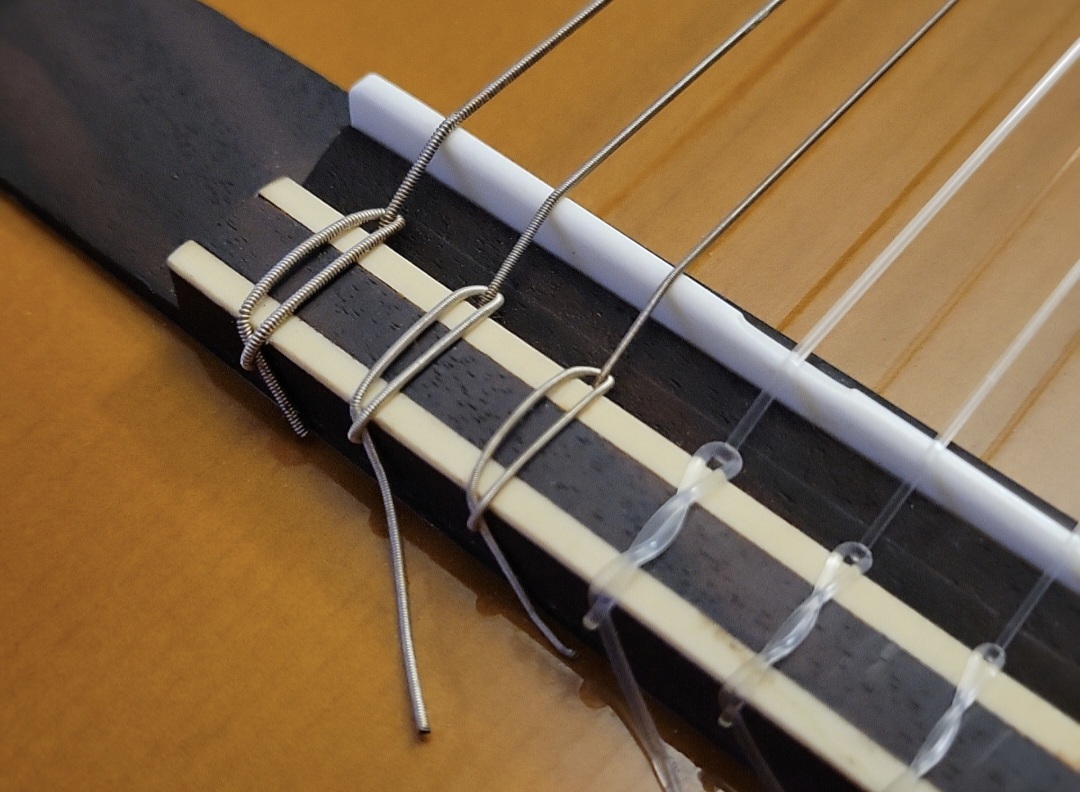
| Bridge | Tie block, strings knotted through it | Pinned, ball-end strings held by bridge pins |
| Fret markers | Side dots only, no face inlays | Face dots plus side dots |
| Typical body shapes | Torres-derived classical, one dominant shape | Dreadnought, concert, grand auditorium, jumbo, parlour |
| Right hand | Fingers and nails, no pick | Pick or fingers, both standard |
| Voice | Warm, round, quick decay, low projection | Bright, loud, long sustain, strong fundamental and harmonics |
| Natural repertoire | Classical, flamenco, bossa nova, Latin American, some jazz | Folk, country, pop, blues, rock, singer-songwriter |
The Neck Is the Real Difference
Ask a player who has switched what surprised them and almost nobody says the strings. They say the neck.
The Yamaha C40’s nut measures 52 mm. The FG800’s measures 43 mm. That is 9 mm of extra width, about 21 percent, and it is a lot of hand travel when you are trying to lay one finger flat across six strings. Add the flat fingerboard, which is the classical tradition, and the geometry works against a barre chord specifically: on a radiused steel-string board the strings sit in a gentle arc that roughly follows the natural curve of a flattened index finger, and on a flat classical board they do not.
That width exists for a good reason. Classical right-hand technique needs space between strings so the thumb and three fingers can place independently without collisions, and the repertoire routinely requires exactly that. The instrument was optimised for the right hand, and the left hand pays for it.
Practically: if you strum chords and play with a pick, the narrow neck is easier and the wide neck will feel like work. If you fingerpick, the wide neck is a relief and a 43 mm nut starts to feel cramped. This is also the single best reason to try both in person before buying rather than reading any more comparisons, including this one. Beginners choosing their first instrument will find both neck widths represented in our best beginner acoustic guitars guide, and the same neck-width question applies at the budget end covered in best cheap acoustic guitars.
Scale Length: A Claim You Will See Everywhere That Is Not Quite Right
Plenty of sources, including some manufacturers, state flatly that classical guitars have a longer scale length than steel-strings. Do not take that as read.
Classical scale is standardised at close to 650 mm, and it has been since Antonio de Torres settled the modern instrument’s proportions in the 19th century. Steel-string scale is not standardised at all. It runs from about 24.75 inches (629 mm) on Gibson-style guitars to 25.5 inches (648 mm) on a large share of Fender, Taylor and Martin models, with plenty in between. So the ranges overlap, and a 25.5 inch steel-string is essentially the same scale as a classical guitar.
The two Yamahas prove the point neatly. The C40 classical and the FG800 dreadnought both have a 650 mm scale. Identical. Every playability difference between those two instruments comes from the nut width, the fingerboard radius and the string tension, and none of it comes from scale length. The accurate statement is that classical scale is standardised and steel-string scale is not, which is a different claim from “classical is longer”.
Inside the Box: Fan Bracing and X Bracing
The top of an acoustic guitar is a thin piece of spruce or cedar that has to be light enough to vibrate and strong enough not to fold. Bracing resolves that conflict, and the two traditions solved it for two different loads.
Classical guitars use fan bracing: a spread of thin struts radiating below the soundhole like the ribs of a hand fan, a Torres design that has barely changed in 150 years. It is a light structure, tuned for responsiveness rather than strength, and it works because nylon asks so little of it.
Steel-strings use X bracing, two main braces crossing below the soundhole with smaller struts filling in around them. It is considerably stronger, and it exists because a top has to survive around 160 pounds of pull for decades without caving. C.F. Martin developed it in the mid-19th century and it became the standard once steel strings arrived, for the obvious reason.
That difference is audible as well as structural. A fan-braced top is easy to drive, so a nylon guitar responds instantly to a light touch and decays quickly. An X-braced top is stiffer, needs more energy to get moving, and stores and releases that energy over a longer window, which is a large part of why steel-strings sustain and project the way they do. The strings get the credit for that and the bracing deserves at least half of it.
The Bridge, the Neck Joint and the Missing Dots
Three visible tells that let you identify either instrument across a room.
The bridge. A classical bridge has a tie block, and the strings are knotted through it. There are no bridge pins and no ball ends. It takes practice and it is the part of a restring that new classical owners get wrong, usually by leaving too little tail or by stacking the wraps so the knot creeps under tension. A steel-string uses ball-end strings held in place by six bridge pins. If you are learning either, our walkthrough of how to restring a guitar covers both bridge types, and the tie-block knot is worth doing slowly the first few times.
The neck joint. A classical neck meets the body at the 12th fret, putting the bridge near the centre of the lower bout where the top moves most. A steel-string usually joins at the 14th, which moves the bridge back, shortens the body relative to the neck and gives easier upper-fret access. It also means the two instruments have different amounts of fretboard clear of the body, which is one reason a lot of classical repertoire lives below the 12th fret.
The dots. Classical fingerboards traditionally carry no face inlays at all, only small side dots visible to the player. It is a cosmetic convention with a practical consequence: a steel-string player picking up a classical for the first time frequently loses their position, because the visual landmarks at frets 3, 5, 7, 9 and 12 that they have been reading without noticing simply are not there.
Truss Rods and the Crossover Guitars Nobody Mentions
Traditional classical guitars have no truss rod. Nylon tension does not require one, so builders left it out and adjusted relief through neck carving and the saddle. This is a real and important difference: it is why steel strings will destroy a classical guitar, and it is why relief on an old classical is a job for a luthier rather than an Allen key.
The flat statement “classical guitars do not have truss rods” is out of date though, and this is where the whole comparison usually stops short. Crossover and hybrid nylon-string guitars have truss rods, along with almost every other steel-string ergonomic feature.
A crossover keeps the things that make nylon worth playing, which are the strings, the tie-block bridge and the warm tone, and swaps the parts a steel-string player finds difficult. Nut width typically drops to around 48 mm or narrower. The fingerboard gets a radius. A truss rod goes in. Most add a cutaway and a pickup system. Yamaha’s NCX and NTX lines, Cordoba’s Fusion and GK series, and Godin’s Multiac range are the ones you will encounter in shops.
I sold a lot of these, and they solved a specific problem over and over: a player who wanted nylon tone for bossa nova, worship, jazz comping or studio work, who had spent fifteen years on a 43 mm radiused neck, and who found a traditional 52 mm flat board genuinely unplayable. A crossover is the instrument for exactly that person. The purist objection is legitimate too. Concert classical repertoire needs the wide right-hand spacing, and a narrow crossover neck crowds the picking hand in a way that shows up in dense polyphony. If you plan to study classical guitar formally, buy a traditional classical. If you want nylon strings on a neck you already know how to play, buy a crossover. And if what you actually want is a plugged-in acoustic voice, the best acoustic-electric guitars roundup covers the steel-string equivalent of that idea.
Flamenco Guitars Are Not Classical Guitars
Worth a short section because they get lumped in constantly. A flamenco guitar is nylon-strung and shaped like a classical guitar, and it is built to a different brief.
The body is shallower. The back and sides are traditionally Spanish cypress rather than rosewood, which is lighter and brighter. The action is set lower, low enough that a small amount of buzz is accepted as part of the sound rather than treated as a fault. There is a golpeador, a clear tap plate glued to the top, because flamenco technique involves striking the soundboard with the fingers. The result is fast, percussive and immediate, with a hard attack and a short decay that cuts through hand claps and dancing. Play a classical piece on one and it sounds thin. Play flamenco on a classical guitar and it sounds slow.
”Nylon Is Easier for Beginners”: How Much of That Is True
Nearly every manufacturer says nylon is easier for beginners, and they cite tension. At least one guitar teaching site pushes back and argues that action and setup dominate, and that a badly set-up classical hurts more than a good steel-string. Both positions are partly right, so let me split it.
True: the tension difference is real, large and measurable. 85.8 pounds against 163.3 pounds, with every individual nylon string slacker than every individual steel string. Nylon is also physically softer and thicker, so it spreads pressure across the fingertip instead of concentrating it on a narrow steel edge. Sore fingertips are the single most common reason beginners stop practising in the first month, and nylon reduces that problem substantially. That is not marketing.
Also true: the fretting hand has a harder job on a classical. A 52 mm flat fingerboard makes a barre chord meaningfully more difficult than a 43 mm radiused one, particularly for a smaller hand, and barre chords are the wall most beginners hit around month two. Lower tension does not help you if you cannot reach across the neck.
More important than either: setup. Action, which is string height above the frets, changes required finger force more than string material does, and it is adjustable on any guitar. A classical with the saddle left high from the factory can be harder to play than a well-adjusted steel-string despite the tension advantage, and cheap instruments of both types routinely ship with action that needs correcting. Whichever you buy, the money spent on a setup by a competent tech is the best value in guitar, and it changes the instrument more than any accessory will.
The honest summary: nylon is kinder to your fingertips, steel is kinder to your fretting hand, and setup outweighs both. Choose on the music you want to play, then get the instrument adjusted. If you are at the very start, guitar chords for beginners works identically on either instrument, and how to hold a guitar pick is only relevant to one of them.
Swapping Strings: One Direction Is Fine, the Other Destroys the Guitar
Steel strings on a classical guitar: do not. This is not gear snobbery, it is arithmetic. A fan-braced top designed for 86 pounds is being asked to hold 163, and the neck has no truss rod to resist the bow. What follows is well documented and expensive: the bridge lifts off the soundboard, the top bellies behind the bridge and sinks in front of it, and the neck pulls forward permanently. It might happen in days or over a year, and a repair costs more than most classical guitars in the beginner tier are worth. There is one further practical obstacle in the other direction that almost nobody mentions: steel-string tuner posts often have holes too narrow for the thicker gauge of nylon to wind through cleanly.
Nylon on a steel-string: harmless, disappointing. Nothing breaks, because you are reducing load rather than increasing it. Ball-end nylon sets exist precisely so nylon can be fitted to a pinned bridge without tying a knot. The guitar just sounds weak, because a top braced and built to be driven by 163 pounds of steel is barely being moved by 86 pounds of nylon. Volume drops, the tone goes dull, and the instrument feels lifeless. It is a fine experiment and a poor permanent arrangement.
If what you actually want is a softer feel on a steel-string, change gauge rather than material: dropping from a 12 to 53 set to a 10 to 47 removes about 28 pounds of tension while keeping the instrument’s voice intact. Our guide to the best acoustic guitar strings covers what each gauge and alloy does, and the tension calculator will give you the exact figure for any steel set before you buy it.
Break-In, Tuning and Why Nylon Rarely Breaks
Nylon creeps. The material physically stretches under tension and keeps stretching for days, so a fresh set typically needs retuning several times a day for roughly the first three to seven days, always going flat rather than sharp. Stretching each string by hand as you fit it shortens that but does not eliminate it. Steel settles in about a day. Neither figure is a law, and a heavier-handed player or a hot dry room will move both. A clip-on tuner earns its keep during that first week more than at any other time, and the best guitar tuners guide covers the ones that track a nylon low E reliably, which not all of them do. If you tune by ear or with an app, how to tune a guitar covers both approaches.
The flip side is lifespan. Nylon strings almost never break, because they neither corrode nor suffer the metal fatigue that cracks a steel string where it has been repeatedly bent over a fret. You replace nylon because the trebles go dull and the wound basses lose brightness and start buzzing, not because one snaps mid-song. Steel strings die of rust from finger acids and of fatigue at the fret contact points, which is why steel-string players carry spares and classical players mostly do not.
Price, and What Actually Drives It
You will find sources claiming classical guitars are cheaper and others claiming entry-level pricing is about the same. Both are describing their own local market rather than a rule.
Price tracks brand, build quality, materials and whether the top is solid or laminated. It does not track string type. At the entry level the two categories sit in essentially the same band, and at every level above that you can spend as much on a hand-built Spanish classical as on a hand-built steel-string. What is true and useful is that a classical is cheaper to own: nylon sets generally cost less than phosphor bronze sets and last longer because they do not corrode, and a nylon guitar needs no pick. Not much of a saving, but it points the right way, and guitar picks are one line item a classical player never has.
How to Choose
Answer in order and stop at the first clear yes.
- Do you want to play written classical repertoire, or study formally? Traditional classical guitar, wide flat neck included. It is what the music was written for.
- Do you want to strum chords and sing? Steel-string. Nylon does not project or chime the way strumming needs, and it goes sharp when you hit it hard.
- Do you want bossa nova, flamenco, Latin American music, or warm intimate fingerstyle? Nylon.
- Do you play steel-string already and want nylon tone without relearning the neck? A crossover, with its narrower radiused neck and truss rod. Try a Yamaha NCX or NTX, a Cordoba Fusion or a Godin Multiac before you conclude nylon is not for you.
- Do you have small hands and no strong style preference? Steel-string, for the 43 mm nut and the fingerboard radius, and use a lighter gauge to take the sting out of the tension.
- Are sore fingertips the specific thing stopping you? Nylon will help genuinely, and so will a proper setup and a lighter gauge on the guitar you already own. Try the cheaper fix first.
- Still undecided? Go and play both for ten minutes each. The neck will tell you within about thirty seconds, and it is a more reliable signal than anything you can read.
Neither instrument is the harder or the more serious one. They are two solutions to the same problem, separated by 78 pounds of string tension and everything a builder has to do to accommodate it. Pick the one that plays the music in your head, spend a little on a setup, and the argument stops mattering the first week you own it. When you are ready to look at specific instruments, the best acoustic guitars roundup covers the steel-string side in detail, and if you have not started playing yet, how to play guitar works the same on both.
Frequently Asked Questions
Which is easier to play, a nylon-string classical or a steel-string acoustic?
Should I get a classical or an acoustic guitar as a beginner?
Can you play classical pieces on a steel-string acoustic, or steel-string songs on a classical guitar?
Can I put steel strings on a classical guitar?
Why do classical guitarists use nylon strings and never a pick?
Is classical guitar actually harder than steel-string acoustic, or is that a myth?
What is a crossover or hybrid nylon-string guitar?
Do nylon strings really need to be retuned constantly, and do they break?
Related Articles
8 Best Acoustic Guitars of 2026 (Every Budget & Body)
guitars
Acoustic vs Electric Guitar: Which Should a Beginner Buy?
guitars
8 Best Beginner Acoustic Guitars of 2026
guitars
8 Best Acoustic Guitar Strings of 2026 (Every Player & Budget)
accessories-care
Guitar Chords for Beginners: The First 8 Chords to Learn (and How)
guitars
About the Reviewer

Julian Reyes, MM, Berklee
M.M. Performance, Berklee College of Music
Julian Reyes is a multi-instrumentalist with a Master of Music from Berklee College of Music and over a decade gigging on guitar, bass, and keys. Before founding House of Octave, he spent years as a gear buyer for an independent music retailer, evaluating hundreds of instruments and audio products for the sales floor. He started House of Octave in 2026 to give players honest, hands-on reviews — judged by how gear actually sounds and holds up on stage and in the studio, not by spec sheets or sponsorships.