8 Best Acoustic Guitar Strings of 2026 (Every Player & Budget)
Berklee-trained gear buyer Julian Reyes (MM) reviews the 8 best acoustic guitar strings of 2026 — phosphor bronze, 80/20, coated, Monel, and silk & steel — matched to your playing style, tone, and budget.
Updated

Strings are the most overlooked upgrade in all of guitar. Players will agonize for months over which two-thousand-dollar acoustic to buy, then leave the same dead, lifeless factory strings on it for a year and wonder why it does not sound like the demo. In two decades of playing — through a music degree at Berklee, years on stage and in the studio, and a stretch on the other side of the counter buying gear for a store — the fastest, cheapest transformation I ever heard from a guitar was a ten-dollar set of fresh strings and a proper stretch-in. The right strings change the voice, the feel, and the playability of your instrument more than almost anything short of a professional setup.
So this is not a list of exotic boutique strings nobody stocks. It is the eight sets I would actually put on a real player’s guitar in 2026, each chosen for a specific voice, feel, and budget — from the warm phosphor bronze I hand to almost everyone, to bright 80/20 bronze, month-lasting coated sets, a revived vintage Monel alloy, and the gentlest silk & steel strings for sore hands. Whether you want the safe universal choice, the brightest possible tone, strings that survive a season of worship sets, or a set that will not hurt a beginner’s fingertips, one of these is right for you. If you are brand new, our guide to how to play guitar starts from holding the instrument, and if you are still choosing a guitar, our roundup of the best beginner acoustic guitars pairs perfectly with the right first set of strings.
Find the Best Acoustic Guitar Strings for Your Need
Jump straight to the strings that fit how you play:
- Best acoustic guitar strings overall
- Best for beginners
- Best light-gauge
- Best coated (longest-lasting)
- Best for fingerstyle
- Best for worship
- More use cases
How We Chose These Acoustic Guitar Strings
Every set here earned its place on a verified Amazon listing (re-checked for availability and pricing as of this update), a deep and consistent owner-review base, a genuine name-brand pedigree, and a clear role for a specific kind of player. I leaned on twenty years of playing and a former gear buyer’s ear to weigh what actually separates a great string from a forgettable one: the alloy and the voice it produces, whether a coating is worth its cost for how you play, the gauge and the tension it puts under your fingers, tuning stability, and how honestly the string lets a good guitar speak. I cross-referenced tens of thousands of owner reviews for the recurring truths — which strings arrive fresh, which hold their tone, which brands stay consistent set to set — and I deliberately built the lineup to cover every major material (phosphor bronze, 80/20 bronze, coated, Monel, silk & steel) and every major use case rather than eight variations on one string. The eight below represent the best acoustic guitar strings for every voice, playing style, and budget.
Best Acoustic Guitar Strings Overall
The lineup runs from the warm phosphor bronze set that suits almost any guitar, through bright and coated options, to specialist Monel and silk & steel strings. Here is every set reviewed in full, starting with my overall pick.
Best Overall: D’Addario EJ16 Phosphor Bronze
When someone asks me for one string recommendation and tells me nothing else about their guitar, this is the answer — and it is not close. The D’Addario EJ16 is a light-gauge phosphor bronze set, and that exact combination is the most-recommended acoustic string on Earth for a simple reason: it does everything well. Phosphor bronze gives a warm, balanced, richly detailed voice with just enough top-end sparkle to stay articulate, so it flatters strumming and fingerpicking equally, sits beautifully under a singing voice, and suits the widest range of body shapes and tonewoods of any string in this guide. If you have no strong opinion yet about what you want your guitar to sound like, this is the sound most people mean by “a good acoustic guitar.”
What makes it a string I trust rather than just like is D’Addario’s consistency. The strings are wound by computer-controlled machines over a hexagonal core, which produces the most reliable set-to-set quality in the business — the same tuning stability, the same intonation, the same feel every single time you open a pack. That is why studios buy them by the box and why teachers put them on student guitars without a second thought. With tens of thousands of ratings at a 4.7-star average and a price under ten dollars, there is simply no cheaper or lower-risk upgrade you can make to any acoustic. The only real caveat is the one every uncoated string shares: expect four to six weeks of bright life from heavy playing before the tone dulls. Change them on that rhythm and this is the string that will never let you down.
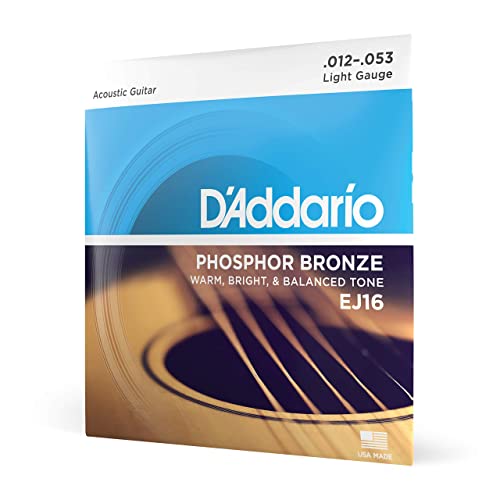
D'Addario EJ16 Phosphor Bronze Acoustic Guitar Strings, Light 12-53
by D'Addario
The string I put on almost any acoustic when someone wants one answer -- warm, balanced phosphor bronze in the universal light gauge, made to a consistency nothing else matches, at a price that makes it a no-brainer.
Pros
- The single most-recommended acoustic string set in the world -- phosphor bronze in a light 12-53 gauge is the exact combination the AI overviews, the forums, and every major gear publication name first, because it does everything well for almost every player and guitar
- Phosphor bronze gives a warm, balanced, richly detailed voice with just enough top-end sparkle -- it flatters strumming and fingerpicking equally, sits well under a vocal, and suits the widest range of body shapes and tonewoods of any string here
- D'Addario's computer-controlled winding over a hex core delivers the most consistent set-to-set quality in the business -- the same tuning stability, intonation, and feel every time, which is why studios and teachers buy them by the box
- One of the best-reviewed music products on Amazon, with tens of thousands of ratings at a 4.7 average and a rock-bottom price -- there is no cheaper or lower-risk upgrade you can make to any acoustic guitar
Cons
- As an uncoated string it will not last as long as a coated set -- expect four to six weeks of bright life from heavy playing before the tone dulls, versus months from an Elixir or XS
- Because it is the safe default, it is not the most distinctive-sounding string here -- a player chasing maximum brightness or a unique vintage character will prefer the 80/20 or Monel sets below
Best Budget: Ernie Ball Earthwood Phosphor Bronze
If the EJ16 is the safe default, the Ernie Ball Earthwood is the set that makes fresh strings a habit rather than a decision. It is a genuine phosphor bronze set from a major American brand at a price tied for the lowest in this roundup, which means you can restring for the cost of a coffee and keep two or three spare packs in your case without a second thought. Dead strings are the most common reason a cheap guitar sounds cheap, and the Earthwood removes every excuse to leave them on too long.
Tonally it delivers the warm, rich, projecting voice phosphor bronze is loved for, with a clarity that genuinely punches above its price — thousands of players rate it at 4.7 stars and never look further. Ernie Ball packages the strings in fresh, well-sealed wrappers so they arrive bright and rust-free, so you are getting a known quantity rather than a bargain-bin gamble. The gauge is a slightly lighter 11-52, a touch below the D’Addario light set, which lowers the tension just enough to make fretting a little easier — a friendly quality for smaller-bodied guitars and newer players. The only trade is the one you accept at this price: uncoated strings lose their sparkle in a few weeks, so plan to change them a little more often. At this cost, that is no hardship at all.

Ernie Ball Earthwood Phosphor Bronze Acoustic Guitar Strings, Light 11-52
by Ernie Ball
The value pick the whole category is measured against -- the lowest-priced phosphor bronze set here, warm and projecting and from a trusted brand, so keeping fresh strings on your guitar costs almost nothing.
Pros
- The best value in acoustic strings -- a genuine phosphor bronze set from a major American brand at a price tied for the lowest here, so you can restring for the cost of a coffee and keep spares in the case without thinking about it
- A slightly lighter 11-52 gauge than the D'Addario light set, which lowers tension a touch -- easier on the fingers and a friendlier feel for smaller-bodied guitars and newer players while keeping the warm, full phosphor bronze voice
- Warm, rich tone with strong projection and clarity that punches well above the price -- thousands of players rate them at 4.7 stars, and many buy the multi-pack and never look further
- Ernie Ball's quality control and fresh, well-sealed packaging mean the strings arrive bright and rust-free -- a known quantity, not a bargain-bin gamble
Cons
- Uncoated, so like any bare phosphor bronze set they lose their sparkle in a few weeks of steady play -- fine at this price, but plan to change them more often than a coated set
- The lighter gauge trades a little low-end punch and volume for comfort -- a heavy strummer chasing maximum projection may prefer a true light or medium set
Best Coated (Longest-Lasting): Elixir NANOWEB Phosphor Bronze
If you dread changing strings — or your hands seem to kill a set in days — the Elixir NANOWEB is the answer, and it is the string that created the entire coated category. Elixir wraps the whole string in an ultra-thin polymer coating that locks out the sweat, skin oil, and airborne grime that actually kill uncoated strings. The result is tone that stays bright and alive three to five times longer than a bare set: where an uncoated string fades in weeks, a set of these routinely lasts three to four months of real playing.
That longevity quietly flips the cost math that scares people off the higher price. A twenty-dollar set that lasts four months works out to roughly one dollar fifteen a week, while an eight-dollar uncoated set changed monthly costs about one dollar eighty-five a week — so the “expensive” coated string is often the cheaper one per week of good tone, and you restring far less often. The coating brings a second real benefit: a smooth, fast feel with dramatically reduced finger squeak, which matters enormously for recording and for playing amplified through a pickup, where string noise gets exposed. It earns the highest owner rating in this roundup from a deep review base. The only players who should hesitate are those who change strings compulsively for that brand-new zing anyway, and traditionalists who feel the coating rounds off a sliver of the very brightest top end. Everyone else who plays regularly should try a set. To see how a lighter or heavier set changes the tension under your fingers, our free guitar string tension calculator does the math for any gauge.
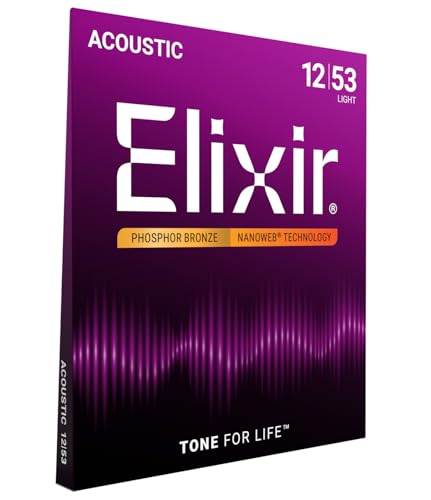
Elixir Strings Phosphor Bronze Acoustic Guitar Strings with NANOWEB Coating, Light 12-53
by Elixir
The set for players who hate changing strings -- a NANOWEB-coated phosphor bronze that holds its warm tone for months, squeaks less, and often costs less per week than the cheap uncoated sets you replace constantly.
Pros
- The longest-lasting tone of any mainstream string -- Elixir's ultra-thin NANOWEB coating wraps the entire string to lock out the sweat, skin oil, and grime that kill uncoated strings, so a single set stays bright three to five times longer
- That longevity flips the cost math: at three to four months of playable life per set, coated strings often work out cheaper per week than uncoated ones you change monthly -- the more you play and the more acidic your hands, the more you save
- The coating gives a smooth, fast feel with dramatically reduced finger squeak -- a real advantage for recording and for playing amplified through a pickup, where string noise is exposed
- The highest owner rating in this roundup, from a deep review base -- Elixir essentially invented the coated-string category and still sets the durability benchmark everyone else chases
Cons
- A premium up-front price, more than twice the cost of the cheapest sets here -- the per-set cost only pays off if you actually keep them on for months rather than changing on a schedule
- Some traditionalists feel the coating slightly rounds off the very brightest top-end sparkle of a fresh uncoated string, and prefer that raw zing even if it fades faster
Best Coated With a Natural Feel: D’Addario XS Phosphor Bronze
For years the knock on coated strings was the feel — a slightly slick, damped quality under the fingers that some players never warmed to. The D’Addario XS is the set that answers that complaint. Its coating is exceptionally thin, thin enough that these feel and sound remarkably close to a raw uncoated string while still delivering the long life coated strings are bought for. If you have wanted string longevity but refused to give up the top-end and the natural feel of bare phosphor bronze, this is the string that finally lets you have both.
It is the longest-lasting string D’Addario makes, and it breaks in with a fresh, bright tone that sits closer to a plain EJ16 than most coated strings manage — players cross-shopping it against the Elixir consistently praise its cleaner high end and more natural feel. Because it is built on the same precision-wound phosphor bronze core as the EJ16, it keeps D’Addario’s class-leading tuning stability and consistency, which makes it the obvious upgrade path if you already love the standard light set but want it to last. It is priced near the Elixir, so it is a premium purchase that only makes sense if you value long string life — and the review base, while strong and fast-growing at 4.7 stars, is younger than the decades-old uncoated sets. For the player who wants coated-string longevity without the coated-string compromise, it is superb.
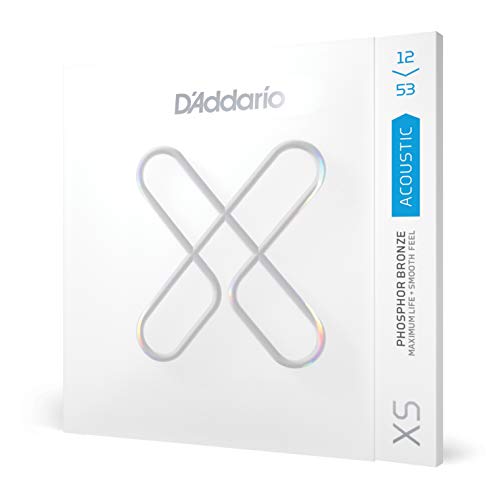
D'Addario XS Phosphor Bronze Coated Acoustic Guitar Strings, Light 12-53
by D'Addario
The coated string for players who hated coated strings -- D'Addario's ultra-thin XS coating delivers Elixir-class longevity with a brighter, more natural feel that stays close to raw phosphor bronze.
Pros
- D'Addario's newest coating technology, and the one that finally makes a coated string feel like an uncoated one -- the XS coating is exceptionally thin, so you get long life without the slightly slick, damped feel some players dislike on older coated sets
- The longest-lasting string D'Addario makes, with a fresh, bright break-in tone that sits closer to a raw phosphor bronze than most coated strings manage -- the best of both worlds for players who want longevity but refuse to give up top-end
- Built on the same precision-wound phosphor bronze core as the EJ16, so it keeps D'Addario's class-leading tuning stability and set-to-set consistency -- a natural upgrade path from the standard light set
- Strong, fast-growing reviews at 4.7 stars -- players cross-shopping it against Elixir consistently praise its more natural feel and cleaner high end
Cons
- Priced near the Elixir, so it is a premium purchase that only makes sense if you value long string life
- A newer product with a smaller review base than the decades-old uncoated sets -- excellent, but with less long-term track record than an EJ16 or Elixir
Best for Bright Tone: D’Addario EJ11 80/20 Bronze
When a guitar sounds warm to the point of being dark or muddy — or when you simply want maximum sparkle and cut — the answer is 80/20 bronze, and the D’Addario EJ11 is the cheapest, most trusted way to get it. 80/20 bronze (80% copper, 20% zinc) is the original acoustic alloy, and it is the brightest, most cutting material you can string a guitar with. Fresh out of the pack these have a lively, bell-like ring that phosphor bronze simply cannot produce — crisp, sparkling, articulate highs that are glorious for bluegrass flatpicking, percussive strumming, and any warm-bodied guitar that needs waking up.
It shares the same precision winding and hex core as the EJ16, so only the alloy changes — you keep the consistent intonation and tuning stability and swap warmth for brightness. With more than seventeen thousand ratings behind it, and a price tied for the lowest in this entire guide, it is a zero-risk experiment: buy one pack and hear whether a brighter voice suits your instrument. The trade-off is inherent to the alloy — 80/20 bronze oxidizes and loses its signature sparkle faster than phosphor bronze, so the crisp top end is brilliant for a week or two and then mellows more quickly. Brightness-chasers simply change them more often, which at this price is easy to do.
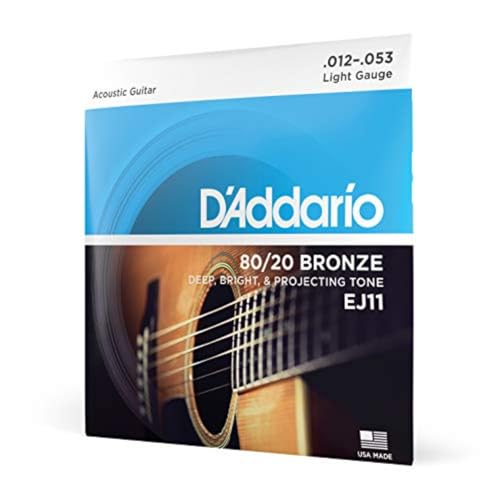
D'Addario EJ11 80/20 Bronze Acoustic Guitar Strings, Light 12-53
by D'Addario
The brightest, crispest way to wake up a warm-sounding guitar -- classic 80/20 bronze with a bell-like sparkle that cuts through any mix, at a price tied for the lowest here.
Pros
- 80/20 bronze (80% copper, 20% zinc) is the brightest, most cutting acoustic alloy -- these strings deliver a crisp, sparkling, articulate top end that phosphor bronze cannot match, which is why stage and studio pros reach for them when a guitar needs to cut through a mix
- One of the most-reviewed 80/20 sets on Amazon, with more than seventeen thousand ratings at 4.7 stars and a price tied for the lowest in this entire roundup -- an unbeatable, zero-risk way to hear whether a brighter voice suits your guitar
- Fresh 80/20 strings have a lively, bell-like ring straight out of the pack -- superb for bluegrass flatpicking, percussive strumming, and any guitar with a warm, dark body that needs waking up
- The same D'Addario precision winding and hex core as the EJ16, so you keep the consistent intonation and tuning stability -- only the alloy, and therefore the tone, changes
Cons
- 80/20 bronze oxidizes and loses its signature brightness faster than phosphor bronze -- the crisp top end is glorious for the first week or two, then mellows more quickly, so brightness-chasers change them often
- That bright, present voice is not for everyone -- a player who wants warmth and low-end body under a vocal will prefer phosphor bronze
Best for Fingerstyle & Vintage Tone: Martin Retro Monel
Some strings are all-purpose; the Martin Retro Monel is a character actor, and for the right player it is unforgettable. Monel is a solid nickel-copper alloy that Martin used back in the 1940s and 50s, before bronze became the industry standard, and revived in the modern Retro line at the urging of the late flatpicking master Tony Rice, who wanted that vintage voice back. What Monel gives you is a warm, dry, woody, midrange-forward tone unlike any bronze string — it does not shimmer or sparkle so much as let the guitar itself speak, honestly and evenly, which is exactly what dedicated fingerstyle and vintage-tone players are chasing.
The most distinctive thing about these strings is how they feel and sound from the very first minute: broken-in, played-in, with almost none of the bright, brash new-string phase you wait out on a fresh bronze set. That consistency makes them a quiet favorite for recording, where you want the tone you tracked yesterday to match the tone you track today. Monel is also naturally corrosion-resistant, so these uncoated strings hold their tone noticeably longer than standard bronze without any coating or its trade-offs in feel. They are a genuine Martin string at a budget price with a devoted following. I specify the custom light gauge here rather than the standard light set: the slightly lower tension is easier on a bare picking hand over a long session, which suits the way most people play these. Understand that the dry, mid-focused voice is a specialist taste — if you want big hi-fi highs and booming lows, a bronze string will please you more — but if you have ever wished your good guitar sounded like the old records, this is the set that gets you there. Our walkthrough of the first chords every guitarist should learn is a great place to hear how a warm string flatters open chords.

Martin Retro Monel MM11 Acoustic Guitar Strings, Custom Light 11-52
by Martin
The connoisseur's fingerstyle string -- a revived 1940s Monel alloy with a warm, dry, played-in voice that lets a good guitar speak honestly, corrosion-resistant and loved by vintage-tone players.
Pros
- Monel -- a solid nickel-copper alloy Martin used in the 1940s and revived at the urging of flatpicking legend Tony Rice -- gives a warm, dry, woody, midrange-forward voice unlike any bronze string, prized by fingerstyle and vintage-tone players for how honestly it lets a great guitar speak
- The tone is remarkably even and uncolored, with a broken-in, played-in feel from the very first minute -- there is no bright, brash new-string phase to wait out, which makes them a favorite for recording where consistency matters
- Monel is naturally corrosion-resistant, so these uncoated strings hold their tone noticeably longer than standard bronze without any coating and its trade-offs in feel
- A genuine Martin string at a budget price, with a devoted following -- players describe them as the set that finally made their expensive acoustic sound like the records they grew up on
Cons
- That dry, mid-focused voice is a specialist taste -- if you want big, sparkling, hi-fi highs and booming lows, a bronze string will please you more
- A smaller (though very positive) review base than the mainstream bronze sets, and less low-end scoop, so strummers chasing maximum boom should look elsewhere
Best for Tender Fingers & Beginners: D’Addario EJ40 Silk & Steel
The single biggest reason beginners quit is that their fingertips hurt, and the D’Addario EJ40 Silk & Steel is the most effective cure I know. These strings wrap a layer of silk filament under the metal winding, which does two things: it lowers the string tension dramatically, and it cushions the string against your fingertip. The result is that fretting takes far less pressure and hurts far less — the difference between a frustrating first month and one where you actually keep playing. As a teacher I have handed these to more than one student whose hands, for reasons of soreness or age or injury, simply would not tolerate standard strings.
That makes them the obvious choice not only for beginners building calluses but for players with arthritis, carpal tunnel, or a recovering hand injury who need to keep playing without pain — an audience nearly every string guide ignores. The voice is soft, warm, mellow, and intimate, which flatters gentle fingerpicking, folk, and quiet late-night practice, and the low tension is genuinely kind to delicate vintage and parlor guitars that heavier strings can strain. The trade-offs follow directly from the design: noticeably less volume and projection, and less brightness and sustain, than a standard bronze set — these are not the strings for cutting through a loud jam. But for comfort, for sore hands, and for quiet intimate playing, nothing else here comes close.

D'Addario EJ40 Silk & Steel Acoustic Guitar Strings, Light 11-47 (Pack of 2)
by D'Addario
The kindest strings you can put on a guitar -- a low-tension silk & steel set that makes fretting almost effortless, ideal for sore beginner fingers, achy hands, and gentle folk fingerpicking.
Pros
- The gentlest strings on your fingertips of anything here -- a silk-and-steel construction wraps a silk-filament layer under the winding, which lowers tension dramatically and cushions the string, so fretting takes far less pressure and hurts far less
- The obvious choice for beginners building calluses, and for players with arthritis, carpal tunnel, or a recovering hand injury who need to keep playing without pain -- as a teacher I have handed these to more than one student whose hands would not tolerate standard strings
- A soft, warm, mellow, intimate voice that flatters gentle fingerpicking, folk, and quiet late-night practice -- the low tension also suits delicate vintage and parlor guitars that heavier strings can strain
- A genuine D'Addario set with the consistency and value that implies, now sold as a two-pack that works out to a very fair price per set, backed by a strong 4.7-star rating
Cons
- The low tension and silk core mean noticeably less volume and projection -- these are not the strings for cutting through a jam or a loud strumming session
- The mellow voice sacrifices brightness and sustain, and the softer strings can wear a little faster -- a trade you make deliberately for comfort
Best Premium Uncoated: Martin Authentic Acoustic SP Phosphor Bronze
When a player on a genuinely good acoustic wants the best uncoated string to match it, the Martin Authentic Acoustic SP is where I point them. This is Martin’s flagship uncoated set, and it is the string most likely to come stock on a serious acoustic and to be recommended by the company that built the guitar. It is built with high-strength SP (Superior Performance) core wire that holds tuning and resists breakage better than standard sets, so it stays in tune through hard playing and holds its character longer than a bargain string, even without a coating.
Tonally it delivers a rich, full, professional-grade voice — deep lows and clear, singing highs — voiced specifically to make a quality guitar sound its best. The custom-light 11-52 gauge is a deliberate middle ground that balances easy playability against real projection, which suits a wide range of players and bodies. For anyone on a Martin, a Taylor, or another premium acoustic who wants the strings their guitar was essentially voiced around, this is the natural pairing, and it carries a solid 4.6-star rating to back it up. The honest caveat is the price: you are paying a premium for the core wire and the voicing, not for longevity, so a coated set will still outlast them. But for pure uncoated tone on an instrument that deserves it, these are worth every cent.

Martin Authentic Acoustic SP Phosphor Bronze Strings, Custom Light 11-52
by Martin
The premium uncoated string a great guitar was voiced around -- Martin's high-strength SP phosphor bronze delivers a rich, full, tuning-stable voice in a comfortable custom-light gauge.
Pros
- Martin's flagship uncoated string, built with high-strength core wire that holds tuning and resists breakage better than standard sets -- the premium phosphor bronze most likely to come stock on a serious acoustic and to be recommended by its maker
- A rich, full, professional-grade voice with deep lows and clear, singing highs -- these are voiced to make a quality guitar sound its best, and the custom-light 11-52 gauge balances easy playability with real projection
- The SP (Superior Performance) core is engineered for tuning stability and long tone life for an uncoated string, so they stay in tune through hard playing and hold their character longer than a bargain set
- The natural pairing for the many players on a Martin, Taylor, or other premium acoustic who want the strings the guitar was voiced around -- backed by a solid 4.6-star rating
Cons
- A premium price for an uncoated string -- you are paying for the core wire and voicing, not longevity, so a coated set will still outlast them
- The custom-light gauge is a deliberate middle ground -- dedicated light or medium players may want to size up or down
Best Acoustic Guitar Strings for Beginners
The strings that make learning easier all share three traits: a light gauge that takes less finger pressure, a forgiving feel, and a warm, encouraging voice. The goal for a first set is simply to keep playing from hurting, so your hands build calluses and your ear starts to develop. These three picks from the lineup serve new players best, from the gentlest possible feel to the universal all-rounder.
| Product | Price | Buy |
|---|---|---|
| D'Addario EJ40 Silk & Steel Acoustic Guitar Strings, Light 11-47 (Pack of 2)Best for tender fingers Silk & steel lowers tension the most and cushions the string -- the kindest set on sore beginner fingertips while calluses form. | $23.98 | View on Amazon |
| D'Addario EJ16 Phosphor Bronze Acoustic Guitar Strings, Light 12-53Best all-around starter The universal light phosphor bronze set: easy to fret, warm, and consistent, so a beginner never blames the strings for a bad sound. | $9.99 | View on Amazon |
| Ernie Ball Earthwood Phosphor Bronze Acoustic Guitar Strings, Light 11-52Best value starter A slightly lighter 11-52 gauge at one of the lowest prices here, so keeping fresh, easy-playing strings on a first guitar costs almost nothing. | $7.99 | View on Amazon |
If sore fingers are the obstacle, start with the D’Addario EJ40 Silk & Steel — its low tension makes fretting almost effortless while you toughen up. Once your hands are ready for a standard set, the D’Addario EJ16 is the all-around light phosphor bronze that suits any first guitar, and the Ernie Ball Earthwood delivers the same easy-playing warmth for even less, so you can change strings often without thinking about cost. Whichever you pick, keep the gauge light — a heavy set is the fastest way to make a beginner give up.
Best Light-Gauge Acoustic Guitar Strings
Light gauge is the industry-standard sweet spot, and for good reason: it offers the ideal balance of volume, sustain, and playability for the vast majority of acoustics and players. A light set (roughly .011-.052 to .012-.053) frets easily and bends without a fight, yet still projects and holds low end far better than an extra-light set. If you are not sure what gauge you want, light is the right default — these three are the best of the lineup.
| Product | Price | Buy |
|---|---|---|
| D'Addario EJ16 Phosphor Bronze Acoustic Guitar Strings, Light 12-53Best overall light set The definitive light-gauge phosphor bronze -- warm, balanced, and made to a consistency nothing else matches, at under ten dollars. | $9.99 | View on Amazon |
| Ernie Ball Earthwood Phosphor Bronze Acoustic Guitar Strings, Light 11-52Best budget light set A slightly lighter 11-52 that lowers tension a touch for even easier fretting, at one of the lowest prices here. | $7.99 | View on Amazon |
| Elixir Strings Phosphor Bronze Acoustic Guitar Strings with NANOWEB Coating, Light 12-53Best long-lasting light set A coated light set that holds its warm tone for months -- the light-gauge feel with three-to-five times the lifespan. | $21.99 | View on Amazon |
The D’Addario EJ16 is the definitive light-gauge set: warm, balanced phosphor bronze at a price and consistency nothing else touches. The Ernie Ball Earthwood shaves the gauge slightly to 11-52 for a hair less tension and an even lower price, and the Elixir NANOWEB gives you that same easy light-gauge feel with months of extra life thanks to its coating. All three fret easily and suit almost any guitar — the choice comes down to whether you prioritize price or longevity.
Best Coated Acoustic Guitar Strings (Longest-Lasting)
Coated strings exist to solve one problem: uncoated strings die too fast, especially if you play a lot or have acidic sweat. A microscopic polymer layer blocks the corrosion that dulls tone, so a coated set stays bright for months instead of weeks — and because they last three-to-five times longer, they often cost less per week of good tone than the cheap sets you replace constantly. These two are the best coated strings you can buy.
| Product | Price | Buy |
|---|---|---|
| Elixir Strings Phosphor Bronze Acoustic Guitar Strings with NANOWEB Coating, Light 12-53Best longest-lasting The original and still the durability benchmark -- NANOWEB-coated phosphor bronze that holds its tone for three to four months with the least squeak. | $21.99 | View on Amazon |
| D'Addario XS Phosphor Bronze Coated Acoustic Guitar Strings, Light 12-53Best natural feel An ultra-thin coating that feels and sounds closest to a bare string -- Elixir-class life with a brighter, more natural top end. | $19.99 | View on Amazon |
The Elixir NANOWEB is the longevity king and the smoothest, quietest-squeaking option — the set to buy if maximum life is the goal. The D’Addario XS matches it for lifespan but wins on feel: its thinner coating stays closest to a raw, natural uncoated string with a brighter top end, so it is the pick for players who want coated-string life without the coated-string compromise. Both are premium purchases that pay for themselves if you keep them on for months rather than changing on a schedule.
Best Acoustic Guitar Strings for Fingerstyle
Fingerstyle asks different things of a string than strumming does: you want an even, articulate voice where individual notes ring clear rather than blur together, a feel that is comfortable under bare fingertips, and ideally low finger squeak as your hand moves constantly across the wound strings. These three picks cover the range, from a warm vintage voice to the gentlest possible feel.
| Product | Price | Buy |
|---|---|---|
| Martin Retro Monel MM11 Acoustic Guitar Strings, Custom Light 11-52Best overall for fingerstyle Monel's warm, dry, even voice keeps complex fingerpicking clear and musical, with a played-in feel from the first minute. | $7.99 | View on Amazon |
| D'Addario EJ40 Silk & Steel Acoustic Guitar Strings, Light 11-47 (Pack of 2)Best easiest on fingers Silk & steel's low tension is the most comfortable set for delicate picking and tender picking-hand fingertips. | $23.98 | View on Amazon |
| D'Addario EJ16 Phosphor Bronze Acoustic Guitar Strings, Light 12-53Best affordable choice The universal light phosphor bronze balances warmth and note clarity for fingerstyle at a rock-bottom price. | $9.99 | View on Amazon |
The Martin Retro Monel is the standout: its warm, dry, midrange-forward voice and broken-in feel are exactly what fingerstyle players chase, letting a good guitar speak with clarity and honesty. The D’Addario EJ40 Silk & Steel is the comfort choice — its low tension makes delicate picking effortless and is the kindest set on a tender picking hand. And the D’Addario EJ16 proves you do not have to spend big: its balanced warmth and clear note separation serve fingerstyle beautifully for under ten dollars.
Best Acoustic Guitar Strings for Worship
Worship and regular live playing put demands on strings that standard guides ignore entirely. A worship guitarist often plays several rehearsals plus a service every week, runs through a pickup into a PA, leans on a capo constantly, and cannot restring before every set. That points to three priorities the average roundup never weighs: longevity so the strings survive weeks of heavy use, low finger squeak so string noise does not get amplified through the PA, and a light, capo-friendly gauge that stays effortless and in tune.
| Product | Price | Buy |
|---|---|---|
| D'Addario XS Phosphor Bronze Coated Acoustic Guitar Strings, Light 12-53Best for long service life Coated phosphor bronze that lasts months and feels natural -- the set that survives a full season of rehearsals and services. | $19.99 | View on Amazon |
| Elixir Strings Phosphor Bronze Acoustic Guitar Strings with NANOWEB Coating, Light 12-53Best low-squeak coated The smoothest, quietest coated string through a PA, with the longest tone life for the least restringing. | $21.99 | View on Amazon |
| D'Addario EJ16 Phosphor Bronze Acoustic Guitar Strings, Light 12-53Best light-gauge budget option If budget rules out coated, a fresh light-gauge EJ16 on a regular change schedule keeps capo work easy and in tune. | $9.99 | View on Amazon |
For most worship players the D’Addario XS is the pick — a coated phosphor bronze that lasts months, feels natural, and stays quiet through a pickup and PA. The Elixir NANOWEB is the alternative when maximum lifespan and the lowest squeak matter most. And if a coated set is out of budget, a fresh light-gauge EJ16 changed on a regular schedule will still serve faithfully — just plan to swap it more often, and never the day of a service, since new strings need a night to stretch and settle.
Best Acoustic Guitar Strings by Use Case
A few more specific situations call for a specific string. These sets each solve one particular problem well — and unlike a plain table, every row keeps a live Amazon link so you can grab the right set in a click.
| Product | Price | Buy |
|---|---|---|
| Martin Authentic Acoustic SP Phosphor Bronze Strings, Custom Light 11-52Best for recording Martin's premium SP phosphor bronze is rich, full, and tuning-stable -- a consistent, professional voice that tracks cleanly take after take. | $20.99 | View on Amazon |
| D'Addario EJ11 80/20 Bronze Acoustic Guitar Strings, Light 12-53Best for bright strumming 80/20 bronze's crisp, cutting sparkle projects and slices through a mix -- the loudest, brightest choice for hard strumming and flatpicking. | $7.99 | View on Amazon |
For recording, the Martin Authentic Acoustic SP delivers a rich, full, professional-grade voice with the tuning stability that keeps takes consistent. For bright, cutting strumming and flatpicking that has to be heard, the D’Addario EJ11 80/20 bronze is the loudest, sparkliest set here. Matching the string to the specific job is the cheapest way there is to make a guitar do exactly what you need.
How to Choose the Best Acoustic Guitar Strings
After two decades of playing and a stint buying gear for a living, I have learned that choosing strings is less about chasing one “best” set and more about matching the string to your guitar, your hands, and the music you make. Here is the framework I walk everyone through.
String Material (Alloy)
The alloy wrapped around the steel core is the biggest tone decision you make. 80/20 bronze is the bright, crisp, cutting original — glorious sparkle that fades relatively fast. Phosphor bronze adds phosphor for a warmer, rounder voice with more low-end body and longer life, which is why it is the versatile default that suits most players and guitars. Monel, a vintage nickel-copper alloy, is warm, dry, and midrange-forward with a played-in feel prized by fingerstyle and recording players. Silk & steel wraps a silk layer under the winding for a soft, mellow, low-tension voice. Choose the alloy for the voice you want first — everything else is fine-tuning.
Coating
Coated strings wear an ultra-thin polymer layer that blocks the sweat and grime that kill uncoated strings, extending playable life from weeks to months and reducing finger squeak. Uncoated strings cost far less up front and, to some ears, sound a hair brighter brand-new. The decisive question is how often you play and how acidic your hands are: because a coated set lasts three-to-five times longer, it often works out cheaper per week despite the higher sticker price, and it is the clear choice for gigging, recording, and anyone whose strings die in days. If you play rarely or love changing strings for that fresh zing, uncoated is perfectly fine.
Gauge (String Thickness)
Gauge is the diameter of the strings, and it sets both tension and tone. Lighter gauges hold less tension, so they are easier to fret and bend — the right call for beginners, smaller-bodied guitars, and delicate vintage instruments. Heavier gauges hold more tension for bigger volume, deeper low end, and more projection, at the cost of harder fretting and more strain on the guitar’s top. Light gauge is the sensible default for most acoustics and nearly every player in this guide; go heavier only when you specifically want more power and your hands and guitar can take it.
Guitar Body and Tonewood Pairing
Use strings to balance what your guitar already gives you. A warm, mahogany-bodied guitar often benefits from a bright 80/20 set that adds top-end clarity; a bright rosewood-and-spruce dreadnought pairs beautifully with the warmth of phosphor bronze. Smaller bodies and delicate vintage guitars want lighter gauges that will not overstress the top. This tonewood-and-string matching is the most underused trick I know for making a guitar sound like the best version of itself — and because strings are cheap, it costs almost nothing to experiment until you find the pairing your ears love.
Buyer's Guide
Strings are the cheapest, fastest, most dramatic upgrade you can make to any acoustic guitar -- a fresh set transforms how an instrument sounds and feels more than almost any other change short of a professional setup. As a Berklee-trained player and a former gear buyer who evaluated string contracts by the caseload, I have restrung more guitars than I can count and heard exactly how much the right set matters. These are the six factors I weigh for every player before recommending a string, in the order that actually changes what you hear and feel.
String Material (Alloy)
The alloy wrapped around the steel core is the biggest tone decision you make. 80/20 bronze is the bright, crisp, cutting original -- glorious sparkle that fades relatively fast. Phosphor bronze adds phosphor for a warmer, rounder voice with more low-end body and longer life, which is why it is the versatile default that suits most players and guitars. Monel, a vintage nickel-copper alloy, is warm, dry, and midrange-forward with a played-in feel prized by fingerstyle and recording players. Silk & steel wraps a silk layer under the winding for a soft, mellow, low-tension voice. Choose the alloy for the voice you want first -- everything else is fine-tuning.
Coating
Coated strings (Elixir NANOWEB, D'Addario XS) wear an ultra-thin polymer layer that blocks the sweat and grime that kill uncoated strings, extending playable life from weeks to months and reducing finger squeak. Uncoated strings cost far less up front and, to some ears, sound a hair brighter brand-new. The decisive question is how often you play and how acidic your hands are: because a coated set lasts three-to-five times longer, it often works out cheaper per week despite the higher sticker price, and it is the clear choice for gigging, recording, and anyone whose strings die in days. If you play rarely or love changing strings for that fresh zing, uncoated is perfectly fine.
Gauge (String Thickness)
Gauge is the diameter of the strings, and it sets both tension and tone. Lighter gauges (extra light .010-.047, custom light .011-.052, light .012-.053) hold less tension, so they are easier to fret and bend -- the right call for beginners, smaller-bodied guitars, and delicate vintage instruments. Heavier gauges (medium .013-.056) hold more tension for bigger volume, deeper low end, and more projection, at the cost of harder fretting and more strain on the guitar's top. Light gauge is the sensible default for most acoustics and nearly every player in this guide; go heavier only when you specifically want more power and your hands and guitar can take it.
Playing Style and Genre
Match the string to how you actually play. Hard strummers and flatpickers who want volume and cut lean toward brighter 80/20 or a heavier gauge. Fingerstyle players want an even, articulate voice and a comfortable feel -- Monel, phosphor bronze, or low-tension silk & steel. Worship and live players prioritize longevity and low squeak through a PA, which means coated light-gauge sets. Recording players often want the consistency and reduced squeak of Monel or coated strings. There is no universally best string -- there is the best string for the music you make.
Guitar Body and Tonewood Pairing
Use strings to balance what your guitar already gives you. A warm, mahogany-bodied guitar often benefits from a bright 80/20 set that adds top-end clarity; a bright rosewood-and-spruce dreadnought pairs beautifully with the warmth of phosphor bronze. Smaller bodies and delicate vintage guitars want lighter gauges that will not overstress the top. This tonewood-and-string matching is the most underused trick I know for making a guitar sound like the best version of itself -- and because strings are cheap, it costs almost nothing to experiment until you find the pairing your ears love.
Lifespan and Cost-Per-Week
Do not judge strings by the price on the pack -- judge them by the cost per week of good tone. An uncoated set at eight dollars changed every month costs about one dollar eighty-five a week; a coated set at twenty dollars that lasts four months costs about one dollar fifteen a week and saves you the hassle of restringing. Your own sweat chemistry is the wild card: if your strings go dead in days, coated sets pay for themselves fast; if you barely leave a mark on a string, cheap uncoated sets are all you need. Factor in how often you are willing to restring, wipe your strings down after every session to stretch their life, and buy the set that gives you the most good-sounding weeks for your money.
The Bottom Line on the Best Acoustic Guitar Strings
The best acoustic guitar strings are the ones matched to your guitar, your hands, and the music you make — and for most players, most of the time, that is the D’Addario EJ16, a warm, balanced, endlessly consistent phosphor bronze light set at a price that makes it a no-brainer. If you want to spend even less and change strings more freely, the Ernie Ball Earthwood is the value benchmark; if you hate restringing or your hands eat strings alive, the coated Elixir NANOWEB or D’Addario XS will hold their tone for months and often cost less per week. Reach for the 80/20 EJ11 when you want maximum brightness, the Martin Retro Monel for a warm vintage fingerstyle voice, and the D’Addario EJ40 Silk & Steel when comfort and sore fingers matter most.
Whichever set you choose, do the two things that matter more than the brand on the pack: change your strings before they sound dead, and wipe them down after every session so they last longer. Fresh strings are the cheapest transformation in all of guitar — point them at the songs you actually want to play, and your instrument will finally sound like the one you fell for. When you are ready to build skills, our free interactive guitar scales chart maps every scale across the fretboard in any key, so you can turn those fresh strings loose the moment your hands are ready.
Frequently Asked Questions
What is the difference between phosphor bronze and 80/20 bronze acoustic guitar strings?
Are coated acoustic guitar strings worth the extra cost?
What gauge acoustic guitar strings should a beginner use?
How often should I change my acoustic guitar strings?
What are the best acoustic guitar strings for fingerstyle playing?
What strings should I use for a mahogany-body acoustic guitar?
What are Monel acoustic guitar strings?
What are the best acoustic guitar strings for worship and playing live?
Related Articles
8 Best Electric Guitar Strings of 2026 (Every Style & Budget)
accessories-care
9 Best Guitar Picks of 2026 (Beginner, Acoustic, Metal, Jazz & Bass)
accessories-care
10 Best Guitar Tuners of 2026 (Clip-On, Pedal, Strobe & More)
accessories-care
How to Clean a Guitar: Fretboard, Body, Strings and Hardware, Step by Step
accessories-care
Guitar String Notes Explained: The 6 Open Strings (E-A-D-G-B-E)
accessories-care
About the Reviewer

Julian Reyes, MM, Berklee
M.M. Performance, Berklee College of Music
Julian Reyes is a multi-instrumentalist with a Master of Music from Berklee College of Music and over a decade gigging on guitar, bass, and keys. Before founding House of Octave, he spent years as a gear buyer for an independent music retailer, evaluating hundreds of instruments and audio products for the sales floor. He started House of Octave in 2026 to give players honest, hands-on reviews — judged by how gear actually sounds and holds up on stage and in the studio, not by spec sheets or sponsorships.