10 Best Guitar Tuners of 2026 (Clip-On, Pedal, Strobe & More)
Berklee-trained gear buyer Julian Reyes (MM) reviews the 10 best guitar tuners of 2026 (clip-on, pedal, soundhole, strobe, and automatic) matched to your instrument, rig, and budget, with accuracy in cents for each.
Updated
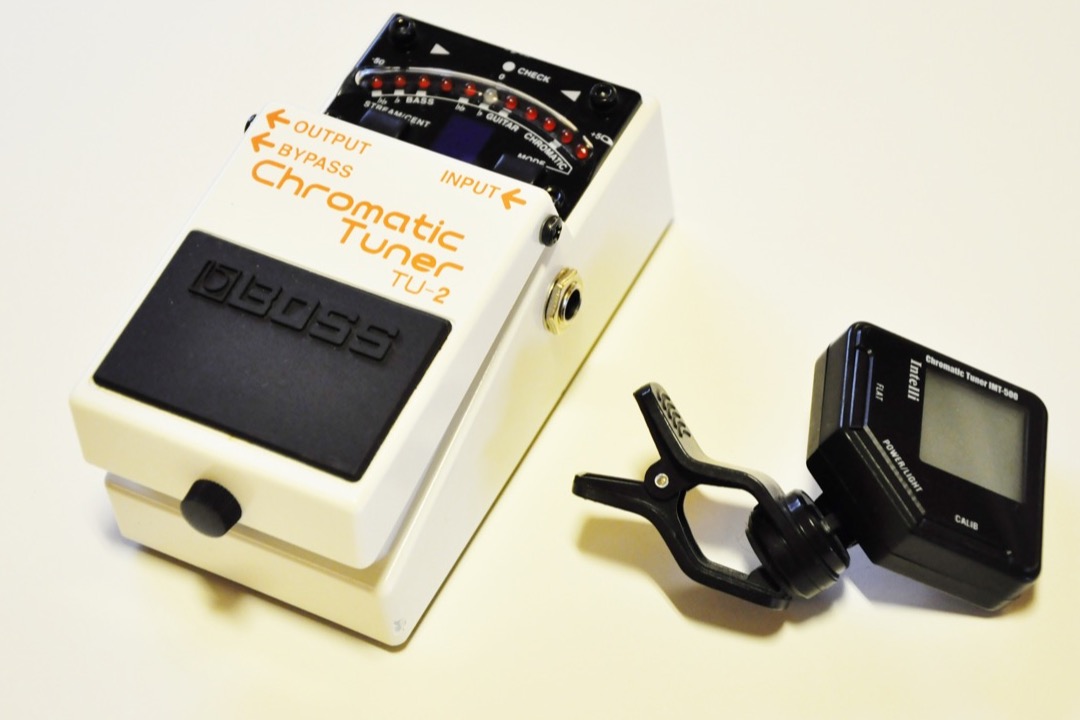
10 Best Guitar Tuners of 2026 (Clip-On, Pedal, Strobe & More)
Nothing makes a guitar sound worse than being out of tune, and nothing fixes it faster or cheaper than the right tuner. In twenty years of playing — through a music degree at Berklee, years on stages and in studios, and a stretch buying gear from the other side of the counter — I have watched more beginners blame their guitar, their strings, or their hands for a sound that was really just a flat B string. A ten-dollar habit of tuning up before you play, with a tuner you can actually read, does more for your tone than almost any upgrade. If you have never done it by hand, our guide to how to tune a guitar walks through the process step by step.
The catch is that “best guitar tuner” is really five different questions, because there are five kinds of tuner and they solve different problems. A bedroom beginner and a gigging electric player and a recording engineer setting intonation all need something different. So this is not one ranked list — it is the ten tuners I would actually put in a real player’s hands in 2026, organized so you can jump straight to the type that fits your instrument and rig: clip-on, pedal, soundhole, strobe, handheld, or automatic. Whether you play an acoustic you never plug in or an electric with a loaded pedalboard, one of these is the right answer for you.
| Product | Price | Buy |
|---|---|---|
| Snark SN5X Clip-On Tuner for Guitar, Bass & ViolinBest Overall | $17.54 | View on Amazon |
| KLIQ UberTuner Clip-On Guitar TunerRunner-Up | $26.99 | View on Amazon |
| Fender FT-1 Professional Clip-On Guitar TunerBudget Pick | $18.50 | View on Amazon |
| D'Addario Nexxus 360 Rechargeable Clip-On TunerRunner-Up | $29.99 | View on Amazon |
| TC Electronic PolyTune 3 Noir Polyphonic Tuner PedalPremium Pick | $63.90 | View on Amazon |
| BOSS TU-3 Chromatic Tuner PedalRunner-Up | $109.99 | View on Amazon |
| D'Addario NS Micro Soundhole TunerRunner-Up | $23.00 | View on Amazon |
| Peterson StroboClip HD Clip-On Strobe TunerPremium Pick | $59.99 | View on Amazon |
| Korg TM-70T Tuner & MetronomeRunner-Up | $39.49 | View on Amazon |
| ROADIE 3 Automatic Guitar Tuner, Metronome & String WinderPremium Pick | $109.00 | View on Amazon |
Find the Best Guitar Tuner for Your Need
Jump straight to the tuner that fits how you play:
- Best guitar tuners overall
- Best clip-on tuner
- Best tuner pedal
- Best for acoustic guitar
- Best for bass guitar
- Best for electric guitar
- Best for intonation (strobe)
- More use cases
How We Chose These Guitar Tuners
Every tuner here earned its place on a verified, in-stock Amazon listing, a real owner-review track record, a genuine brand pedigree, and a clear job for a specific kind of player. I leaned on two decades of playing and a former gear buyer’s eye to weigh what actually separates a great tuner from a forgettable one: how accurately and quickly it locks onto a note, how readable the display is under real stage and practice lighting, whether it tunes by vibration or microphone (vibration wins in any noisy room), its calibration range, and how well it tracks the low fundamentals of a bass or a dropped tuning. I deliberately built the list to cover every tuner type — clip-on, pedal, soundhole, strobe, handheld, and automatic — rather than ten variations on one clip-on, because the right tuner depends entirely on your instrument and rig. The ten below are the best guitar tuners for every player, from a first acoustic to a touring pedalboard.
Best Guitar Tuners Overall
If you want one tuner and you are not sure which type you need, start here. These are the picks that serve the widest range of players — and for most people, a great clip-on is the whole answer.
Best Overall: Snark SN5X
The Snark SN5X is the tuner I recommend more than any other, and the numbers back it up: it is the most-owned clip-on tuner in the world, with tens of thousands of owner reviews at a strong rating. That popularity is not an accident. It clips onto any headstock, reads guitar, bass, and violin, and tunes by sensing the instrument’s vibration through the clip — so it completely ignores room noise, band volume, and the guitar tuning up next to you. For a beginner, that combination removes every excuse to play out of tune.
What makes it genuinely beginner-proof is the display: a big, bright, full-color screen on a ball joint that rotates a full 360 degrees, so you can angle it to your eye whether it is clipped to the front or back of the headstock. Being able to clearly see whether you are sharp or flat is the difference between a new player who stays in tune and one who gives up. It is fast, it is chromatic so it handles any tuning, and it costs so little that the only real mistake is not owning two.

Snark SN5X Clip-On Tuner for Guitar, Bass & Violin
by Snark
The tuner I hand to almost anyone who asks -- a bright, rotating, vibration-sensing clip-on that reads any string on any instrument, costs next to nothing, and is trusted by more players than any other tuner on Amazon. Buy two and never scramble for a tuner again.
Pros
- The most-owned clip-on tuner in the world by a wide margin -- tens of thousands of players rate it at 4.6 stars, which is exactly why it is the safe default answer to 'what tuner should I buy': it clips on any headstock, reads guitar, bass, and violin, and just works
- A large, bright, full-color display on a ball-joint clip that rotates a full 360 degrees, so you can angle the screen to your eye whether the tuner is on the front or back of the headstock -- readability is the single biggest reason beginners actually stay in tune, and Snark nails it
- Tunes by vibration through the clip rather than by microphone, so it ignores room noise and band volume completely -- you can tune mid-rehearsal or in a loud green room and it still locks onto your string, not the guitar next to you
- Fast note pickup, a genuine chromatic mode that handles any tuning, and a rock-bottom price that makes it a no-brainer to keep one in every case -- there is no cheaper way to guarantee an in-tune instrument
Cons
- The plastic clip and ball joint are the weak point -- drop it or over-tighten the hinge and it can crack, so treat it gently and expect to replace it every couple of years with heavy gigging use
- Accuracy is the standard plus-or-minus one cent of a good clip-on, which is perfect for playing but not tight enough for setting intonation at the bridge -- for that you want the strobe tuner further down this list
- The coin-cell battery drains if you leave the display on, so get in the habit of letting it auto-sleep or popping the battery for long storage
Best Clip-On for Precision: KLIQ UberTuner
When a player wants a clip-on that feels a step above the budget crowd, I point them to the KLIQ UberTuner. Its processing chip locks onto the note faster and holds it steadier than most clip-ons — instead of hunting around the target pitch, it snaps to it and stays put, which makes tuning quicker and more confident. The full-color backlit screen is large, high-contrast, and readable from a wide angle, so it holds up on a dark stage or in bright sun.
It also has a wide calibration range that reaches well beyond standard A440, plus a true chromatic mode, so it handles alternate tunings and non-standard pitch references that cheaper tuners choke on. (If you want to see exactly how far a 432 or 442 reference shifts every note, our free note frequency chart recalculates the whole scale as you move A4.) Backed by more than fourteen thousand ratings and a long warranty, it is the clip-on for the player who wants one really good one.
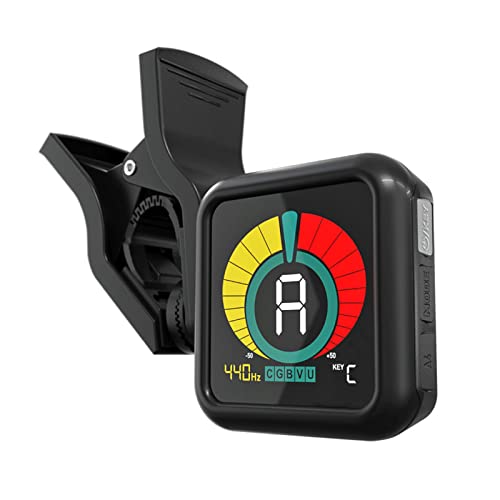
KLIQ UberTuner Clip-On Guitar Tuner
by KLIQ
The thinking player's clip-on: faster and steadier than the budget crowd, with a bright wide-angle screen and a calibration range that suits alternate tunings. If you want one clip-on that feels a cut above, this is it.
Pros
- The clip-on serious players reach for when they want more precision than a Snark -- a fast, sensitive processing chip locks onto the note almost instantly and holds it steady instead of hunting around the target
- A big, high-contrast full-color backlit screen with a wide viewing angle that stays readable on a dark stage or in bright sun -- the display is genuinely a step above most clip-ons in this price range
- A wide calibration range (it tunes well outside standard A440) plus a true chromatic mode, so it handles alternate tunings, transposing instruments, and orchestral pitch standards that trip up cheaper tuners
- Extremely well reviewed across more than fourteen thousand ratings, backed by a long manufacturer warranty -- KLIQ built its reputation on this one tuner and it shows in the build and support
Cons
- The clamp is sturdier than a Snark's but also bulkier, so on a small headstock or a violin scroll it can feel oversized
- Still a vibration-based clip-on at plus-or-minus one cent -- more than accurate enough for tuning, but not a substitute for a strobe when you are dialing in intonation
- No rechargeable option -- it runs on a coin cell, so keep a spare in the case
Best Budget: Fender FT-1
You do not need to spend much to get a reliable tuner, and the Fender FT-1 proves it. This is a genuine name-brand clip-on at a true budget price — Fender build quality and a clean, accurate chromatic tuner without paying for features a beginner will never touch. The crisp color display flips its orientation automatically depending on which way you clip it, so the readout is always right-side-up, and the spring clamp grips the headstock firmly without sliding.
It is one of the best-reviewed budget tuners on Amazon, which means you are buying a proven product rather than a bargain-bin gamble. As a first tuner, or a spare to leave in a second case, it is an easy way onto a name-brand tuner that will not let you down.

Fender FT-1 Professional Clip-On Guitar Tuner
by Fender
The value benchmark: a proper Fender clip-on for the price of a couple of picks and a coffee. If you just need a reliable, accurate tuner to keep a guitar in tune, this is the safe, no-thought choice.
Pros
- A genuine name-brand clip-on at a true budget price -- you get Fender's build quality and a clean, no-nonsense tuner without paying for features a beginner will never use
- A crisp color display that flips its orientation automatically depending on which way you clip it, so the readout is always right-side-up -- a small touch that makes it beginner-proof
- Fast, accurate chromatic tuning that reads guitar, bass, ukulele, and more, with a firm spring clamp that grips the headstock securely and does not slide
- One of the best-reviewed budget tuners on Amazon, so you are buying a proven quantity rather than a bargain-bin gamble -- ideal as a first tuner or a spare for the gig bag
Cons
- The feature set is deliberately basic -- no rechargeable battery, no strobe mode, no metronome -- which is the point at this price but worth knowing
- Standard plus-or-minus one cent accuracy: great for everyday tuning, not for bridge intonation work
- The screen is a touch smaller than the Snark's, so from a distance it is a little harder to read on a dark stage
Best Rechargeable: D’Addario Nexxus 360
If you have ever reached for your tuner mid-practice only to find a dead coin cell, the D’Addario Nexxus 360 is the fix. It is USB-rechargeable, so you never buy another battery — a single charge lasts weeks of regular use, and a quick top-up gets you gig-ready. Around that it is a genuinely premium clip-on: a true 360-degree rotating color screen that reads clearly from any angle, a wide calibration range, and a bright, saturated display D’Addario tuned for stage visibility.
The low-profile clip tucks neatly behind the headstock, and the whole thing feels like a proper accessory rather than a throwaway. If you play often enough to hate feeding a tuner batteries, spend a little more once and be done with it.
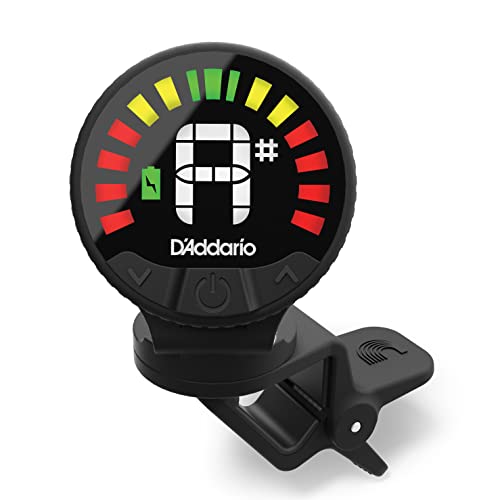
D'Addario Nexxus 360 Rechargeable Clip-On Tuner
by D'Addario
The clip-on for players tired of dead coin cells: rechargeable, bright, fully rotating, and built by D'Addario. Spend a little more once and stop feeding your tuner batteries forever.
Pros
- USB-rechargeable, so you never buy another coin cell -- a single charge lasts weeks of regular use, and a quick top-up gets you gig-ready, which is the feature clip-on owners wish they had after their third dead battery
- A true 360-degree rotating color screen on a low-profile clip that reads clearly from any angle and tucks neatly behind the headstock when you are on stage
- Fast, accurate chromatic tuning with a wide calibration range and a bright, saturated display that D'Addario tuned for stage visibility -- it looks and feels like a premium accessory, not a throwaway
- Auto-power-off and a slim, tour-ready build from the brand that makes the strings on most of the guitars in this list -- it is the natural upgrade from a disposable-battery clip-on
Cons
- Costs more up front than a battery clip-on, though it pays that back over time in batteries you never buy
- Like all vibration clip-ons it holds plus-or-minus one cent, so it is a tuning tool, not an intonation instrument
- If you forget to charge it before a gig you cannot just swap in a spare cell -- keep a short USB cable in the bag
Best Pedal Tuner: TC Electronic PolyTune 3
For a gigging electric player with a pedalboard, the TC Electronic PolyTune 3 is the one to own. Its headline trick, polyphonic tuning, is genuinely useful live: strum all six strings at once and the display shows you which individual strings are out, so you can spot-fix one string in a second between songs instead of tuning them one at a time. Built into the same pedal is an ultra-precise strobe mode accurate to plus-or-minus 0.02 cent — intonation-bench precision in a unit that is already on your board.
It reads clearly under stage lights on a bright 109-LED display, and it offers a switchable high-quality buffer to fight the tone loss of a long cable run, plus your choice of true bypass. Put it first in your signal chain and it doubles as a silent-tuning mute switch. It needs 9V pedal power and only makes sense if you run a board — but if you do, nothing else covers this much ground.
One thing to know before you click through: the Noir version has been running on backorder at Amazon for a couple of weeks now. The listing still takes orders and you are not charged until it ships, but there is no promised delivery date attached, so if you need a tuner on your board for a gig this month, buy the Boss TU-3 below instead and come back to this one when it restocks.

TC Electronic PolyTune 3 Noir Polyphonic Tuner Pedal
by TC Electronic
The pedal tuner that does everything: whole-chord polyphonic checking for speed on stage, a 0.02-cent strobe mode for the setup bench, a tone-saving buffer, and silent true-bypass tuning. If you gig with an electric, this is the one to bolt to your board.
Pros
- Polyphonic tuning is the headline trick and it is genuinely useful live -- strum all six strings at once and the display shows you which individual strings are out at a glance, so you can spot-fix one string in a second between songs instead of tuning one at a time
- A built-in ultra-precise strobe mode reads to plus-or-minus 0.02 cent -- that is intonation-bench accuracy in a pedal you already have on your board, so this one unit covers both fast stage tuning and careful setup work
- A bright 109-LED display that is dead easy to read under stage lights, plus a switchable high-quality buffer that fights the tone-sucking signal loss of a long cable run -- a real bonus for anyone with a big pedalboard
- True-bypass or buffered by choice, rock-solid metal housing, and TC Electronic's long track record make it the pedal tuner most gigging electric players end up buying -- put it first in your signal chain and it doubles as a mute switch for silent tuning
Cons
- It needs a 9V pedal power supply (no battery option on this compact version), so it only makes sense if you already run a powered pedalboard
- Overkill for an acoustic player who never plugs in -- if you do not have a board, a clip-on gets you the same in-tune guitar for far less
- The polyphonic feature needs a clean, evenly-strummed chord to read all strings, which takes a moment to get used to
Best Pedal for the Road: BOSS TU-3
The BOSS TU-3 is the tuner you see on more professional pedalboards than any other, and it earns that spot with legendary durability. BOSS’s metal-chassis pedals shrug off years of touring abuse that destroys lighter tuners, and the TU-3’s 21-segment LED meter has a high-brightness mode that stays perfectly readable in direct sunlight where dimmer tuners wash out completely.
It also tracks big low notes with total confidence — the low strings of a bass and dropped-tuning guitars lock in fast, which is exactly why bassists trust it. Add a flat-tuning mode for down-tuned rigs and a mute output for silent tuning between songs, and you have the reliable workhorse you buy once and never think about again. It is the priciest pedal here and not the most accurate, but it may be the last tuner you ever need to replace.

BOSS TU-3 Chromatic Tuner Pedal
by BOSS
The tank. If you gig hard, tune a bass, or run dropped tunings and want a tuner that will still work after a decade of being stepped on, the TU-3 is the professional default for good reason -- bomb-proof, bright, and utterly dependable.
Pros
- The industry-standard road tuner -- you will find a TU-3 on more professional pedalboards than any other tuner because BOSS's legendary metal-chassis build shrugs off years of touring abuse that lighter pedals cannot survive
- A 21-segment LED meter with a high-brightness mode that stays perfectly readable in direct sunlight on an outdoor stage, where dimmer tuners wash out completely
- Tracks the low strings of a bass and dropped-tuning guitars cleanly and confidently -- big fundamental notes that confuse some tuners lock in fast, which is why bassists trust it
- An 'Accu-Pitch' confirmation, a flat-tuning mode for down-tuned rigs, and a bypass output that mutes your signal for silent tuning between songs -- it is the reliable workhorse you buy once and never think about again
Cons
- The most expensive pedal tuner here and not the most accurate -- it holds a solid plus-or-minus one cent, but the PolyTune's strobe mode is far tighter for intonation
- No polyphonic all-strings-at-once mode -- you tune one string at a time, the classic way
- Like any pedal it needs a 9V supply or battery and takes up a board slot, so it is not for the acoustic-only player
Best for Acoustic: D’Addario NS Micro Soundhole Tuner
Acoustic players who hate the look of a clip on the headstock have a better option, and it is the D’Addario NS Micro Soundhole tuner. It clamps discreetly inside the soundhole, completely invisible from the front, so there is nothing cluttering your headstock on stage or in photos. Like a clip-on it tunes by vibration through the guitar’s top, so it ignores room and band noise entirely — you just get the clean look with none of the compromise.
A tiny tri-color display sits right at the edge of the soundhole where you can glance down and read it while you play, and it is unobtrusive enough to live in the guitar permanently. It only works on acoustics with a soundhole, of course — but for a performing acoustic player, that clean, hidden setup is exactly the point.

D'Addario NS Micro Soundhole Tuner
by D'Addario
The invisible tuner for acoustic players who hate the look of a clip on the headstock. Tuck it in the soundhole, leave it there, and glance down to tune -- your audience never sees it, and your guitar keeps its clean silhouette.
Pros
- Completely invisible from the front -- it clamps discreetly inside the soundhole of an acoustic guitar, so there is nothing clipped to your headstock ruining the look on stage or in photos, which is exactly why performing acoustic players love it
- Tunes by vibration picked up through the top of the guitar, so it is immune to room and band noise just like a clip-on, but with none of the visual clutter
- A tiny tri-color display sits right at the edge of the soundhole where you can glance down and read it while you play -- you can leave it installed permanently and forget it is there
- Featherweight and unobtrusive enough to live in the guitar full-time, from a brand acoustic players already trust for strings and accessories
Cons
- Only works on acoustic-electrics or acoustics with a soundhole -- it is useless on a solid-body electric, so it is a specialist, not an all-rounder
- The small display is angled for the player, not the audience, and is harder to read than a big headstock clip-on
- Standard plus-or-minus one cent accuracy, and the coin-cell battery is fiddly to reach once the tuner is tucked in the soundhole
Best for Intonation & Recording: Peterson StroboClip HD
When plus-or-minus one cent is not tight enough — when you are setting a guitar’s intonation or tracking overdubs in the studio — the Peterson StroboClip HD is the clip-on to reach for. Its true strobe display is accurate to plus-or-minus 0.1 cent, roughly ten times tighter than a standard clip-on, and it shows pitch movement so smoothly that you can dial a string in exactly rather than chase a jumpy needle.
It also ships with Peterson’s “Sweetened” tuning presets — specialized offsets for acoustic, nylon/classical, bass, and more that compensate for the small compromises of equal temperament so your chords ring truer than dead-on standard tuning. The metal-and-glass build feels like the professional reference instrument it is. It costs several times what a basic clip-on does, and a beginner does not need it — but if you do your own setups or record seriously, it is worth every cent.

Peterson StroboClip HD Clip-On Strobe Tuner
by Peterson
The clip-on for players who care about being genuinely in tune, not just close. Ten-times-tighter strobe accuracy plus instrument-specific Sweetened presets make this the tuner luthiers and recording players reach for -- and the one to own if you set your own intonation.
Pros
- True strobe accuracy of plus-or-minus 0.1 cent -- roughly ten times tighter than any standard clip-on, which is the difference between 'in tune enough to play' and 'in tune enough to record and set intonation by'
- Comes loaded with Peterson's 'Sweetened' tuning presets -- specialized offsets for acoustic guitar, nylon/classical, bass, ukulele, and more that compensate for the small compromises of equal temperament so chords ring truer than dead-on standard tuning
- A gorgeous high-definition strobe display that shows pitch movement smoothly and precisely, letting you dial a string exactly rather than chasing a jumpy needle -- once you tune on a strobe it is hard to go back
- A premium metal-and-glass clip build that feels like a professional instrument, from the company that has made the reference strobe tuners for luthiers and studios for decades
Cons
- Costs several times what a basic clip-on does -- the accuracy is real, but a beginner who just wants an in-tune guitar does not need it
- The strobe readout has a small learning curve if you have only ever used a needle tuner
- Runs on a coin cell rather than recharging, so keep a spare for long sessions
Best Tuner + Metronome: Korg TM-70T
For a student, a teacher, or anyone who practices with intent, the Korg TM-70T does something a clip-on cannot: it is a full chromatic tuner and a real metronome in one unit, and it runs both at once. You can drill a passage in time and check your pitch together, which is why it lives on so many practice desks and music stands. Transpose modes for F, B-flat and E-flat instruments sit alongside standard chromatic tuning, so it follows a player who doubles on horn or clarinet as easily as it handles a guitar.
The large backlit needle display reads easily across a stand, and a “sound out” reference-tone mode helps train your ear and tune by pitch. It listens through a built-in mic rather than reading vibration, so it wants a reasonably quiet room — Korg’s CM-400 contact mic covers the noisy-band-room case, but it is a separate purchase. It is bigger than a clip-on and lives in the bag rather than on the headstock, but as a practice tool it does more for your playing than a bare tuner ever will.

Korg TM-70T Tuner & Metronome
by Korg
The practice-desk workhorse: tuner and metronome in one box, running together, with transpose modes for band instruments and a reference tone for ear training. If you are learning or teaching, this does more for your playing than a headstock clip ever will.
Pros
- A full chromatic tuner and a real metronome in one handheld unit, and it runs both at the same time -- so you can practice a passage in time and check your pitch together, which is why teachers and students pick it over a bare tuner
- Transpose modes for F, B-flat and E-flat instruments alongside standard chromatic tuning, so the same unit serves a horn or clarinet player as readily as it serves a guitarist
- A large backlit needle-and-bar display that is easy to read across a music stand, plus a 'sound out' reference-tone mode for training your ear and tuning by pitch
- A wide C1 to C8 detection range and roughly 250 hours of tuner runtime on two AAA cells, so it covers every instrument on the practice desk and rarely needs fresh batteries
Cons
- Bigger than a clip-on and not something you leave attached to the guitar -- it lives on the music stand or in the gig bag, not on the headstock
- Listens through a built-in microphone rather than reading vibration, so it wants a reasonably quiet room -- the CM-400 contact mic that handles noisy band rooms is a separate purchase
- As a practice tool it is plus-or-minus one cent, so it is about versatility and the metronome, not strobe-level precision
Best Automatic Tuner: ROADIE 3
The ROADIE 3 tunes the guitar for you. Clip it onto a tuning peg, pluck the string, and a motor turns the machine head to pitch automatically before moving to the next string — a full retune takes seconds, with zero guessing about which way to turn. It also doubles as a motorized string winder, which turns the most tedious chore in guitar, restringing, into a non-event.
Its own screen stores a huge library of alternate and custom tunings with no phone required, so switching to drop D, DADGAD, or open G is a one-tap job — a real gift for players who juggle many tunings, and for anyone whose hands make fine peg adjustments difficult. It is one of the most expensive tools here and a convenience device rather than a precision reference, but for fast, repeatable tuning and painless restringing it is part tuner, part power tool.

ROADIE 3 Automatic Guitar Tuner, Metronome & String Winder
by Band Industries
The tuner that turns the pegs for you. If you switch tunings constantly, restring often, or just want the fastest, most repeatable way to get to pitch, the Roadie 3's motorized tuning and built-in string winder are a legitimate time-saver -- part tuner, part power tool.
Pros
- It tunes for you -- clip it on a tuning peg, pluck the string, and a motor turns the machine head to pitch automatically, then moves to the next string, so a full retune takes seconds with zero guessing about which way to turn
- Doubles as a motorized string winder, which makes restringing dramatically faster -- the single most tedious chore in guitar becomes a non-event
- Stores a huge library of alternate and custom tunings in its own screen (no phone required), so switching to drop D, DADGAD, or open G is a one-tap job -- a genuine gift for players who juggle many tunings
- Works across guitars, bass, ukulele, and most geared-tuner instruments, and its precision motor gets you consistently to pitch far more repeatably than a shaky hand -- a favorite for players with limited dexterity
Cons
- One of the most expensive options here, and it is a specialist convenience tool rather than a precision reference -- you are paying for the automatic motor and winder, not tighter accuracy
- It does not fit some non-standard or locking tuners, and very large or unusual peg buttons can be a tight grip
- It is a rechargeable gadget with a motor, so it is bulkier and more failure-prone over years than a simple clip-on -- keep it charged
Best Clip-On Guitar Tuner
A clip-on is the right tuner for most players — it works on any instrument, needs no cables, and tunes by vibration so noise never fools it. If a clip-on is all you want, these three are the ones I trust: the everyday default, the precision step-up, and the no-battery option.
| Product | Price | Buy |
|---|---|---|
| Snark SN5X Clip-On Tuner for Guitar, Bass & ViolinBest overall clip-on Most-owned clip-on in the world; bright 360° screen and unbeatable value | $17.54 | View on Amazon |
| KLIQ UberTuner Clip-On Guitar TunerBest for precision & display Locks on faster and holds steadier, with the best wide-angle display here | $26.99 | View on Amazon |
| D'Addario Nexxus 360 Rechargeable Clip-On TunerBest rechargeable USB-rechargeable, so you never buy another coin cell | $29.99 | View on Amazon |
Best Guitar Tuner Pedal (for Pedalboards)
If you gig with an electric and run a pedalboard, a pedal tuner sits first in your chain, mutes your signal for silent tuning, and survives the road. It comes down to the feature-rich polyphonic option versus the indestructible workhorse.
| Product | Price | Buy |
|---|---|---|
| TC Electronic PolyTune 3 Noir Polyphonic Tuner PedalBest overall pedal tuner Polyphonic all-strings check plus a 0.02-cent strobe mode and a tone-saving buffer. On backorder at Amazon with no delivery date, so pick the TU-3 if you need it for a gig this month | $63.90 | View on Amazon |
| BOSS TU-3 Chromatic Tuner PedalBest for durability & bass Bomb-proof metal build, sunlight-readable, and a bassist favorite for low-note tracking. In stock and shipping now | $109.99 | View on Amazon |
Best Tuner for Acoustic Guitar
Acoustic players have two good paths: a discreet soundhole tuner that hides inside the guitar, or a reliable clip-on for the headstock. All three tune by vibration, so they work perfectly in a noisy room.
| Product | Price | Buy |
|---|---|---|
| D'Addario NS Micro Soundhole TunerBest hidden/soundhole option Clamps inside the soundhole -- invisible from the front, keeps your guitar's clean look | $23.00 | View on Amazon |
| Fender FT-1 Professional Clip-On Guitar TunerBest name-brand budget clip-on A trusted Fender clip-on for barely more than our top pick | $18.50 | View on Amazon |
| Snark SN5X Clip-On Tuner for Guitar, Bass & ViolinBest all-round clip-on The most popular clip-on going, bright and easy to read | $17.54 | View on Amazon |
Best Tuner for Bass Guitar
Bass and extended-range players need a chromatic tuner that tracks low fundamentals cleanly — some cheaper tuners hunt or read an octave off on a low B. These lock onto big low notes with confidence.
| Product | Price | Buy |
|---|---|---|
| BOSS TU-3 Chromatic Tuner PedalBest bass pedal tuner The bassist's standard -- confident low-note tracking and a flat-tuning mode for down-tuned rigs | $109.99 | View on Amazon |
| Snark SN5X Clip-On Tuner for Guitar, Bass & ViolinBest bass clip-on (value) Chromatic, vibration-sensing, and reads a low B once it settles | $17.54 | View on Amazon |
| KLIQ UberTuner Clip-On Guitar TunerBest bass clip-on (precision) Fast, steady tracking with a wide calibration range for extended-range basses | $26.99 | View on Amazon |
Best Tuner for Electric Guitar
Electric players split two ways: bedroom and rehearsal players are well served by a clip-on, while anyone gigging through a rig wants a pedal tuner on the board for silent, tone-safe tuning.
| Product | Price | Buy |
|---|---|---|
| TC Electronic PolyTune 3 Noir Polyphonic Tuner PedalBest for a gigging rig Sits first in your chain for silent tuning, with a buffer to protect your tone over long cables. Currently on backorder -- the Boss TU-3 above is the shipping alternative | $63.90 | View on Amazon |
| Snark SN5X Clip-On Tuner for Guitar, Bass & ViolinBest grab-and-go clip-on Cheap, instant, and cable-free -- the perfect backup even if you run a pedal tuner | $17.54 | View on Amazon |
Best Guitar Tuner for Intonation (Strobe Tuners)
Setting intonation at the bridge or tracking in the studio demands more than one-cent accuracy. A strobe tuner reads ten times tighter, letting you dial each string in exactly. Pick the clip-on strobe for the workbench or the pedal with a strobe mode for the board.
| Product | Price | Buy |
|---|---|---|
| Peterson StroboClip HD Clip-On Strobe TunerBest strobe for setups & recording ±0.1-cent strobe plus instrument-specific Sweetened presets -- the luthier's and studio's choice | $59.99 | View on Amazon |
| TC Electronic PolyTune 3 Noir Polyphonic Tuner PedalBest strobe on a pedalboard A 0.02-cent strobe mode built into a gig-ready pedal you already have on your board, though it is on backorder at the moment | $63.90 | View on Amazon |
Best Guitar Tuners by Use Case
A few more players need a more specialized tool. These are the tuners I reach for when the job is narrower — practice with a metronome, hands-free automatic tuning, nylon-string precision, extended-range guitars, or a name brand on a tight budget.
| Product | Price | Buy |
|---|---|---|
| Korg TM-70T Tuner & MetronomeBest for practice (tuner + metronome) Runs a metronome and tuner together, with transpose modes for band instruments -- built for the practice desk | $39.49 | View on Amazon |
| ROADIE 3 Automatic Guitar Tuner, Metronome & String WinderBest automatic / hands-free A motor turns the pegs to pitch for you and winds new strings -- fast and repeatable | $109.00 | View on Amazon |
| Peterson StroboClip HD Clip-On Strobe TunerBest for classical & nylon-string Strobe accuracy plus a nylon/classical Sweetened preset for truer-ringing chords | $59.99 | View on Amazon |
| BOSS TU-3 Chromatic Tuner PedalBest for 7-string & drop tunings Chromatic with rock-solid low-note tracking and a flat-tuning mode for down-tuned rigs | $109.99 | View on Amazon |
| Fender FT-1 Professional Clip-On Guitar TunerBest name-brand pick on a budget A genuine Fender clip-on for the price of a couple of picks | $18.50 | View on Amazon |
Buyer's Guide
A tuner is the cheapest accessory that most directly changes whether your guitar sounds good -- an out-of-tune instrument undermines every note, no matter how well you play it. As a Berklee-trained multi-instrumentalist and a former gear buyer who stocked tuners by the case, I have used every type on this list on real stages and workbenches. The right tuner depends entirely on your instrument, your rig, and how precise you need to be. These are the six factors I weigh before recommending one, in the order that actually decides which tuner is right for you.
Tuner Type (Clip-On, Pedal, Soundhole, Handheld, Auto)
Type is the first and biggest decision because it is dictated by how you play. Clip-ons attach to the headstock, tune by vibration, work on any instrument, and are the right default for beginners and acoustic players. Pedal tuners live on an electric player's pedalboard, mute the signal for silent stage tuning, and survive touring abuse. Soundhole tuners hide inside an acoustic guitar for a clean, clip-free look. Handheld tuner-metronomes sit on the practice desk and pair pitch with timing. Automatic tuners turn the pegs for you. Pick the type that fits your instrument and setting first -- everything else is secondary.
Accuracy (Measured in Cents)
A cent is one hundredth of a semitone. Standard tuners hold plus-or-minus one cent, which is finer than the ear can hear on a single note and perfect for playing and gigging. Strobe tuners tighten that tenfold or more (plus-or-minus 0.1 to 0.02 cent) -- accuracy you only need for setting intonation at the bridge or for critical studio recording. Do not overpay for strobe precision if you just want an in-tune guitar; do buy it if you do your own setups or record seriously. Match the accuracy to the job rather than assuming tighter is always better.
Chromatic vs. Guitar-Specific Detection
A chromatic tuner reads all twelve notes; a guitar-specific tuner only recognizes the six standard open strings. Always choose chromatic -- it costs the same and never limits you. Chromatic detection is what lets you use drop and alternate tunings, tune a bass or extended-range guitar, work with a capo, and check any note on the neck. A guitar-only mode is a beginner convenience at best and a roadblock the moment you want to explore a new tuning. Every tuner worth buying today, including all of ours, is chromatic.
Display Readability
You have to read the tuner at a glance, often in bad light, so the display matters more than spec sheets suggest. Look for a bright, high-contrast screen with a wide viewing angle and, on a clip-on, a head that rotates so you can angle it to your eye. On a dark stage a dim readout is useless; in direct sun a low-brightness LED washes out. This is the single biggest reason beginners actually stay in tune -- if they can clearly see whether the note is sharp or flat, they fix it. A big, legible, well-angled display is worth paying a little more for.
True Bypass, Buffer & Pedalboard Integration (Pedal Tuners)
If you are buying a pedal tuner, how it sits in your signal chain matters. Placed first in the chain, a tuner with a mute output lets you tune silently between songs instead of blasting notes through the PA. True-bypass models take themselves out of the signal when off; buffered models add a circuit that protects your high end over long cable runs -- the better pedal tuners, like the PolyTune 3, let you switch between the two. Also check the power draw and that it takes standard 9V pedal power so it daisy-chains with the rest of your board. None of this applies to a clip-on, but for a gigging electric rig it is the whole point.
Calibration Range (Hz) & Power Source
Most tuners default to the A440 standard, but many can be recalibrated a few hertz up or down (typically 435 to 445Hz) -- useful if you play with an orchestra tuned to 442, alongside a fixed-pitch instrument, or in genres that tune slightly sharp. A wide calibration range is a mark of a serious tuner. Finally, consider power: disposable coin cells are cheap and swappable but die at inconvenient moments; USB-rechargeable models (like the D'Addario Nexxus 360 or Roadie 3) never need new batteries but must be charged before a gig; pedal tuners run on 9V board power. Pick the trade-off that matches how and where you play.
How to Choose the Best Guitar Tuner
Start with type, because it is decided by your instrument and where you play, not by specs. If you are a beginner or an acoustic player, a clip-on like the Snark SN5X is the whole answer — cheap, cable-free, accurate, and readable. If you gig with an electric and have a pedalboard, add a pedal tuner like the PolyTune 3 or Boss TU-3 for silent, tone-safe tuning on stage. If you perform on acoustic and want a clean headstock, a soundhole tuner hides inside the guitar. If you practice with intent, a tuner-metronome earns its desk space. And if you set your own intonation or record, a strobe tuner’s tenfold-tighter accuracy is the one upgrade that matters.
After type, weigh accuracy against your actual needs — one cent is perfect for playing, strobe precision is for the workbench and studio. Insist on a chromatic tuner so alternate tunings never box you in, favor the brightest, most readable display you can get, and match the power source to your habits: rechargeable if you play daily, coin cells if you want a swappable spare, 9V board power for a pedal. Get those five things right and the tuner disappears into your routine, which is exactly what a good one should do.
One habit worth pairing with a new tuner: know what key you are actually in before you start. Clamping a capo pulls every string slightly sharp, so the moment you move a song into a new key you want to re-check tuning — and our free interactive circle of fifths will tell you which sharps or flats that key carries, which chords belong to it, and exactly where to put the capo to play it with open shapes.
The Bottom Line on the Best Guitar Tuners
For the vast majority of players, the best guitar tuner is a great clip-on, and the Snark SN5X is the one I hand out most — bright, accurate, works on anything, and costs almost nothing. If you gig with an electric rig, the TC Electronic PolyTune 3 is the smarter buy for its polyphonic speed and built-in strobe; if you set your own intonation or record, the Peterson StroboClip HD’s strobe accuracy is worth the premium; and acoustic players who want a clean headstock should look at the discreet D’Addario NS Micro Soundhole tuner. Match the tuner to your instrument and rig rather than chasing a single “best,” and you will always sound like the best version of your playing. Once you are locked in, put that in-tune guitar to work with the right electric guitar or acoustic for your style, and if you are still learning the ropes, keep our guide to how to tune a guitar close.
Frequently Asked Questions
What is the best guitar tuner?
Are clip-on tuners accurate enough for gigging?
What's the difference between a chromatic tuner and a guitar-specific tuner?
How accurate does a guitar tuner need to be? What do 'cents' mean?
Pedal tuner vs. clip-on tuner -- which should I buy first?
Do I need a special tuner for a bass or a 7-string guitar?
What is the best guitar tuner app?
Do I still need a hardware tuner if I have a guitar tuner app on my phone?
Related Articles
8 Best Acoustic Guitar Strings of 2026 (Every Player & Budget)
accessories-care
9 Best Guitar Picks of 2026 (Beginner, Acoustic, Metal, Jazz & Bass)
accessories-care
8 Best Electric Guitar Strings of 2026 (Every Style & Budget)
accessories-care
Guitar String Notes Explained: The 6 Open Strings (E-A-D-G-B-E)
accessories-care
How to Tune a Guitar: A Complete Beginner's Guide (Standard EADGBE)
accessories-care
About the Reviewer

Julian Reyes, MM, Berklee
M.M. Performance, Berklee College of Music
Julian Reyes is a multi-instrumentalist with a Master of Music from Berklee College of Music and over a decade gigging on guitar, bass, and keys. Before founding House of Octave, he spent years as a gear buyer for an independent music retailer, evaluating hundreds of instruments and audio products for the sales floor. He started House of Octave in 2026 to give players honest, hands-on reviews — judged by how gear actually sounds and holds up on stage and in the studio, not by spec sheets or sponsorships.