10 Best Multi-Effects Pedals of 2026 (Budget, Compact, Acoustic & Live)
Berklee-trained multi-instrumentalist Julian Reyes (MM) reviews the 10 best multi-effects pedals of 2026 -- from the pocket-sized SONICAKE Pocket Master to the BOSS ME-90 and Line 6 HX Stomp -- matched by use: budget, beginner, compact, looper, acoustic, and live performance.
Updated
A multi-effects pedal is the only piece of gear that can replace an entire pedalboard, an amp, and a recording interface at once — which is exactly why choosing one is harder than choosing any single stompbox. Ask what the best multi-effects pedal is and the honest answer is another question: are you buying your first effects and want to find out what chorus even does, or are you a gigging guitarist who needs eight footswitches and a preset for every song in the set? Do you need a looper and a drum machine because you practise alone, or do you have a drummer and would rather spend the money on modeling quality? Are you plugging into a real amp, or going straight to a front-of-house desk?
Those questions pull in genuinely different directions, and the specification that gets quoted most — the effect count — is the one that answers none of them. A unit advertising 278 effects is counting amp and cabinet simulations separately; a unit with eleven amp models can sound dramatically better than one with eighty. So I approached this roundup the way I approached buying inventory as a gear buyer: not “which multi-effects pedal is best” but “which is best for each kind of player,” from a sixty-dollar pocket box to a flagship floorboard. I evaluated ten units on modeling quality, format and footswitch count, practice features, outputs, and power, and matched each to a clear role. As you read, it is worth browsing our full amps and effects category for how these fit the wider rig.
| Product | Price | Buy |
|---|---|---|
| BOSS ME-90 Guitar Multi-Effects ProcessorBest Overall | $384.99 | View on Amazon |
| MOOER GE100 Multi-Effects Guitar PedalBudget Pick | $95.99 | View on Amazon |
| Line 6 HX Stomp Multi-Effects Guitar PedalPremium Pick | $599.99 | View on Amazon |
| Zoom G1X Four Guitar Multi-Effects ProcessorRunner-Up | $99.99 | View on Amazon |
| Line 6 POD Go Guitar Multi-Effects PedalRunner-Up | $599.99 | View on Amazon |
| Donner Arena 2000 Guitar Multi-Effects PedalRunner-Up | $229.99 | View on Amazon |
| MOOER GE150 Pro Guitar Multi-Effects ProcessorRunner-Up | $128.20 | View on Amazon |
| SONICAKE Pocket Master Portable Multi-Effects PedalRunner-Up | $56.99 | View on Amazon |
| M-VAVE TANK-G Multi-Effects Guitar PedalRunner-Up | $71.99 | View on Amazon |
| Zoom A1X FOUR Acoustic Guitar Multi-Effects PedalRunner-Up | $149.99 | View on Amazon |
Find the Best Multi-Effects Pedal for Your Need
Jump straight to the unit that fits how you play:
- Best multi-effects pedals overall
- Best budget multi-effects pedal
- Best multi-effects pedal for beginners
- Best compact and mini multi-effects pedals
- Best multi-effects pedal with a looper and drum machine
- Best multi-effects pedal for live performance
- Best multi-effects pedal for acoustic guitar
- More multi-effects picks by use case
How I Tested and Evaluated These Multi-Effects Pedals
Every unit in this roundup was selected on a verified, active Amazon listing, a real owner-review base, a genuine brand reputation, and a clear fit for a specific kind of player. I drew on twenty years of playing and a gear-buyer’s eye for what actually matters once a multi-effects pedal is on a floor: how the amp models feel and respond at the edge of breakup rather than how many there are, how many tones you can genuinely reach with your foot mid-song, whether the practice features are usable or box-ticking, and where the outputs let you plug in. I cross-referenced thousands of owner reviews for the recurring complaints — thin or brittle modeling, cramped displays, firmware headaches, footswitch reliability — and weighed format, power, and connectivity against the way each unit is meant to be used. Units from unverified sellers or with thin, suspicious review histories were left out. Because a multi-effects pedal replaces so much of a rig, I have noted throughout how each one fits alongside your amp, your board, and your recording setup.
Best Multi-Effects Pedals Overall
These ten units span every budget and format, but they share one thing: each is the honest best choice for the player it targets. Below, every unit is reviewed once in full. Farther down, use-case sections pull the right two or three together so you can compare and decide fast for your specific situation.
Best Overall: BOSS ME-90
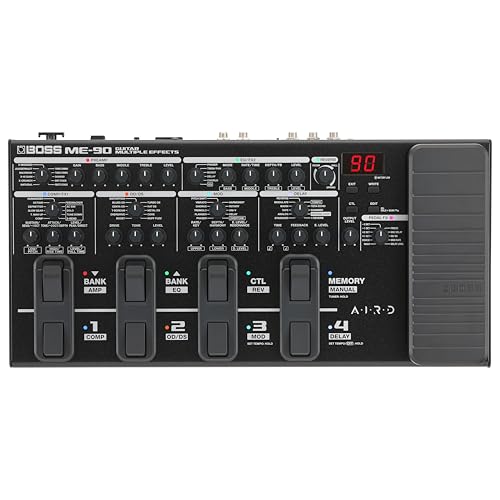
The BOSS ME-90 earns best overall because it is the only unit here that still behaves like a pedalboard. Every important parameter has a real knob, so you shape drive, EQ, and delay with your hand while the band keeps playing instead of scrolling a menu. Underneath that familiar interface sit eleven flagship AIRD amp models and sixty effects taken straight from the GT-1000, plus IR loading, an effects loop, and eight footswitches with a redesigned expression pedal. It is large and it is not cheap, but for a working guitarist it is the fastest, most reliable box on this page.
BOSS ME-90 Guitar Multi-Effects Processor
by BOSS
The multi-effects pedal that behaves like a pedalboard instead of a computer -- flagship BOSS tone with a knob for every function and eight footswitches to reach it.
Pros
- The only unit here that gives you a real knob per function instead of a menu -- you reach down and turn the drive, the EQ, or the delay time with your hand while the band keeps playing, which is exactly why the ME series has been the working guitarist's default for three decades
- Eleven flagship-grade AIRD amp models and sixty effects lifted directly from the BOSS GT-1000, so the raw tone quality is genuinely professional rather than merely adequate for the money
- Eight multi-function footswitches plus a redesigned expression pedal with a toe switch mean you can build a whole set's worth of tones and reach every one of them with your foot, no crouching and no preset scrolling
- It runs on batteries and loads third-party IRs, so the same box covers a rehearsal room with no power, a fly-in gig with a rented amp, and a direct-to-desk stage rig
Cons
- It is one of the two or three most expensive units on this page, which is a lot to spend if you only ever need a handful of tones
- The knob-per-function layout that makes it fast also makes it physically large -- this is a floorboard, not something you tuck into a gig-bag pocket
- Deep editing still means the BOSS Tone Studio app, so the hands-on control has limits once you go past the front-panel parameters
Best Budget: MOOER GE100
The MOOER GE100 is the most feature-complete cheap rig here rather than a stripped-down one. Amp models, eighty presets, sixty-six effects, a tuner, a 180-second looper, forty drum rhythms, and a built-in expression pedal for wah and volume — at a price where most units start cutting features. Two units on this page cost less, but neither puts a pedal under your foot or loops for anywhere near as long, and the core modeling is a clear step below the flagships. Nearly 1,500 owner ratings at 4.4 stars make it a proven, low-risk first buy.

MOOER GE100 Multi-Effects Guitar Pedal
by MOOER
The most complete multi-effects pedal you can buy for under a hundred dollars -- amp models, a long looper, a drum machine, and a wah pedal in one box.
Pros
- A genuinely complete multi-effects feature set -- amp models, eighty presets, sixty-six effects, a tuner, a looper, and a drum machine -- rather than the stripped-down subset that usually gets cut at this price
- A 180-second looper is longer than what units costing several times as much offer, and paired with forty drum rhythms it turns the pedal into a genuine practice partner
- A real expression pedal is built in for volume and wah duty, so you are not buying a separate pedal to get the one control that most changes how expressive a rig feels
- Nearly 1,500 owner ratings at 4.4 stars is the proven, no-surprises track record you want when you are spending your first money on effects
Cons
- The core tone quality is honestly a step below the Line 6 and BOSS units -- it is very good for the price, not competitive with flagship modeling
- The small screen and shallow control set mean deep editing is slower and less precise than on a unit with a colour display
- Build is budget-tier plastic-and-metal rather than the road-ready chassis of a BOSS or Line 6 floorboard
Best Upgrade: Line 6 HX Stomp
The Line 6 HX Stomp is the pedal you buy when tone quality stops being negotiable. It runs the identical HX modeling engine as the flagship Helix — over three hundred amp, cab, and effect models — with six simultaneous blocks, full stereo routing, an effects loop, and third-party IR loading, all in a box small enough to sit on an existing pedalboard. It also doubles as a studio-grade USB interface. Three footswitches limit live control without a controller, and it is the joint-priciest unit here, but it carries the highest rating on this page for good reason.

Line 6 HX Stomp Multi-Effects Guitar Pedal
by Line 6
The highest-rated pedal in this roundup -- genuine Helix modeling and stereo routing in a box small enough to live on an existing pedalboard.
Pros
- It runs the exact same HX modeling engine as the flagship Helix -- more than three hundred amp, cab, and effect models -- so there is no tonal compromise for the smaller box, which is the single most important thing about this pedal
- Six simultaneous blocks with full stereo routing, an effects loop, and third-party IR loading make it the most flexible signal-path builder here, capable of the parallel and four-cable-method rigs the simpler units cannot touch
- It doubles as a studio-grade USB audio interface, so the same pedal that runs your live rig is also your recording front end -- no re-amping, no second box, no tone change between stage and session
- It carries the highest rating on this page at 4.7 stars across nearly five hundred reviews, which is the clearest owner-satisfaction signal in the entire roundup
Cons
- It is the joint-most expensive unit here, and it ships without an expression pedal, so a fully expressive rig costs more than the sticker
- Only three footswitches means live preset access is genuinely limited unless you add an external controller -- this is a pedalboard component, not a standalone floorboard
- The deep, menu-driven editing has a real learning curve; you will spend evenings with the manual before it sings
Best for Beginners: Zoom G1X Four
The Zoom G1X Four is by a wide margin the most-reviewed multi-effects pedal in this roundup, and that is the whole argument. Over five thousand owner ratings at 4.6 stars, a built-in expression pedal, seventy-plus effects and amp models, a tuner, a looper, and sixty-eight rhythm patterns — powered by four AA batteries so it works anywhere. The modeling is entry-level and the chassis is not built for touring, but nothing else makes it this easy or this cheap to find out what effects you actually like.

Zoom G1X Four Guitar Multi-Effects Processor
by Zoom
The most-reviewed multi-effects pedal in this roundup and the safest first purchase -- battery powered, expression pedal included, and impossible to get lost in.
Pros
- By a very wide margin the most-reviewed multi-effects pedal on this page at over five thousand ratings, and still holding 4.6 stars -- that combination of scale and score is the strongest proof of reliability anywhere in this roundup
- The built-in expression pedal, seventy-plus effects and amp models, tuner, looper, and sixty-eight rhythm patterns cover everything a new player needs to explore what effects actually do before committing to any of them
- It runs on four AA batteries, so it works on a sofa, in a dorm, or at a park with no power supply and no cables to trip over -- the reason it ends up being the pedal people actually practice with
- The interface is deliberately shallow: a handful of buttons, one clear job each, and you are auditioning effects within a minute of opening the box
Cons
- The amp modeling is entry-level and will not stand up to the HX or AIRD engines once your ear develops
- The 30-second looper is short for anything beyond simple practice loops
- The plastic chassis and light expression pedal are not built for the abuse of regular gigging
Best for Live Performance: Line 6 POD Go
The Line 6 POD Go is the HX engine packaged as a complete stage rig instead of a pedalboard component. Four footswitches, an expression pedal, and the clearest colour display on this page mean you build a set’s worth of presets and read them at a glance on a dark stage. More than 270 HX and legacy models plus third-party IR loading give it real depth, and the fixed-block signal path gets you to usable presets fast. Its fixed routing is less flexible than the HX Stomp’s, and it needs mains power — but as a self-contained gigging floorboard it is the cleanest answer here.

Line 6 POD Go Guitar Multi-Effects Pedal
by Line 6
The complete Line 6 stage rig in one box -- HX modeling, four footswitches, an expression pedal, and the clearest display here.
Pros
- It packages the HX modeling engine into a complete, self-contained floorboard -- four footswitches, an expression pedal, and a large colour display -- so unlike the HX Stomp you are not buying a controller and a pedal separately to gig it
- More than 270 HX and legacy Line 6 models plus third-party IR loading gives you a genuinely deep tonal library, and the fixed-block signal path means you build usable presets in minutes instead of hours
- The large colour display is the clearest on this page, which matters more than it sounds -- on a dark stage you can read your preset at a glance instead of squinting at a two-digit LED
- A stereo effects loop and expression/footswitch input let it sit at the centre of a hybrid rig with your favourite analog pedals still in the chain
Cons
- It is the joint-most expensive unit here, and the price gap over a MOOER or Zoom unit is very large for a player who is not gigging
- The fixed signal-path blocks that make it fast also make it less flexible than the free-form routing on the HX Stomp
- It is a full floorboard, so it takes real space in a gig bag and needs mains power
Best Looper and Drum Machine: Donner Arena 2000
The Donner Arena 2000 is the one-man-band box. Forty drum rhythms and a 60-second looper driven from the footswitches let you lay a beat, loop a progression, and solo over it without ever crouching, and 278 effect types with a hundred IR slots give you the tones to do it with. Stereo XLR outputs with switchable cab sim and MIDI in send it straight to a desk without a DI box. The modeling sits below the HX and AIRD engines and there is no battery compartment at all, but for solo performance nothing else here is this complete.

Donner Arena 2000 Guitar Multi-Effects Pedal
by Donner
The best solo-performance box here -- a real looper, a real drum machine, and stereo XLR outputs that go straight to the desk.
Pros
- The most complete one-man-band feature set here -- forty drum rhythms and a 60-second looper controlled from the footswitches, so you build a rhythm bed, loop a part over it, and solo on top without ever bending down
- 278 effect types (100 effects, 80 amp simulations, 50 cabinet simulations) is the largest raw tone library on this page outside the two Line 6 units, and it spans clean pop through thrash metal
- Fifty built-in IRs plus fifty user slots for third-party impulse responses, at a resolution long enough to genuinely reproduce a captured cabinet -- a specification usually reserved for units at twice this price
- Stereo XLR outputs with a switchable cab-sim option, MIDI in, dual expression pedal support, and aux in mean it goes straight to a front-of-house desk without a DI box
Cons
- The core amp modeling, while good, is a clear step below the HX and AIRD engines in feel and dynamic response
- There is no battery compartment, so it always needs mains power -- a real limitation for busking or outdoor practice
- Donner's brand pedigree is thinner than BOSS's or Line 6's, and long-term road reliability is less proven
Best Value Flagship: MOOER GE150 Pro
The MOOER GE150 Pro packs the biggest tone library per dollar on this page. Two hundred presets, fifty-five modelled preamps, and twenty-six cabinet simulations are the starting point — but the real feature is twenty amp slots and twenty cab slots that accept MOOER’s MNRS samples and third-party neural amp captures, which makes the library effectively open-ended. Add an 80-second stereo looper, forty drum rhythms, four footswitches, an expression pedal with toe-tap switching, and USB-C recording. Its rating is among the lowest here, reflecting a genuine learning curve, but the capability is remarkable at this price.

MOOER GE150 Pro Guitar Multi-Effects Processor
by MOOER
The deepest tone library per dollar here -- neural amp captures, a long stereo looper, and a drum machine at a mid-tier price.
Pros
- It supports both MOOER's MNRS sample files and third-party neural amp captures across twenty amp slots and twenty cabinet slots, which means the amp library is effectively open-ended rather than fixed at whatever shipped in the firmware
- Two hundred factory presets, fifty-five modelled preamps, and twenty-six cabinet simulations put a flagship-sized tone library in a mid-price box -- the best raw models-per-dollar ratio on this page
- An 80-second stereo looper plus forty drum rhythms and ten metronome modes, all driven from four multi-purpose footswitches, makes it a serious practice and songwriting tool rather than a tone box with a looper bolted on
- Type-C USB with OTG support means you can record straight into a phone or laptop, and the expression pedal has a toe-tap switch to flip between parameter and volume control mid-song
Cons
- It sits among the lower-rated units in this roundup, which reflects a firmware-and-workflow learning curve owners consistently mention
- The sheer depth of the routing and sample-loading system is genuinely complex -- this is not a pedal you master in an evening
- The standard model is mains-powered; the battery version is a separate purchase
Best Pocket-Size: SONICAKE Pocket Master
The SONICAKE Pocket Master delivers more useful function per cubic inch than anything else here. It covers guitar, bass, and acoustic effects with twenty amp models and a nine-block chain, runs a looper and ninety-nine drum rhythms, works as a stereo USB audio interface with phone OTG and Bluetooth, and does all of it on an internal rechargeable battery in something that fits a gig-bag pocket. There is no footswitch array and the modeling is budget-tier, but as a travel, practice, and recording rig it is extraordinary value.

SONICAKE Pocket Master Portable Multi-Effects Pedal
by SONICAKE
The most useful pedal here per cubic inch -- guitar, bass, and acoustic models, a drum machine, and a USB interface in something you can pocket.
Pros
- The only unit here that covers guitar, bass, and acoustic effects in one pocket-sized box with a rechargeable battery -- it genuinely fits in a gig-bag pocket and still runs a nine-block signal chain
- It works as a stereo USB audio interface with OTG support for phones and tablets plus Bluetooth audio, so it is a complete practice and recording rig for anyone without a desk or an interface
- Ninety-nine drum rhythms and a looper alongside twenty amp models and 100-plus effects is a startlingly complete feature list for the cheapest pedal on this page
- A clear LCD colour screen and free desktop and mobile editing software make it far easier to navigate than the two-digit displays that budget units usually ship with
Cons
- The pocket format means no full-size footswitch array and no built-in expression pedal, so live preset control is limited
- Amp modeling is budget-tier and will not stand comparison with the HX or AIRD engines
- Only five user IR slots, which is tight if you collect third-party impulse responses
Best Battery Life: M-VAVE TANK-G
The M-VAVE TANK-G takes the opposite approach to the feature-stuffed budget units: it does a focused set of sounds properly and runs for about twelve hours doing it. Nine preamp slots, a three-band EQ, three modulations, three delays, three reverbs, eight IR cabinet slots, and a tuner is precisely the palette an ambient or worship player reaches for, and the XLR balanced output sends it to a PA or an interface with no DI box. There is no looper and no drum machine at all, and the effect palette is small — but for untethered playing it outlasts everything here.

M-VAVE TANK-G Multi-Effects Guitar Pedal
by M-VAVE
Twelve hours of battery, a balanced XLR output, and a tight ambient effect set -- the pedal for players who need reverb, delay, and a preamp anywhere.
Pros
- A 3000mAh rechargeable battery gives roughly twelve hours of playing time, which is the longest untethered runtime here and the reason it survives a full day of rehearsals, busking, or travel without a power supply
- The effect set is deliberately focused on the ambient core -- nine preamp slots, a three-band EQ, three modulations, three delays, three reverbs, and eight IR cabinet slots -- so it does the sounds a modern worship or ambient player actually uses, and does them cleanly
- An XLR balanced output plus computer sound-card operation means it goes straight into a PA or an interface without an extra DI, unusual at this price
- Thirty-six fully editable presets with desktop and mobile apps for importing IRs and swapping preset libraries keeps it from feeling locked down
Cons
- There is no looper and no drum machine, so it is not a practice or solo-performance tool the way the GE100 or Arena 2000 is
- The three-each modulation, delay, and reverb slots are a small palette next to the hundreds of effects in the bigger units
- M-VAVE is a young brand with a thin long-term reliability record compared with BOSS, Line 6, or Zoom
Best for Acoustic Guitar: Zoom A1X FOUR
The Zoom A1X FOUR is the only unit in this roundup voiced for acoustic instruments rather than electric guitar, and that distinction matters more than any spec. Its effects, preamp, and modeling are built around what a piezo pickup actually does wrong, giving an acoustic player ninety-plus effects, five simultaneous in any order, and fifty user patches. A 30-second looper with seamless loop points and sixty-eight unplugged-style rhythm patterns make it a real solo-gig rig, and the expression pedal is built in. It is specialised and its review base is small, but for acoustic work nothing else here competes.

Zoom A1X FOUR Acoustic Guitar Multi-Effects Pedal
by Zoom
The one genuinely acoustic-voiced multi-effects pedal here -- built around a piezo pickup's problems, with a looper and unplugged rhythms for solo gigs.
Pros
- It is the only unit on this page voiced specifically for acoustic instruments rather than electric guitar, which matters enormously -- the effects, the preamp, and the modeling are built around a piezo pickup's real problems instead of an amp's
- Over ninety built-in effects with up to five chained in any order, plus fifty user patch slots, gives an acoustic player the same depth of tone-shaping electric players take for granted
- A 30-second CD-quality looper with seamless start and end points paired with sixty-eight rhythm patterns tailored for unplugged styles makes it a legitimate solo-performance rig for a singer-songwriter
- The built-in expression pedal is included rather than an add-on, so real-time control over reverb, volume, or modulation is there from the first day
Cons
- It is genuinely specialised -- run an electric guitar through it and you are using the wrong tool, so this is a second pedal for most players rather than the only one
- It has the smallest review base here at 90 ratings, simply because the acoustic multi-effects market is much smaller than the electric one
- Stock runs thin at times, so availability can be less dependable than the mainstream electric units
Best Budget Multi-Effects Pedal
If your ceiling is around a hundred dollars, three units here give you a genuinely complete rig rather than a crippled one. The MOOER GE100 is the most feature-complete cheap box — amp models, a 180-second looper, a drum machine, and a wah pedal built in. The SONICAKE Pocket Master is the cheapest of the three and adds bass and acoustic models, a USB interface, and a rechargeable battery. The Zoom G1X Four costs a little more but buys the most-proven track record on this page and a sturdier expression pedal.
| Product | Price | Buy |
|---|---|---|
| MOOER GE100 Multi-Effects Guitar PedalBest budget overall The longest looper and a drum machine plus a built-in wah pedal for under a hundred dollars | $95.99 | View on Amazon |
| SONICAKE Pocket Master Portable Multi-Effects PedalCheapest complete rig Guitar, bass, and acoustic models with a USB interface and a rechargeable battery in a pocket box | $56.99 | View on Amazon |
| Zoom G1X Four Guitar Multi-Effects ProcessorBest proven budget buy Over 5,000 owner ratings at 4.6 stars -- the safest low-risk purchase in the category | $99.99 | View on Amazon |
Best Multi-Effects Pedal for Beginners
A beginner does not yet know whether they want chorus or phaser, plate or spring reverb, or how much drive is too much — and a multi-effects pedal answers all of those questions for the price of one boutique stompbox. The Zoom G1X Four is the classic first unit: battery powered, expression pedal built in, and impossible to get lost in. The MOOER GE100 adds a drum machine and a much longer looper for practice. And if you already know you will be gigging within a year, the BOSS ME-90’s knob-per-function layout is the fastest thing here to learn on and will not need replacing.
| Product | Price | Buy |
|---|---|---|
| Zoom G1X Four Guitar Multi-Effects ProcessorBest first multi-effects pedal Runs on AA batteries with a shallow menu -- you are auditioning effects a minute out of the box | $99.99 | View on Amazon |
| MOOER GE100 Multi-Effects Guitar PedalBest beginner practice tool A 180-second looper and 40 drum rhythms make solo practice genuinely productive | $95.99 | View on Amazon |
| BOSS ME-90 Guitar Multi-Effects ProcessorBest beginner buy-once unit A real knob for every function means no menus to learn, and it grows with you into gigging | $384.99 | View on Amazon |
Best Compact and Mini Multi-Effects Pedals
If you already have a pedalboard, or you need something that travels, format matters more than feature count. The Line 6 HX Stomp is the compact unit to beat — full Helix modeling and stereo routing in a footprint that drops onto an existing board. The SONICAKE Pocket Master is the genuinely pocket-sized option, running on an internal battery with a USB interface built in. The M-VAVE TANK-G is the longest-running portable here at roughly twelve hours, with an XLR output that plugs straight into a PA.
| Product | Price | Buy |
|---|---|---|
| Line 6 HX Stomp Multi-Effects Guitar PedalBest compact pro unit Flagship HX modeling and six stereo blocks in a three-switch pedalboard footprint | $599.99 | View on Amazon |
| SONICAKE Pocket Master Portable Multi-Effects PedalSmallest complete rig Pocket-sized with a rechargeable battery, colour screen, and a stereo USB interface | $56.99 | View on Amazon |
| M-VAVE TANK-G Multi-Effects Guitar PedalLongest-running portable About 12 hours on an internal battery with a balanced XLR out -- no DI box needed | $71.99 | View on Amazon |
Best Multi-Effects Pedal with a Looper and Drum Machine
A looper paired with a drum machine is the most underrated practice tool in this whole category, and for a solo performer it is the difference between a guitarist and a one-man band. The Donner Arena 2000 is the most capable — a 60-second looper and forty drum rhythms driven from the footswitches, with stereo XLR outs for a real gig. The MOOER GE150 Pro offers an 80-second stereo loop plus forty rhythms and ten metronome modes. And the budget MOOER GE100 has the single longest loop time on this page at 180 seconds.
| Product | Price | Buy |
|---|---|---|
| Donner Arena 2000 Guitar Multi-Effects PedalBest for solo performance 60-second looper and 40 drum rhythms on footswitches, with stereo XLR outs to the desk | $229.99 | View on Amazon |
| MOOER GE150 Pro Guitar Multi-Effects ProcessorBest looper for songwriting 80-second stereo loop, 40 rhythms, and 10 metronomes across four multi-purpose switches | $128.20 | View on Amazon |
| MOOER GE100 Multi-Effects Guitar PedalLongest loop time A full 180 seconds of loop plus 40 drum rhythms at the lowest price here | $95.99 | View on Amazon |
Best Multi-Effects Pedal for Live Performance
Gigging changes the priorities entirely: what matters is how many tones you reach with your foot, how fast you read the display on a dark stage, and how the signal gets to front of house. The BOSS ME-90 is the most immediate — eight footswitches and a knob for every parameter, so you fix a tone mid-set without stopping. The Line 6 POD Go is the most refined stage rig, with the clearest display here and four switches. The HX Stomp is the choice when you already have a board and a controller and want the best possible modeling in the chain.
| Product | Price | Buy |
|---|---|---|
| BOSS ME-90 Guitar Multi-Effects ProcessorBest hands-on stage control Eight footswitches, an expression pedal with toe switch, and a real knob for every parameter | $384.99 | View on Amazon |
| Line 6 POD Go Guitar Multi-Effects PedalBest complete stage floorboard Four switches, an expression pedal, and the clearest colour display for reading presets on stage | $599.99 | View on Amazon |
| Line 6 HX Stomp Multi-Effects Guitar PedalBest board-integrated live tone Flagship HX tone with stereo routing and MIDI for an existing controller-driven board | $599.99 | View on Amazon |
Best Multi-Effects Pedal for Acoustic Guitar
Acoustic guitar needs a different toolkit from electric: a preamp voiced for a piezo pickup, feedback control, and reverbs and modulations that flatter a natural tone rather than an amplified one. The Zoom A1X FOUR is the only purpose-built acoustic unit here and the clear pick, with unplugged-style rhythm patterns and a looper for solo shows. The SONICAKE Pocket Master includes dedicated acoustic models alongside guitar and bass, making it a good travel option for a player who switches instruments. The MOOER GE150 Pro is the choice if you want one box for electric and acoustic and are willing to build acoustic presets yourself using its cab and IR slots.
| Product | Price | Buy |
|---|---|---|
| Zoom A1X FOUR Acoustic Guitar Multi-Effects PedalBest dedicated acoustic unit Purpose-built acoustic voicing with 68 unplugged rhythm patterns and a seamless looper | $149.99 | View on Amazon |
| SONICAKE Pocket Master Portable Multi-Effects PedalBest acoustic travel option Dedicated acoustic models alongside guitar and bass in a pocket-sized rechargeable box | $56.99 | View on Amazon |
| MOOER GE150 Pro Guitar Multi-Effects ProcessorBest one-box electric and acoustic Build your own acoustic presets from 20 cab slots and third-party impulse responses | $128.20 | View on Amazon |
More Multi-Effects Picks by Use Case
A few more situations come up often enough to deserve a direct answer. If you need a stereo multi-effects pedal for a wet-dry rig or stereo amps, if you are looking for a multi-effects pedal for guitar and bass on the same box, if you want the deepest modulation multi-effects pedal here, if your ceiling is a multi-effects pedal under $500, or if you want the best multi-effects pedal for metal, for worship, or for recording, these are the picks. Each one is reviewed in full above.
| Product | Price | Buy |
|---|---|---|
| Line 6 POD Go Guitar Multi-Effects PedalBest stereo multi-effects pedal A stereo effects loop and stereo outs for wet-dry and dual-amp rigs | $599.99 | View on Amazon |
| SONICAKE Pocket Master Portable Multi-Effects PedalBest for guitar and bass Dedicated guitar, bass, and acoustic models in one pocket-sized box | $56.99 | View on Amazon |
| Donner Arena 2000 Guitar Multi-Effects PedalBest modulation multi-effects pedal 278 effect types give it the deepest chorus, phaser, flanger, and tremolo bank here | $229.99 | View on Amazon |
| BOSS ME-90 Guitar Multi-Effects ProcessorBest multi-effects pedal under $500 Flagship AIRD amp models and eight footswitches well inside the five-hundred mark | $384.99 | View on Amazon |
| MOOER GE150 Pro Guitar Multi-Effects ProcessorBest multi-effects pedal for metal Neural amp captures and 55 preamps cover modern high-gain better than any budget unit | $128.20 | View on Amazon |
| Line 6 HX Stomp Multi-Effects Guitar PedalBest multi-effects pedal for recording A studio-grade USB audio interface with the same Helix models you gig with | $599.99 | View on Amazon |
| M-VAVE TANK-G Multi-Effects Guitar PedalBest multi-effects pedal for worship A focused reverb, delay, and modulation palette with 12-hour battery and XLR out | $71.99 | View on Amazon |
Buyer's Guide
A multi-effects pedal is the single largest decision on a modern pedalboard, because it usually replaces most of the board. The right one depends far less on which has the most effects than on the format you will actually use, the modeling quality your ear needs, and whether you play alone or with a band. Here is what genuinely matters when you compare units.
Format: floorboard, compact unit, or pocket box
This is the first real fork, and it is about how you will use the pedal rather than how it sounds. A full floorboard like the BOSS ME-90, Line 6 POD Go, or Donner Arena 2000 gives you multiple footswitches and an expression pedal, so you reach every tone with your foot -- essential for gigging, bulky for a bedroom. A compact unit like the Line 6 HX Stomp or MOOER GE150 Pro sits on an existing pedalboard alongside your analog pedals. A pocket box like the SONICAKE Pocket Master or M-VAVE TANK-G is for practice, travel, and recording, and trades live control for portability. Decide this before you compare specifications.
Modeling quality vs. number of effects
Effect counts are the most misleading number in this category. A unit advertising 278 effect types is counting amp and cabinet simulations separately, and a hundred mediocre models are worth less than eleven excellent ones. What separates tiers is the modeling engine and the conversion: the BOSS AIRD models and the Line 6 HX engine feel and respond differently under your fingers than budget algorithms, especially at the edge of breakup. MOOER's support for neural amp captures on the GE150 Pro is a genuinely different approach that opens the library up. Judge the engine, not the effect count.
Footswitches and expression control
How many tones you can reach mid-song is decided by footswitch count, and it is the specification people most regret ignoring. The ME-90's eight switches and the POD Go's four let you change amps, kick in a solo boost, and tap tempo without crouching; the HX Stomp's three are limiting live without an external controller. An expression pedal is equally important and is not always included -- the ME-90, POD Go, GE100, GE150 Pro, Zoom G1X Four, and A1X FOUR have one built in or attached, while the HX Stomp expects you to add one. If you gig, count switches before you count effects.
Looper, drum machine, and practice features
If you practise alone or perform solo, these turn a tone box into a musical partner. Look at loop length and whether the looper is footswitch-controlled: the MOOER GE100 offers 180 seconds, the GE150 Pro an 80-second stereo loop with forty drum rhythms, the Arena 2000 a 60-second loop plus forty rhythms, and the Zoom units 30 seconds with rhythm patterns. The M-VAVE TANK-G has neither, by design. A drum machine paired with a looper is the most underrated practice tool in this whole category.
Outputs, IR loading, and recording
Decide where the sound is going. Playing into a real amp means you want an effects loop and a way to bypass cabinet simulation; going direct to a PA or an interface means you want cabinet sims, third-party impulse-response loading, and ideally a balanced output. The Arena 2000's stereo XLR outs with switchable cab sim and the TANK-G's XLR output go straight to a desk without a DI box. For recording, the HX Stomp, GE150 Pro, and Pocket Master all work as USB audio interfaces, which removes an entire piece of gear from the chain.
Power, portability, and build
Check power before you buy, because it silently rules units in and out. The Donner Arena 2000 has no battery compartment and always needs mains power. The Zoom units run on AA batteries, and the SONICAKE and M-VAVE boxes have built-in rechargeable batteries -- the TANK-G's runs about twelve hours. The BOSS ME-90 does both. Then weigh build: a BOSS or Line 6 floorboard is made for years of touring, while budget chassis are made for a bedroom and a light gig schedule. A multi-effects pedal is a several-year purchase, so buy for where you will be playing in two years, not just this month.
How to Choose the Best Multi-Effects Pedal for You
Start with format, because it rules out whole categories before tone ever enters the conversation. If you gig, you need footswitches and an expression pedal you can reach — that points at the BOSS ME-90 or the Line 6 POD Go, and it rules out the pocket boxes no matter how good their value is. If you already have a pedalboard and analog dirt you love, you want a compact unit that slots in, which is the HX Stomp’s entire reason to exist. If the pedal is mostly for practice, travel, and recording, a pocket box like the SONICAKE Pocket Master or M-VAVE TANK-G gives you far more usable function for the money than a floorboard you never take anywhere.
Then decide how much modeling quality your ear actually needs, and be honest about it. The step from a budget unit to a mid-tier one — from a Zoom G1X Four to a MOOER GE150 Pro or a BOSS ME-90 — changes the feel and dynamic response far more than the step from mid-tier to flagship. If you are still learning what effects do, spend less now and upgrade when you know what you reach for. Finally, check power and outputs before you buy: the Arena 2000 has no battery option at all, several units need a separate expression pedal, and only some have the balanced outputs or effects loops your rig may require. And remember that a multi-effects pedal does not replace everything — many players run one alongside a favourite analog drive, so it is worth reading our best guitar pedals roundup for the individual effects worth keeping and our best distortion pedals guide for the dirt most people still buy separately.
The Bottom Line
If you want one multi-effects pedal that does everything and does it fast, the BOSS ME-90 is the clearest best overall pick — flagship AIRD tone, eight footswitches, and a real knob for every parameter. On a budget, the MOOER GE100 is the most complete cheap rig and the Zoom G1X Four is the most proven first purchase. From there it comes down to your situation: the Line 6 HX Stomp for the best possible modeling on an existing board, the Line 6 POD Go for a complete stage floorboard, the Donner Arena 2000 for looping and solo performance, the MOOER GE150 Pro for the deepest tone library per dollar, the SONICAKE Pocket Master for travel and recording, the M-VAVE TANK-G for all-day battery life, and the Zoom A1X FOUR for acoustic guitar. Match the format to how you play, the modeling to what your ear needs, and the outputs to where the sound is going — and one box will replace most of your board. Pair it with the right amp using our best guitar amps guide, and if you want a dedicated ambient sound alongside it, our best reverb pedals roundup is the natural next step.
Frequently Asked Questions
Is a multi-effects pedal better than individual pedals?
What is the difference between an analog and a digital multi effects pedal?
Where does a multi-effects pedal go in a pedalboard signal chain?
Can I use a multi-effects pedal for recording?
Do I need a multi-effects pedal with a looper and a drum machine?
Are multi-effects pedals good for beginners?
How much should I spend on a multi-effects pedal?
Related Articles
9 Best Looper Pedals of 2026 (Budget, Beginner, Bass, Drums & Live)
amps-effects
9 Best Reverb Pedals of 2026 (Spring, Ambient, Budget & Studio)
amps-effects
10 Best Distortion Pedals of 2026 (Metal, Rock, Blues & Budget)
amps-effects
9 Best Guitar Amps of 2026 (Every Budget, Practice to Gigging)
amps-effects
11 Best Guitar Pedals of 2026 (One Pick for Every Effect)
amps-effects
About the Reviewer

Julian Reyes, MM, Berklee
M.M. Performance, Berklee College of Music
Julian Reyes is a multi-instrumentalist with a Master of Music from Berklee College of Music and over a decade gigging on guitar, bass, and keys. Before founding House of Octave, he spent years as a gear buyer for an independent music retailer, evaluating hundreds of instruments and audio products for the sales floor. He started House of Octave in 2026 to give players honest, hands-on reviews — judged by how gear actually sounds and holds up on stage and in the studio, not by spec sheets or sponsorships.