9 Best Reverb Pedals of 2026 (Spring, Ambient, Budget & Studio)
Berklee-trained multi-instrumentalist Julian Reyes (MM) reviews the 9 best reverb pedals of 2026 — from the sub-$50 Donner Verb Square to the flagship Strymon BigSky — matched by reverb type, budget, and how you actually play: spring, ambient shimmer, hall/plate, worship swells, and gigging.
Updated
Ask ten guitarists to name the best reverb pedal and you will get ten different answers, because they are quietly answering ten different questions. The surf player wants authentic, drippy spring. The worship guitarist wants huge shimmer swells that hang in the air. The bedroom player wants one great room sound for under a hundred dollars. The studio obsessive wants a dozen reference-grade algorithms and stereo outputs. There is no single best reverb pedal — there is only the best reverb for the sound in your head, the size of your board, and what you can spend. Reverb is the effect that decides how big and how professional your guitar sounds, so this choice matters as much as almost anything else on your board.
So I approached this roundup the way I approached buying inventory as a gear buyer: not “which reverb is best” but “which reverb is best for each kind of player,” across every budget from a sub-fifty-dollar first pedal to a flagship studio machine. I evaluated nine pedals on sound quality, build, features, and how honestly each one serves a specific player, and I matched each to a clear role. Whether you want a do-everything digital reverb, an authentic spring tank, a lush ambient washer, or a pristine studio hall, one of these nine is built for you. As you read, it is worth browsing our full amps and effects category for how these fit the wider rig, and our best guitar amps guide for the other half of your tone — how your amp and reverb interact is a big part of the final sound.
| Product | Price | Buy |
|---|---|---|
| BOSS RV-6 Reverb Guitar PedalBest Overall | $145.20 | View on Amazon |
| Donner Verb Square Reverb PedalBudget Pick | $41.99 | View on Amazon |
| Strymon BigSky Multidimensional Reverb PedalPremium Pick | $479.00 | View on Amazon |
| Walrus Audio Slö Multi Texture ReverbRunner-Up | $186.99 | View on Amazon |
| Catalinbread Topanga Spring Reverb PedalRunner-Up | $201.22 | View on Amazon |
| MXR M300 ReverbRunner-Up | $235.99 | View on Amazon |
| Walrus Audio Fundamental Series Ambient ReverbRunner-Up | $99.99 | View on Amazon |
| TC Electronic Hall of Fame 2 Reverb PedalRunner-Up | $129.00 | View on Amazon |
| Strymon blueSky V2 Reverb PedalRunner-Up | $379.00 | View on Amazon |
Find the Best Reverb Pedal for Your Need
Jump straight to the pedal that fits how you play:
- Best reverb pedals overall
- Best budget reverb pedal
- Best spring reverb pedal
- Best ambient & shimmer reverb pedal
- Best reverb pedal by use case
How I Tested and Evaluated These Reverb Pedals
Every pedal in this roundup was selected on a verified, active Amazon listing, a real owner-review base, a genuine brand reputation, and a clear fit for a specific kind of player. I drew on twenty years of playing and a gear-buyer’s eye for what actually matters once a reverb is on a board: how musical and natural the core tones are, how honestly the pedal is built, how usable the controls are on a dark stage, and whether details like trails, stereo, and power draw serve a real rig. I cross-referenced hundreds of owner reviews for the recurring complaints — thin digital wash, fiddly menus, noisy bypass, flimsy footswitches — and weighed reverb type, control set, and format against the way each pedal is meant to be used. Pedals from unverified sellers or with thin, suspicious review histories were left out. Because the right reverb depends heavily on the rest of your rig, I have noted throughout how each pedal fits alongside your amp, your other effects, and your playing style.
Best Reverb Pedals Overall
These nine pedals span every budget and use case, but they share one thing: each is the honest best choice for the player it targets. Below, every pedal is reviewed once in full. Farther down, use-case sections pull the right two or three together so you can compare and decide fast for your specific need.
Best Overall: BOSS RV-6
If I could hand one reverb pedal to a player who was not sure exactly what they needed, it would be the BOSS RV-6. It has become the default recommendation across the guitar world for a simple reason: it does almost everything well. Eight modes cover convincing Room, Hall, Plate, and Spring, then add Modulate, Dynamic, Shimmer, and a clever Delay+Reverb mode, so you rarely reach for another pedal to get where you want to go. For a developing player, that is an entire education in what reverb can do, all in one box.
What elevates it from a good digital reverb to a genuinely great one is the balance of depth and simplicity. Three knobs — Time, Tone, and Effect Level — plus a mode selector get you a professional sound in seconds, with no menus to dig through, while an expression-pedal input lets you swell reverb depth with your foot for ambient passages. And it is built to the legendary BOSS standard that has survived decades on touring pedalboards, backed by a five-year warranty and by far the deepest owner-review base of any reverb here.
The trade-offs are honest and small. It uses buffered bypass rather than true bypass out of the box — actually an asset on a big board, since it drives long cable runs without dulling your high end, though a minority of purists prefer true bypass. And its Shimmer mode, while good, is not as lush as a dedicated ambient pedal like the Walrus Slö. For nearly everyone else, this is the reverb that answers the most questions for the least fuss.

BOSS RV-6 Reverb Guitar Pedal
by BOSS
The clearest do-everything reverb on this page -- eight strong modes, bulletproof BOSS build, and the deepest review base of any pedal here outside the budget pick, which is why it is the default recommendation for almost any player.
Pros
- The widest, most usable range of any reverb near this price -- eight modes cover convincing Room, Hall, Plate, and Spring plus Modulate, Dynamic, Shimmer, and a Delay+Reverb mode, so a single box handles nearly every style a player will chase without ever feeling like a compromise
- It is built to the legendary BOSS standard that has survived decades on touring pedalboards -- the rugged compact chassis, the reliable footswitch, and the five-year warranty mean this is a buy-it-once pedal, which is exactly why more players own and trust it than any other reverb here
- The buffered bypass is a genuine feature, not a flaw -- it keeps your signal strong and your high end intact across long cable runs and a crowded pedalboard, where a chain of true-bypass pedals would otherwise dull your tone before it reaches the amp
- A dead-simple three-knob layout (Time, Tone, Effect Level) plus a mode selector gets you a great sound in seconds, and an expression-pedal input lets you swell reverb depth with your foot for ambient work
Cons
- It uses buffered bypass rather than true bypass out of the box, which a minority of tone purists prefer to avoid (an internal mod exists, but most players never need it)
- The Shimmer mode is good but not as lush or deep as a dedicated ambient pedal like the Walrus Slö or Strymon blueSky, if that specific sound is your whole reason for buying
- There is no MIDI or preset storage, so you set the pedal by hand rather than recalling saved patches mid-set
Best Budget: Donner Verb Square
The Donner Verb Square is the smartest money you can spend on a first reverb, and it is not close. At the lowest price on this page, it hands you seven distinct modes: Room, Hall, Church, Spring, Plate, Studio, and Mod. Most pedals in this price band give you three. Getting seven matters more than it sounds when you are still working out which reverb voice you actually want, because you can hear the differences side by side on your own rig instead of guessing from demo videos.
Two things make it stand out from the crowd of cheap reverbs. First, true bypass keeps your dry tone completely untouched when the pedal is off, which matters most on a beginner’s short, simple signal chain. Second, the build genuinely punches above its price: a full aluminium-alloy enclosure in a mini footprint survives being thrown in a gig bag and still slips into the last free inch of a crowded board. It is also the most-reviewed pedal on this list by a wide margin and currently the best seller in its Amazon effects category, so you are buying a proven product rather than gambling.
The limits are exactly what you expect at the price. There is no preset storage and no stereo output, so a player building a layered ambient rig will outgrow it, and Donner is a value brand rather than a boutique house — these algorithms are good for the money, not a match for the Strymon and Walrus voicings further down this list. Watch the power draw too: at 140mA it asks more of your supply than most compact pedals. But as the cheapest reverb here that still sounds genuinely good, nothing does more for the money.

Donner Verb Square Reverb Pedal
by Donner
The smart-money first reverb -- seven usable modes, true bypass, and an alloy build for the price of a couple of patch cables, and the best entry point on this list.
Pros
- Seven reverb modes for the lowest price on this page -- Room, Hall, Church, Spring, Plate, Studio, and Mod give you more tonal range than the three-mode boxes that usually occupy the budget slot, so you can actually explore what reverb does before committing to a voice
- True bypass keeps your dry tone completely untouched when the pedal is off, which matters most on a beginner's short, simple signal chain where you want zero coloration
- A full aluminium-alloy enclosure in a genuinely mini footprint survives gig-bag abuse and slips into the last free inch of a crowded board, backed by the deepest owner review base on this list at over 2,000 ratings
- It is currently the best-selling pedal in its Amazon effects category, and the controls are simple enough that there is nothing to learn -- pick a mode, set the mix, and play
Cons
- No preset storage and no stereo output, so a player building a layered ambient rig will outgrow it
- Donner is a value brand rather than a boutique house -- the algorithms are genuinely good for the money, but they do not match the Strymon or Walrus voicings higher up this list
- It draws 140mA, which is more than most compact pedals, so check your power supply has the headroom before adding it to a full board
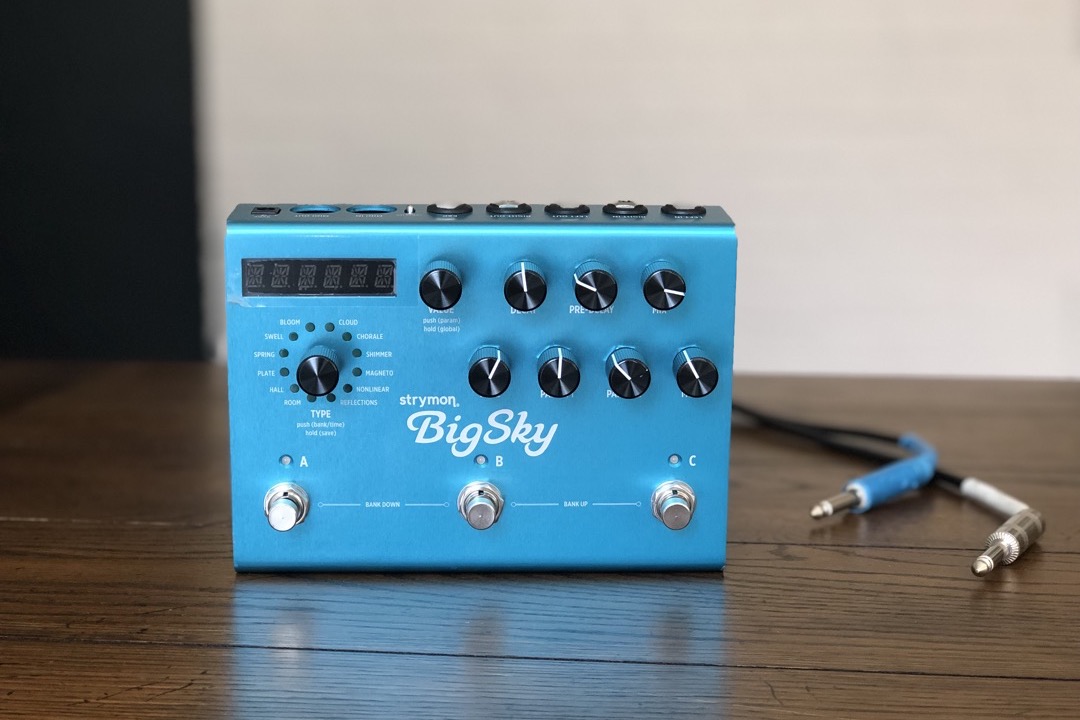
Best Premium: Strymon BigSky
The Strymon BigSky is the reverb you buy when money is no object and you want to stop shopping forever. It packs twelve distinct, studio-class reverb machines — Room, Hall, Plate, Spring, Swell, Bloom, Cloud, Chorale, Shimmer, Magneto, Nonlinear, and Reflections — so a single pedal genuinely replaces an entire pedalboard’s worth of ambience. Whatever reverb sound exists in your imagination, one of these machines gets you there.
It is built for a serious rig from the ground up. Stereo inputs and outputs, full MIDI, and 300 nameable presets let it anchor a complex live or studio setup, while an analog dry path keeps your clean signal from ever being converted to digital. The sound quality is reference-grade — 24-bit/96kHz converters and hand-crafted algorithms produce the kind of lush, three-dimensional reverb you normally only hear in a professional studio — and press-and-hold Infinite and Freeze functions let you build evolving soundscapes most pedals cannot touch.
The caveats are simply the cost of that ambition. At $479 it is a real investment and overkill for a player who mainly wants one good room sound. The large dual-footswitch enclosure eats board space, it needs a dedicated 300mA supply, and unlocking all twelve machines takes real time with the manual. But if you want the last reverb you will ever need to buy, this is it.

Strymon BigSky Multidimensional Reverb Pedal
by Strymon
The aspirational grail reverb -- twelve world-class algorithms, stereo, MIDI, and 300 presets in one pedal that can genuinely replace every other reverb you own.
Pros
- Twelve distinct, studio-class reverb machines -- Room, Hall, Plate, Spring, Swell, Bloom, Cloud, Chorale, Shimmer, Magneto, Nonlinear, and Reflections -- give you a complete reverb collection in one box, replacing an entire pedalboard's worth of ambience
- It is built for a serious rig from the ground up: stereo in and out, full MIDI, 300 nameable presets, an analog dry path that never converts your clean signal to digital, and expression-pedal support for real-time control
- The sound quality is genuinely reference-grade -- 24-bit/96kHz converters and hand-crafted algorithms deliver the kind of lush, three-dimensional reverb you normally only hear in a professional studio, which is why it is the industry-standard flagship
- Press-and-hold Infinite and Freeze functions, plus per-preset spillover, let you build evolving ambient soundscapes that most pedals simply cannot produce
Cons
- At $479 it is a real investment -- overkill for a bedroom player who mainly wants one good room reverb
- The large dual-footswitch enclosure eats significant pedalboard space and needs a dedicated 300mA power supply (it is not daisy-chain safe at a low-current tap)
- The sheer depth means a learning curve -- getting the most from all twelve machines takes real time in the manual
Best Ambient & Shimmer: Walrus Audio Slö
The Walrus Audio Slö is the pedal I point ambient and shoegaze players toward, because it is built for texture rather than just space. Its three algorithms — Dark, Rise, and Dream — are designed specifically for lush, modulated, dreamlike washes. Dark adds a lower octave for deep, cavernous atmosphere; Rise is an auto-swell that gently wakes up under your notes; and Dream is a latching pad you can hold beneath your playing, which turns a guitar into a full soundscape machine.
What makes it special is how much character lives in that reverb trail. Deep modulation with selectable wave shapes — smooth sine, warped, and sinking detune — spreads across the tail for a genuinely three-dimensional wash, and a boutique analog dry path keeps your clean tone intact underneath. A simple four-knob layout plus a clever secondary X control covers a huge range without menu diving, and a deep 500-plus review base confirms the sound lives up to its cult reputation.
The caveats are about focus. There are no presets or MIDI and a single footswitch with no tap tempo, so it is a hands-on pedal, and it uses buffered bypass with trails rather than true bypass. Most of all, its magic is ambient texture — if you mainly want a clean, natural room or plate, a more neutral pedal will serve you better. For dreamy, modulated washes, though, nothing here matches it.

Walrus Audio Slö Multi Texture Reverb
by Walrus Audio
The go-to for lush, modulated ambient and shoegaze tones -- swells, pads, and washy trails that turn a guitar into a soundscape machine.
Pros
- The most inspiring ambient reverb near this price -- three algorithms (Dark, Rise, Dream) built specifically for lush, modulated, dreamlike washes make it a favorite of ambient and shoegaze players who want texture, not just space
- The Rise auto-swell mode and the latching Dream pad let you generate cinematic, evolving soundscapes and hold a pad under your playing, tricks a standard room reverb cannot do
- Deep modulation with selectable wave shapes (sine, warp, sink) spreads across the reverb trail for a genuinely three-dimensional, washy character, and the boutique analog dry path keeps your clean tone intact
- A simple four-knob interface (plus a clever X knob) covers a huge tonal range without menu diving, and a deep 500-plus review base confirms the sound lives up to the hype
Cons
- No presets or MIDI, and a single footswitch with no tap tempo, so it is a hands-on pedal rather than a programmable one
- It uses buffered bypass with trails rather than true bypass, which a few purists will note
- Its magic is ambient texture -- if you mainly want a clean, natural room or plate, a more neutral pedal serves you better
Best Spring: Catalinbread Topanga
If your idea of great reverb is the splashy, drippy sound of a vintage amp tank, the Catalinbread Topanga is the pedal that nails it. Its authentic 6G15-style emulation delivers all the splash, clang, flutter, and drench of a classic outboard tube spring reverb — the unmistakable surf and rockabilly tone — without the fragility and weight of an actual spring tank. Many players prefer its real analog character to any digital spring mode, and the difference is obvious the moment you hear it.
It also improves on the vintage units it emulates. A full-wet Mix option lets you run 100 percent reverb, something old tank units could not do, which is perfect for dramatic surf leads and drenched textures. The onboard discrete preamp doubles as a clean volume boost, and the all-metal chassis with a true-bypass footswitch and trails is genuinely gig-proof and made in the USA. Simple controls — Dwell, Tone, Mix, and Volume — get you there entirely by ear.
The trade-offs are the flip side of its authenticity. It is a specialist: it does spring reverb beautifully and nothing else, so it is not the pick if you also want hall, plate, or ambient sounds. Its review base is smaller than the mainstream picks because it is a boutique pedal, and it costs more than a digital pedal that includes a spring mode among many. For real, hands-on surf and vintage drip, though, it has soul the digital pedals cannot fake.
One practical note as of this update: Amazon is not running a featured offer on the Topanga, so the listing opens without the usual buy box and you have to open the full list of sellers to order one. The stock there comes from specialist music retailers rather than Amazon itself, which is normal for boutique pedals, and there is a used listing sitting below the new ones, so check the condition and the return terms before you commit.

Catalinbread Topanga Spring Reverb Pedal
by Catalinbread
The most credible dedicated spring reverb here -- splashy, authentic 6G15 drip for surf and vintage players, with a full-wet option real tanks never had.
Pros
- It nails the real, drippy vintage spring-tank sound -- an authentic 6G15-style emulation gives you all the splash, clang, flutter, and drench of a classic outboard tube reverb without the fragility of an actual spring tank
- A full-wet Mix option lets you run 100 percent reverb, something vintage units could not do, which makes it perfect for surf leads and dramatic, drenched textures
- The onboard discrete preamp doubles as a clean volume boost, and the all-metal chassis with a true-bypass footswitch (with trails) is genuinely gig-proof and made in the USA
- Simple, musical controls -- Dwell, Tone, Mix, and Volume -- get you an authentic surf and vintage tone by ear, no menus involved
Cons
- It is a specialist -- it does spring reverb beautifully and nothing else, so it is not the pick if you want hall, plate, or ambient sounds too
- A smaller review base (under 100) than the mainstream picks, simply because it is a boutique pedal
- It costs more than a digital pedal that includes a spring mode among many, so you are paying for authenticity
Best Hall & Plate: MXR M300
The MXR M300 is the reverb for players who want pristine, studio-grade hall and plate tones without ever coloring their dry signal. It delivers six meticulously tuned, high-fidelity reverbs — Plate, Spring, Epic, Mod, Room, and Pad — each crafted by MXR’s award-winning design team, and you step through them simply by pushing the Tone knob. The Plate and Room settings in particular are the kind of smooth, detailed space you normally only find in high-end rack units and plug-ins.
Its signature feature is the 100 percent analog dry path with a massive 20 volts of headroom. That means even at high reverb mix, your guitar’s core tone stays completely uncolored — the reason engineers and clean-tone players reach for it over busier pedals. Add rock-solid MXR build in a standard-size box, relay true bypass with selectable trails, stereo in and out, and a 100 percent wet mode for studio and parallel-rig use, and you have a genuinely professional tool that still dials in from three simple knobs.
The caveats are minor. It is pricier than pedals offering more modes, because you are paying for fidelity and that analog dry path rather than sheer quantity, and it is larger and heavier than mini formats. Just be sure to buy the bare M300 rather than a look-alike bundle listing. For clean, high-fidelity hall and plate tones, it is the standout here.

MXR M300 Reverb
by MXR
Best for players who want studio-clean hall and plate tones -- six hi-fi reverbs and an analog dry path that never colors your dry signal.
Pros
- Six meticulously tuned, high-fidelity reverbs (Plate, Spring, Epic, Mod, Room, Pad) cover pristine studio-grade hall and plate tones alongside spring and ambient options, all switchable by pushing the Tone knob
- A 100 percent analog dry path with a massive 20 volts of headroom keeps your guitar's core tone completely uncolored even at high reverb mix -- the reason engineers and clean-tone players love it
- Rock-solid MXR build in a standard-size box, plus relay true bypass and selectable trails, stereo in and out, and a 100 percent wet mode for studio and parallel-rig use
- A simple three-knob operation keeps a genuinely deep pedal easy to dial, and the Epic and Pad modes add ambient and shimmer flavors when you want them
Cons
- Pricier than pedals that offer more modes, because you are paying for fidelity and the analog dry path rather than sheer quantity
- Larger and heavier than mini formats, so it takes real board space
- The base listing is easy to confuse online with bundle variants -- buy the bare M300 pedal
Best Budget Ambient: Walrus Audio Fundamental Ambient
The Walrus Audio Fundamental Ambient is the pedal that proves you do not need to spend big to explore ambient reverb. For under a hundred dollars it brings genuine Walrus character to three atmospheric algorithms — Deep, Lush, and Haze — that deliver pillowy pads and lo-fi textures normally reserved for pedals twice the price. It is the best entry point into ambient sounds for a player who is curious but not ready to commit to a flagship.
Walrus designed the Fundamental series to be friendly enough for a first pedal while still holding tonal integrity on a pro’s board, and it shows. The controls are simple — Decay, Tone, and Mix plus a mode switch — yet the sounds are genuinely lush: Deep adds a dark low octave, Lush stretches into long, breathy pads, and Haze layers in distortion and sample-rate reduction for vintage, experimental textures you almost never find at this price. A Trails mode lets the reverb fade naturally after you switch off, and the true-bypass footswitch sits in a slim, board-friendly enclosure.
The limits are the honest ones for the tier. It has fewer algorithms and parameters than the flagship Slö, no modulation-depth control or presets, and a single footswitch. Walrus also recommends an isolated power supply rather than a daisy chain, which a crowded board may need to plan for. But as a sub-$100 gateway into real ambient reverb, it is the smart-money choice.

Walrus Audio Fundamental Series Ambient Reverb
by Walrus Audio
The best way into ambient reverb without spending big -- boutique Walrus pads and lo-fi textures in a compact, board-friendly box under a hundred dollars.
Pros
- It brings genuine Walrus ambient character to a sub-$100 price -- three atmospheric algorithms (Deep, Lush, Haze) deliver pillowy pads and lo-fi textures that normally cost twice as much, making it the best entry point into ambient reverb
- The controls are simple enough for a first pedal (Decay, Tone, Mix plus a mode switch) but the tones have the tonal integrity to hold their place on a pro's pedalboard
- A Trails mode lets the reverb fade naturally after you switch off, and the true-bypass footswitch and slim, board-friendly enclosure make it easy to fit
- The Haze mode adds distortion and sample-rate reduction for vintage, experimental textures you rarely find at this price, backed by a growing review base approaching a hundred owners
Cons
- Fewer algorithms and parameters than the flagship Slö -- it is a taste of ambient, not the deep end
- No modulation depth control, tap tempo, or presets, and a single footswitch
- Walrus recommends an isolated supply rather than a daisy chain, which some crowded boards will need to plan for
Best Multi-Mode: TC Electronic Hall of Fame 2
When a player wants the most tonal flexibility for the least money, the TC Electronic Hall of Fame 2 is the answer. Ten reverb types — Room, Hall, Plate, Spring, Church, Modulated, Shimmer, Lo-fi, Ambient and more — mean one affordable box covers nearly every reverb sound you will ever reach for, from a subtle room to a huge shimmering wash. For around $130, that is an extraordinary amount of range.
Two features push it past the crowd of budget multi-reverbs. The MASH footswitch is pressure-sensitive: press harder and it morphs a parameter in real time, giving you expression-pedal-style control with no extra hardware on your board. And TC’s TonePrint system lets you beam custom reverb tweaks — many designed by well-known artists — straight to the pedal over USB or your phone, so its tonal library effectively never stops growing. Stereo in and out and selectable true bypass or buffered spillover trails round out a genuinely versatile package.
The caveats are about depth of setup. The very best tones often live in the TonePrint app rather than on the pedal, so there is a small learning curve, and the knobs are small enough to feel fiddly on a dark stage. There is also no onboard preset storage beyond the single loaded TonePrint. But for one pedal that does almost everything and keeps evolving, the value is hard to beat.
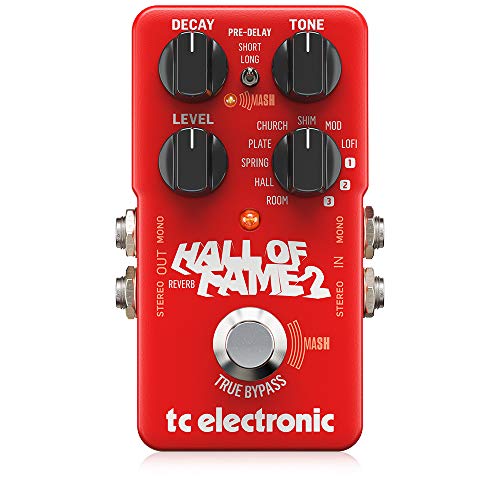
TC Electronic Hall of Fame 2 Reverb Pedal
by TC Electronic
The best one-pedal-many-tones value -- ten reverb types, the pressure-sensitive MASH switch, and an endless TonePrint library for players who love to customize.
Pros
- The most flexible pedal near this price -- ten reverb types (Room, Hall, Plate, Spring, Church, Modulated, Shimmer, Lo-fi, Ambient and more) mean one affordable box covers nearly every reverb sound you will ever reach for
- The MASH footswitch is genuinely clever: it is pressure-sensitive, so pressing harder morphs a parameter in real time, giving you expression-pedal-style control with no extra hardware
- TonePrint lets you load custom reverb tweaks made by well-known artists straight to the pedal over USB or your phone, so its tonal library effectively never stops growing
- Stereo in and out, selectable true bypass or buffered spillover trails, and a strong 500-plus review base make it a proven, do-it-all value pick
Cons
- The best tones often live in the TonePrint app rather than on the pedal, so there is a small setup and learning curve
- The knobs are small and can feel fiddly for fine adjustments on a dark stage
- No onboard preset storage beyond the single loaded TonePrint slot
Best for Worship & Swells: Strymon blueSky V2
The Strymon blueSky V2 is purpose-built for the huge, singing ambient swells that define worship, post-rock, and cinematic playing. Its world-class Spring, Plate, and Room machines plus a variable Shimmer engine make walls of sound its native language — the kind of pad-like, endlessly hanging reverb that a worship guitarist or ambient player builds an entire sound around. It is the pedal I recommend when long, evolving swells are the whole point.
What makes it special is that it delivers Strymon’s premium studio quality without the BigSky’s menu diving. You get gorgeous, three-dimensional reverb straight from front-panel knobs, and a discrete Class-A JFET preamp gives it real touch sensitivity so the reverb responds to how hard you play. Trails mode lets chords ring out naturally after you click the pedal off — exactly what long ambient passages need — and V2 adds serious rig integration with full MIDI, 300 presets, a dedicated Favorite footswitch, stereo I/O, and a USB-C port.
The caveats are about scope and price. Its review base is smaller than the mainstream picks because it is a newer premium pedal, and it offers three core voices plus shimmer rather than the BigSky’s twelve, so it is focused rather than encyclopedic. It is also a premium price for a pedal centered specifically on ambient and shimmer tones. But for players who live in swells, it is close to perfect out of the box.

Strymon blueSky V2 Reverb Pedal
by Strymon
The purpose-built choice for long ambient swells -- worship, post-rock, and cinematic players who live in shimmer and pad-like reverb will feel at home instantly.
Pros
- Purpose-built for the huge, singing ambient swells beloved in worship, post-rock, and cinematic playing -- world-class Spring, Plate, and Room machines plus a variable Shimmer engine make walls of sound its native language
- It delivers Strymon's premium studio quality without the BigSky's menu diving, so you get gorgeous, three-dimensional reverb from straightforward front-panel knobs
- A discrete Class-A JFET preamp gives it real touch sensitivity, and trails mode lets chords ring out naturally after you click off -- exactly what long ambient passages need
- V2 adds serious rig integration: full MIDI, 300 presets, a Favorite footswitch, stereo in and out, and a USB-C port, plus a near-perfect owner satisfaction rating
Cons
- A smaller review base (in the low sixties) than the mainstream picks, since it is a newer premium pedal
- Only three core voices plus shimmer versus the BigSky's twelve, so it is focused rather than encyclopedic
- It is a premium price for a pedal centered on ambient and shimmer tones specifically
Best Budget Reverb Pedal
If your ceiling is around a hundred and thirty dollars, three pedals here deliver real quality without the throwaway feel of the cheapest no-name gear. The Donner Verb Square is the cheapest pedal here worth owning and the most compact for a tight board, with seven modes to explore; the Walrus Fundamental Ambient adds lush ambient pads for well under a hundred dollars; and the TC Hall of Fame 2 packs ten reverb types and the MASH footswitch for the most range per dollar.
| Product | Price | Buy |
|---|---|---|
| Donner Verb Square Reverb PedalBest cheapest pick Seven modes and true bypass in a compact alloy box, the cheapest pick here | $41.99 | View on Amazon |
| Walrus Audio Fundamental Series Ambient ReverbBest budget ambient Lush Walrus pads and lo-fi textures for a small board under $100 | $99.99 | View on Amazon |
| TC Electronic Hall of Fame 2 Reverb PedalBest budget multi-mode Ten reverb types plus the pressure-sensitive MASH switch for the most flexibility per dollar | $129.00 | View on Amazon |
Best Spring Reverb Pedal
For the splashy, drippy vintage spring sound — surf, rockabilly, and classic clean tones — you want a pedal that gets the dynamic, percussive spring character right. The Catalinbread Topanga is the dedicated specialist that nails an authentic 6G15 tank; the MXR M300 gives you a genuinely convincing spring among six studio-grade reverbs; and the Donner Verb Square is the budget way in with a dedicated spring mode.
| Product | Price | Buy |
|---|---|---|
| Catalinbread Topanga Spring Reverb PedalBest dedicated spring Authentic 6G15-style tank with a full-wet option real springs never had | $201.22 | View on Amazon |
| MXR M300 ReverbBest spring in a multi A convincing spring plus five other hi-fi reverbs and an analog dry path | $235.99 | View on Amazon |
| Donner Verb Square Reverb PedalBest budget spring A dedicated spring mode among seven, the cheapest way into the sound | $41.99 | View on Amazon |
Best Ambient & Shimmer Reverb Pedal
For lush washes, shimmer, and long evolving pads — the ambient, shoegaze, and worship sound — you want modulation, long trails, and pitch-shifted shimmer. The Walrus Slö leads with modulated, dreamlike textures; the Strymon blueSky V2 is the premium shimmer-and-swell machine; and the Walrus Fundamental Ambient delivers pillowy pads on a budget.
| Product | Price | Buy |
|---|---|---|
| Walrus Audio Slö Multi Texture ReverbBest modulated ambient Dark, Rise, and Dream modes with deep modulation for washy soundscapes | $186.99 | View on Amazon |
| Strymon blueSky V2 Reverb PedalBest shimmer swells World-class shimmer and pad tones built for worship and post-rock swells | $379.00 | View on Amazon |
| Walrus Audio Fundamental Series Ambient ReverbBest budget ambient Lush Deep/Lush/Haze pads for ambient exploration under $100 | $99.99 | View on Amazon |
Best Reverb Pedal by Use Case
A few more directions worth calling out. Each of these pedals is reviewed in full above — here is the quick map for a handful of specific players, from the studio engineer running a stereo rig to the worship guitarist chasing swells.
| Product | Price | Buy |
|---|---|---|
| Strymon BigSky Multidimensional Reverb PedalBest for studio & stereo Twelve machines with stereo I/O, MIDI, and 300 presets for a pro studio rig | $479.00 | View on Amazon |
| Strymon blueSky V2 Reverb PedalBest for worship swells Long shimmer swells and trails purpose-built for worship and post-rock | $379.00 | View on Amazon |
| MXR M300 ReverbBest for hall & plate Six hi-fi reverbs with an analog dry path that keeps your tone pristine | $235.99 | View on Amazon |
| TC Electronic Hall of Fame 2 Reverb PedalBest for gigging versatility Ten types plus MASH and TonePrint for one pedal that covers every gig | $129.00 | View on Amazon |
| BOSS RV-6 Reverb Guitar PedalBest all-rounder Eight strong modes and bulletproof build for the player who wants one reverb | $145.20 | View on Amazon |
Buyer's Guide
The best reverb pedal is the one that matches the sounds in your head, the size of your board, and your budget -- in that order. Reverb shapes how big and professional your guitar sounds, so it is worth choosing deliberately. Here is what actually matters when you compare pedals.
Reverb types and algorithm variety
Decide whether you want one great sound or many. A dedicated pedal like the Catalinbread Topanga nails authentic spring and nothing else; a multi-mode pedal like the TC Hall of Fame 2 or Strymon BigSky gives you spring, plate, hall, shimmer, and ambient in one box. More players are served by variety, but specialists reward focus.
True bypass vs. buffered bypass (and trails)
True bypass removes the pedal from your signal when off and suits short, simple chains. Buffered bypass helps drive long cable runs and big boards. Just as important is trails -- whether the reverb tail decays naturally when you switch off, which every ambient player wants.
Mono vs. stereo output
If you play through one amp, mono is all you need and a stereo pedal still works fine. If you run two amps or go direct to an interface, a stereo reverb like the BigSky, blueSky V2, or MXR M300 creates a wide, immersive image worth the extra outputs.
Controls and tweakability
Look for the parameters you will actually use: Decay sets tail length, Mix blends wet and dry, Tone shapes brightness, and Pre-delay separates the reverb from your dry note. Simpler pedals get you playing faster; deeper pedals like the BigSky trade simplicity for total control and presets.
Build quality and pedalboard fit
A reverb lives on your board for years, so a rugged metal chassis, a reliable footswitch, and top-mounted jacks all matter. Footprint counts too -- the BigSky is large and the Verb Square is compact, so measure your board before you buy.
Power draw and pedalboard planning
Most reverbs run on standard 9V center-negative power, but current draw varies -- the Strymon BigSky needs a dedicated 300mA supply and is not daisy-chain safe at a low-current tap. Check the milliamp rating against your power supply before adding any digital reverb to a crowded board.
How to Choose the Best Reverb Pedal for You
The right reverb pedal is the one that matches the sound in your head, the size of your board, and your budget — in that order. Start with the sound, because it rules out whole categories: if you chase authentic surf drip, a dedicated spring pedal like the Catalinbread Topanga is worth more to you than a dozen digital algorithms, while an ambient or worship player needs the shimmer and swells of a Walrus Slö or Strymon blueSky. If you are not sure yet, a versatile multi-mode pedal like the BOSS RV-6 or TC Hall of Fame 2 lets you explore every reverb type and discover your own taste.
Then think about your board and rig. Reverb almost always goes at the very end of your signal chain — after drive, modulation, and delay — so it adds space to your finished tone; in an amp with an effects loop, it usually belongs in the loop. Check the footprint and the power draw before you buy, because a large pedal like the BigSky needs real space and a dedicated 300mA supply, while a compact pedal like the Verb Square slips onto any board. If you run two amps or record direct, prioritize a stereo pedal; if you play one amp in mono, do not pay extra for stereo you will not use.
Only then does budget come in, and the good news is that this is a golden era for reverb — the $50-to-150 range from BOSS and TC Electronic is so good that most players never need to spend more. Finally, match the pedal to the rest of your setup: pair it with the right amp (start with our best guitar amps guide) and the right guitar. If you are still choosing the instrument itself, our guide to the best electric guitars is the natural next read, and beginners should start with the best beginner electric guitars.
The Bottom Line
If you want one reverb pedal that does nearly everything, the BOSS RV-6 is the clearest best overall pick — versatile, great-sounding, and built to last. On a budget, the Donner Verb Square is the smartest first reverb for under fifty dollars, and when money is no object the Strymon BigSky is the flagship that replaces every other reverb you own. From there it comes down to the sound you are chasing: the Walrus Audio Slö for lush modulated ambient, the Catalinbread Topanga for authentic spring drip, the MXR M300 for pristine hall and plate, the Walrus Fundamental Ambient for budget ambient pads, the TC Hall of Fame 2 for maximum flexibility per dollar, and the Strymon blueSky V2 for worship and post-rock swells. Match the reverb to your sound, your board, and your budget, and pair it with the right amp — start with our best guitar amps guide — and you will have a rig that sounds three times its size.
Frequently Asked Questions
What does a reverb pedal actually do?
Spring vs. plate vs. hall vs. shimmer reverb -- what is the difference?
Do I need a reverb pedal if my amp already has spring reverb built in?
True bypass vs. buffered bypass -- does it matter for reverb pedals?
Where should a reverb pedal go in my signal chain?
Are digital reverb pedals as good as an authentic analog spring tank?
What is the best reverb pedal on a tight budget?
Do I need a stereo reverb pedal?
Related Articles
10 Best Distortion Pedals of 2026 (Metal, Rock, Blues & Budget)
amps-effects
10 Best Multi-Effects Pedals of 2026 (Budget, Compact, Acoustic & Live)
amps-effects
9 Best Looper Pedals of 2026 (Budget, Beginner, Bass, Drums & Live)
amps-effects
9 Best Guitar Amps of 2026 (Every Budget, Practice to Gigging)
amps-effects
11 Best Guitar Pedals of 2026 (One Pick for Every Effect)
amps-effects
About the Reviewer

Julian Reyes, MM, Berklee
M.M. Performance, Berklee College of Music
Julian Reyes is a multi-instrumentalist with a Master of Music from Berklee College of Music and over a decade gigging on guitar, bass, and keys. Before founding House of Octave, he spent years as a gear buyer for an independent music retailer, evaluating hundreds of instruments and audio products for the sales floor. He started House of Octave in 2026 to give players honest, hands-on reviews — judged by how gear actually sounds and holds up on stage and in the studio, not by spec sheets or sponsorships.