8 Best Bass Guitars for Beginners of 2026
Berklee-trained multi-instrumentalist Julian Reyes (MM) reviews the 8 best bass guitars for beginners of 2026 — matched by scale length, starter-kit value, acoustic vs electric, and 4- vs 5-string for new players.
Updated
I have spent twenty years with an instrument in my hands — as a student at Berklee, as a multi-instrumentalist on stage and in the studio, as a gear buyer who evaluated hundreds of instruments, and as a teacher who has handed a first bass to more beginners than I can count. And the thing that surprised me most when I started teaching is how much the right first bass matters — not for the tone, but for whether a new player keeps playing at all. The wrong first bass — too big for their hands, badly set up, or silent because nobody told them they needed an amp — quietly convinces a beginner they have no talent, when the instrument was fighting them the whole time.
So this roundup is not about which beginner bass sounds the most like a record. It is about which one gets you, specifically, playing and keeping you playing. The best bass guitar for beginners is the one that fits your hands, matches the music you actually want to make, and arrives playable enough that you blame your fingers, not your gear, when a note buzzes. I evaluated eight instruments across scale length, string count, pickup type, build quality, and what comes in the box, and matched each to a specific kind of new player. Whether you want a do-everything Precision Bass, a short-scale bass for smaller hands, a complete kit with an amp, an acoustic bass you can play unplugged, or a 5-string you will grow into, one of these eight is right for you. As you read, it is worth browsing our full guitars category for how bass fits alongside our guitar coverage, and bookmarking our free tools for the tuning and timing references you will lean on from day one.
| Product | Price | Buy |
|---|---|---|
| Fender Squier Debut Series Precision Bass GuitarBest Overall | $169.99 | View on Amazon |
| Donner Electric Bass Guitar 4-String Full-Size PB-StyleRunner-Up | $169.99 | View on Amazon |
| Ibanez Gio GSR200 Electric Bass GuitarPremium Pick | $209.99 | View on Amazon |
| Ibanez GSRM20 Mikro Short-Scale Electric BassRunner-Up | $186.99 | View on Amazon |
| Glarry Full-Size 4-String Electric Bass Guitar KitBudget Pick | $92.99 | View on Amazon |
| Best Choice Products Acoustic-Electric Bass GuitarRunner-Up | $119.99 | View on Amazon |
| Stedman Pro Beginner Series Bass Guitar Bundle with 15-Watt AmpRunner-Up | $149.95 | View on Amazon |
| Yamaha TRBX305 5-String Electric Bass GuitarRunner-Up | $469.99 | View on Amazon |
Find the Best Bass Guitar for Your Need
Jump straight to the bass that fits how you’ll play:
- Best bass guitars for beginners overall
- Best bass guitar and amp for beginners (starter kits)
- Best short-scale bass for beginners
- Best acoustic bass for beginners
- Best cheap and affordable bass for beginners
- Best 5-string bass for beginners
How We Tested and Evaluated These Basses
Every bass in this roundup was selected on a verified, active Amazon listing, real owner-review volume, a genuine name-brand pedigree or a proven large-scale budget track record, and a clear fit for a specific kind of beginner. I drew on twenty years of playing and two decades of teaching to judge what actually matters for a first bass: neck comfort, fret access, scale length, tuning stability, out-of-box playability, and how forgiving the instrument is while a beginner’s hands are still developing. I cross-referenced thousands of owner reviews focusing on the recurring beginner pain points — action that is too high, tuners that will not hold, and the surprise of realizing a bass needs an amp to be heard — and I weighted scale length, string count, and pickup type against the music each bass is built to serve. Basses from unverified sellers or with thin, suspicious review histories were left out. The eight here represent the best first bass for every budget, body size, and musical direction.
Best Bass Guitars for Beginners Overall
These are the picks I hand a new player first, ranked by how well they fit the widest range of beginners. Every bass below is reviewed once, in full; the use-case sections further down reference these same instruments so you can compare them by exactly how you plan to play.
Best Overall: Fender Squier Debut Series Precision Bass
When a student asks me what bass to buy and gives me nothing else to go on, this is the one I name. The Squier Debut Precision Bass is the best beginner bass for most people because it gets the fundamentals right without asking you to gamble. It is a genuine Squier, which is Fender’s own beginner brand, built to Fender’s quality-control specifications — so the neck profile, the fret ends, and the hardware are consistent from unit to unit rather than the lottery you get from anonymous brands. On a first instrument bought sight-unseen, that consistency is worth more than any single spec.
The Precision Bass design itself is the reason this pick is so easy to make. The P-Bass is the most-recorded bass in history, and its single split-coil pickup produces the thick, punchy, fundamental low end you have heard on countless rock, pop, soul, and Motown records. A beginner learning on this instrument is learning on the exact sound that defines the electric bass, not a thin imitation of it. The full 34-inch scale and comfortable neck give you room to build proper left-hand technique — finger spacing and fretting that transfer directly to any bass you touch later, from a rehearsal-room loaner to a gig rig. If you are still deciding between bass and six-string, our guide to the best beginner electric guitars is worth a look, but if the low end is calling you, start here.
My one piece of advice, which applies to every bass on this list: remember that a solid-body bass is silent without an amp, so budget for a small practice amp and a cable, and put about forty dollars toward a professional setup. A good setup lowers the action and dials in the intonation, and it transforms how a starter bass feels to play — a well-set-up Squier Debut plays better than a poorly-set-up bass costing three times as much. Pair this bass with an amp and a setup, and a beginner has genuinely everything they need to learn.

Fender Squier Debut Series Precision Bass Guitar
by Fender / Squier
The best beginner bass for most people -- genuine Squier (Fender) build quality, the most-recorded P-Bass design that teaches you the instrument's defining tone, a comfortable full-scale neck, and a real 2-year warranty through Amazon.
Pros
- Genuine Fender-family build quality backed by a 2-year warranty -- Squier is Fender's own beginner brand, built to Fender's quality-control specs, so the neck profile, fret ends, and hardware are consistent from unit to unit with real Fender warranty service
- The Precision Bass is the most-recorded bass design in history -- its single split-coil pickup produces the thick, punchy, fundamental low end on countless rock, pop, soul, and Motown records, so you learn the exact sound that defines the instrument
- The full 34-inch scale and slim, comfortable neck let a new player develop proper left-hand technique that transfers directly to any bass you pick up later
- Sold and shipped through Amazon, so returns and warranty claims are straightforward -- real protection on a first instrument bought sight-unseen
Cons
- Guitar only -- no amp, cable, or tuner in the box, so budget separately for a practice amp and a cable before you can make a sound
- Action arrives slightly high on some units -- a $40 setup lowers the string height and makes fretting dramatically easier, but it is an extra step out of the box
Best Accessories at the Price: Donner 4-String Full-Size PB-Style Bass
The Donner PB-style bass lists at the same price as the guitar-only Squier Debut and arrives with the accessories included, which makes it the value play for a beginner who does not want to place a second order for the basics. Worth knowing before you compare tags: Donner runs a Prime-exclusive price on this listing that sits a little below the regular one, so what you pay depends on whether you have Prime. What gives me confidence recommending it is the review base: 1,305 ratings at 4.5 stars is a large real-world sample, and on an affordable instrument that volume matters more than it would on a premium one. It tells you the quality control is consistent across many units, not just a few lucky reviewers. A cheap bass with a handful of glowing reviews is a gamble; a cheap bass with over a thousand consistent ones is a known quantity.
Tonally, the Donner earns its keep with a PB-style split-coil pickup that delivers the same fundamental Precision Bass voice you would pay far more for elsewhere — the thick, punchy low end that suits rock, pop, funk, and worship music. For a beginner still figuring out their direction, that classic do-everything tone is exactly right. The kit includes a gig bag, strap, and cable, which are precisely the accessories a first-time bassist forgets to order, so you avoid the frustration of placing three separate orders before you can play. Set against a guitar-only listing at the same price, those extras come along at no added cost, and that combination is the reason to choose it.
Be clear-eyed about the trade-offs: tuning stability varies from unit to unit, the bundled accessories are basic, and there is no tuner in the box despite what some listings for this bass imply. All are easily handled — a forty-dollar setup dials in the tuning, a clip-on tuner costs very little, and you can replace the cable and strap as you go. If you want to spend genuinely less, look at the Glarry kit below instead.

Donner Electric Bass Guitar 4-String Full-Size PB-Style
by Donner
The pick if you want the accessories included -- a heavily-reviewed PB-style bass with the fundamental P-Bass tone that ships with a gig bag, strap, and cable for what the guitar-only Squier costs on its own.
Pros
- One of the largest review bases of any beginner bass on Amazon -- 1,305 ratings at 4.5 stars tells you the quality control is consistent across many units, which matters most on an affordable instrument
- PB-style split-coil pickup delivers the same fundamental P-Bass voice as guitars costing far more -- the thick, punchy tone that suits rock, pop, funk, and worship music
- It ships as a kit rather than a bare instrument -- the gig bag, strap, and cable are the accessories a first-time bassist forgets to order, so the same outlay as a guitar-only name-brand listing also covers the parts you would otherwise order separately
- Lightweight full-size body with a comfortable neck -- a bass you can hold through a long practice session is a bass you will actually pick up
Cons
- Tuning stability varies unit to unit -- some hold pitch well, others need the tuners and nut slots dialed in, which a $40 setup resolves and which is normal at this price
- The included accessories are basic -- the bundled cable and strap get you started but are not built to last, so plan to replace them as you go
Upgrade Pick: Ibanez Gio GSR200
For the beginner who already knows they are committed, the Ibanez Gio GSR200 is the bass I tell them to buy once and grow into rather than out of. The headline is its versatility: the dual P/J pickups pair a split-coil in the neck position with a single-coil at the bridge, so you can dial the fat, fundamental P-Bass thump for rock and pop or blend in the brighter, growlier bridge pickup for funk, fusion, and modern styles. One bass covers far more musical ground than a single-pickup design, which matters for a new player still discovering what they want to sound like.
What makes the GSR200 a true buy-once instrument is that the quality goes beyond beginner-grade. The active EQ — Ibanez’s Phat II bass boost — lets you shape your tone at the bass itself rather than relying entirely on the amp, which is rare at this price and genuinely educational for a new player learning how tone works. The slim, fast GSR neck is one of the most beginner-friendly necks in the roundup, with a thinner profile that suits smaller hands and makes fretting less of a stretch. Working players gig these instruments, so a motivated beginner who starts here skips the entire upgrade cycle and learns on a bass they will keep for years.
Two honest caveats. First, this is a guitar-only purchase — no amp, cable, or accessories in the box, so budget separately for a practice amp and the basics. If you are assembling a full rig, our amps and effects category is where I would point you to choose an amp deliberately. Second, the active EQ runs on a 9-volt battery, so keep a spare — a dead battery cuts your signal, which surprises every new player the first time. Handle those, and you have a bass you will still be playing in ten years.

Ibanez Gio GSR200 Electric Bass Guitar
by Ibanez
The upgrade pick for the committed beginner -- dual P/J pickups and an active EQ make it the most versatile bass here, on a fast, beginner-friendly neck and a build good enough to gig, so you skip the upgrade cycle and keep it for years.
Pros
- Dual P/J pickups (a split-coil neck plus a single-coil bridge) make this the most tonally versatile bass here -- dial the fat P-Bass thump for rock and pop or blend the growlier bridge pickup for funk and modern styles
- The active EQ (a Phat II bass boost) lets a beginner shape their tone at the bass instead of relying on the amp -- rare, hands-on control at this price
- Ibanez's slim, fast GSR neck is genuinely beginner-friendly -- the thinner profile suits smaller hands and makes fretting less of a stretch
- A true buy-once beginner bass -- the build, hardware, and electronics are good enough that working players gig these, so you skip the upgrade cycle and keep it for years
Cons
- Guitar only -- no amp, cable, or accessories in the box, so budget separately for a practice amp and the basics
- The active EQ needs a 9-volt battery -- keep a spare, because a dead battery will cut your signal
Best Short-Scale: Ibanez GSRM20 Mikro
The Ibanez Mikro is the bass I reach for when a student is a younger player, has smaller hands, or is a guitarist making the jump to bass. Its 28.6-inch short scale is the shortest full-featured scale in this roundup, and that number matters more than beginners realize: the frets sit closer together and the string tension is lower, so forming chords, running scales, and reaching the low frets is dramatically less of a stretch than on a standard 34-inch bass. For a smaller frame, that is the difference between a bass that fits and one that fights you.
Crucially, the Mikro is a real, gig-worthy Ibanez, not a scaled-down toy. It has dual P/J pickups, a proper output jack, and genuine Ibanez hardware, so a small player develops real technique on a real instrument rather than outgrowing a novelty in a month. It is also one of the best-reviewed instruments here — 4.6 stars across roughly 2,000 ratings — which is strong real-world validation on a first instrument. The lighter, smaller body is genuinely comfortable for a child or a petite adult to hold, and comfort is what keeps a new player practicing longer before fatigue sets in.
The only real trade-off is that a shorter scale produces slightly less low-end depth than a full-size bass. It is a fair exchange for the playability, and the vast majority of beginners will never notice — and if you eventually want the deepest possible tone, you will know you are ready for a 34-inch instrument. For most smaller players, the Mikro is simply the bass that gets them playing.

Ibanez GSRM20 Mikro Short-Scale Electric Bass
by Ibanez
The best short-scale bass for younger players, smaller hands, and guitar-to-bass switchers -- a real gig-worthy Ibanez with dual P/J pickups on a 28.6-inch scale, and one of the best-reviewed instruments in this roundup.
Pros
- The 28.6-inch short scale is the shortest full-featured bass scale here -- the best choice for younger players, smaller hands, and guitarists switching to bass, because closer frets and lower tension make chords, scales, and low-fret reaches far less of a stretch
- A real, gig-worthy Ibanez, not a scaled-down toy -- dual P/J pickups, a proper output jack, and genuine Ibanez hardware mean a small player develops real technique on a real instrument
- A 4.6-star average across roughly 2,000 ratings -- strong real-world validation on a first instrument bought sight-unseen
- The lighter, smaller body is genuinely comfortable for a child or petite adult to hold, and comfort is what keeps a new player practicing longer before fatigue sets in
Cons
- The short scale slightly reduces low-end depth compared to a 34-inch bass -- a fair trade for the playability, and most beginners will never notice
- Guitar only -- add a practice amp, a cable, and a tuner, so factor those into your total budget
Budget Pick: Glarry Full-Size 4-String Bass Kit
The Glarry full-size kit is the cheapest way I know to get a curious beginner onto a real bass. It carries the lowest price of any full-size electric in this roundup and still ships as a complete kit — bag, strap, cable, and a pick included — which makes it the ideal low-risk entry point for someone testing whether bass is for them, or for a parent gauging a child’s interest without a big commitment. And unlike a genuinely disposable no-name bass, the Glarry has an unusually large review base for its price: 1,485 ratings at 4.6 stars tells you the quality control is far more consistent than the number on the tag suggests. At roughly half the price of every name-brand bass here, it is the budget pick in this roundup, and the cheapest bass of any kind on this list.
The important thing is that this is a full 34-inch scale, so a beginner learns proper finger spacing and technique that transfers directly to any standard bass they buy later. Nothing you learn on it has to be re-learned. The finishes also look far more expensive than the price, and I never dismiss aesthetics for a beginner — a new player who thinks their bass looks cool reaches for it more often, and reaching for it is the whole game in the first few months.
Be realistic about what a sub-hundred-dollar bass is: it benefits from a setup more than any other instrument here, because the frets and nut are built to a low price point. A forty-dollar setup does more for this bass than for any other in the roundup, and the included cable and hardware are the first things you will upgrade as you get serious. As a no-risk first bass, though, it is hard to beat, and it is the one I point budget-first beginners to.

Glarry Full-Size 4-String Electric Bass Guitar Kit
by Glarry
The cheapest way onto a real full-size bass -- a complete kit with bag, strap, cable, and a pick, backed by an unusually large review base for the price, ideal for a curious beginner or a parent testing a child's interest.
Pros
- The lowest price of any full-size electric bass here, and it still ships as a complete kit -- bag, strap, cable, and pick mean the absolute-cheapest entry point for a curious beginner or a parent testing a kid's interest
- A surprising 1,485 ratings at 4.6 stars for a sub-hundred-dollar bass -- that volume tells you the quality control is far more consistent than the price suggests
- The full 34-inch scale means a beginner learns proper technique that transfers to any standard bass -- a real full-scale instrument, not a toy
- The finishes look far more expensive than the price -- a beginner who thinks their bass looks cool reaches for it more often, which matters for motivation early on
Cons
- A budget instrument that genuinely benefits from a setup -- the frets and nut are built to a low price point, so a $40 setup does more here than on any other bass in the roundup
- The included cable and hardware are basic and worth upgrading over time -- they get you playing, but are the first things you will replace
Best Acoustic Bass: Best Choice Products Acoustic-Electric
If you want to be able to practice with no amp at all, the Best Choice Products acoustic-electric is the bass to look at, and it is the only instrument in this roundup you can genuinely play unplugged. The hollow body produces enough acoustic volume for solo practice on the couch or around a campfire, while the built-in pickup and EQ let you plug into an amp or PA when you need more volume. That flexibility is the whole appeal of an acoustic-electric bass, and it removes the “I need an amp before I can hear anything” barrier that stalls so many new bassists.
It also has the largest review base of any bass in this roundup — roughly 5,700 ratings — which is especially reassuring on a hollow-body, where build consistency matters even more because there is more that can go wrong than on a solid body. It sits in the lower half of this roundup on price and includes a padded gig bag, which is a genuinely low bar of entry for an acoustic-electric; the format usually costs considerably more than a comparable solid-body electric. And because it is a full 34-inch scale, the technique you build transfers directly to a solid-body electric bass later; an acoustic-electric is a legitimate first bass, not a dead-end.
The honest caveats are volume and value. An acoustic bass guitar is naturally much quieter than an acoustic six-string, so it is great for solo practice but gets buried the moment a guitar or drums join in — you will still want an amp to play with others. This bass has also climbed steeply in price recently, so it no longer undercuts the solid-body kits the way it once did: if playing unplugged is not specifically what you want, the Glarry kit below costs meaningfully less. And as a budget hollow-body, it benefits from a setup and a fresh set of strings to sound its best. For unplugged practice, though, nothing else here matches it. If you are weighing acoustic feel more broadly, our best beginner acoustic guitars guide covers the six-string side of that decision.

Best Choice Products Acoustic-Electric Bass Guitar
by Best Choice Products
The pick for a beginner who wants to play unplugged -- a genuine acoustic-electric with a hollow body you can practice on with no amp, the largest review base in the roundup, and a padded gig bag included.
Pros
- A genuine acoustic-electric bass -- the hollow body produces enough acoustic volume to practice unplugged, while the built-in pickup and EQ let you plug into an amp or PA, so it is the only bass here you can play with no amp at all
- By far the largest review base in the roundup at roughly 5,700 ratings -- reassuring on an acoustic-electric, where build consistency matters even more because a hollow body has more that can go wrong
- It ships with a padded gig bag that carries like a backpack, and it sits in the lower half of this roundup on price -- a low-risk way to try the acoustic-bass format, which normally costs far more than a comparable solid-body electric
- The full 34-inch scale means the technique you build transfers directly to a solid-body electric bass later -- a legitimate first bass, not a dead-end format
Cons
- Unplugged acoustic volume is modest -- an acoustic bass is naturally much quieter than an acoustic six-string, so it works for solo practice but gets buried the moment a guitar or drums join in
- As a budget hollow-body, it benefits from a setup and fresh strings to sound its best -- the usual weak points at this price
Complete Kit with Amp: Stedman Pro Bass Bundle
The Stedman Pro bundle solves the single biggest surprise new bassists run into: a solid-body bass is silent without an amp. This is the only kit in the roundup that includes a real 15-watt amp, which makes it the true day-one complete package — the difference between unboxing and playing versus unboxing and waiting on a second order to arrive before you can make a sound. For a total beginner who wants zero friction, that matters enormously.
The 15-watt amp is also a meaningful step up from the tiny 5-watt amps that come with most cheap bundles. It offers more clean headroom and usable low-end volume, which is important because a bass needs more amp power than a guitar to reproduce the low frequencies you are actually there to play. On top of the amp, the bundle includes a gig bag, strap, cable, and picks, so there is genuinely nothing else to buy before your first practice session. The bass itself is a full-scale P/J-style instrument, so it teaches proper technique and covers a wide tonal range while you figure out the music you want to make.
Two things to keep in mind: the bundled amp is right for bedroom practice but not for playing with a band — 15 watts is plenty to learn on, but you will want a bigger amp once you start rehearsing with a drummer. And Stedman Pro is a bundle brand rather than a legacy instrument maker, so judge this as an excellent get-started kit rather than a buy-once heirloom. As the fastest path from box to playing, it is exactly what many beginners need.
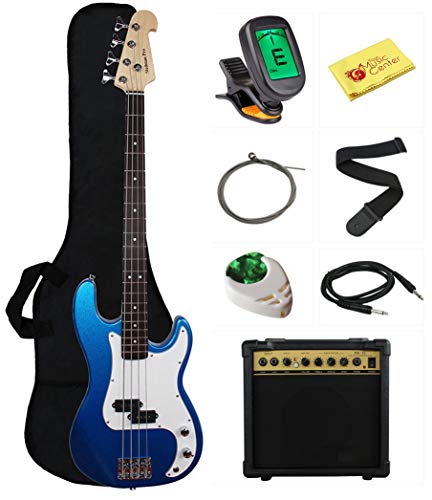
Stedman Pro Beginner Series Bass Guitar Bundle with 15-Watt Amp
by Stedman Pro
The true day-one kit -- the only bundle here with a real 15-watt amp, plus a gig bag, strap, cable, and picks, so a complete beginner can unbox, plug in, and play immediately with nothing else to buy.
Pros
- The only bass in the roundup that includes a real 15-watt amp -- a bass is silent without an amp, so the bundle is the difference between unboxing and playing versus unboxing and waiting on a second order
- The 15-watt amp meaningfully outperforms the tiny 5-watt amps in most cheap bundles -- more clean headroom and usable low-end volume, which a bass needs to reproduce its low frequencies
- A complete accessory package -- gig bag, strap, cable, and picks mean there is genuinely nothing else to buy before your first practice session
- A full-scale P/J-style bass, so the instrument teaches proper technique and covers a wide tonal range for a beginner still figuring out their music
Cons
- The bundled amp is right for bedroom practice but not for a band -- 15 watts is plenty to learn on, but you will outgrow it if you start rehearsing with a drummer
- Stedman Pro is a bundle brand rather than a legacy instrument maker -- judge it as a get-started kit rather than a buy-once heirloom bass
Best 5-String: Yamaha TRBX305
Most beginners should start on a 4-string, but if you already know you want the low B string — for modern worship, metal, gospel, or R&B — the Yamaha TRBX305 is the 5-string I steer new players toward. It is the go-to affordable 5-string for beginners precisely because it is a genuinely good instrument rather than a cheap copy: the fifth string extends your range down five more semitones, and Yamaha’s build quality means you are learning that extended range on a bass that plays and stays in tune.
Yamaha’s manufacturing consistency is legendary, and it matters even more on a 5-string, where the neck is wider and there is more that can feel wrong on a poorly-made instrument. The neck, frets, and electronics arrive playable and reliable with very little unit-to-unit variation, which removes the “did I get a bad one” anxiety that haunts cheaper basses. The dual humbucking pickups and active/passive 5-band EQ give a beginner enormous tonal flexibility, and the ability to switch to passive mode means a dead battery never leaves you silent mid-practice. This is a genuinely gig-worthy instrument that working players use, so a committed beginner buys once and keeps it.
The honest caveats are price and neck width. It is the most expensive bass in this roundup, which is justified for a player who specifically wants a 5-string but is overkill for a beginner happy on four strings. And the wider neck is a bigger reach with an extra string to mute, so for a brand-new player with no direction yet, a 4-string remains the easier and more traditional starting point. Choose the TRBX305 when you know the low B is part of your plan.

Yamaha TRBX305 5-String Electric Bass Guitar
by Yamaha
The best 5-string for a beginner who wants the low B -- a genuinely gig-worthy Yamaha with dual humbuckers and a flexible active/passive EQ, built with Yamaha's legendary consistency, so you buy once and keep it for years.
Pros
- The go-to affordable 5-string for beginners who want the low B string -- the fifth string extends your range down five semitones for modern worship, metal, gospel, and R&B, so you learn on a genuinely good 5-string instead of a cheap copy
- Yamaha's manufacturing consistency is legendary -- neck, frets, and electronics arrive playable and reliable with little unit-to-unit variation, which matters even more on a wider 5-string neck
- Dual humbucking pickups with an active/passive 5-band EQ give enormous tonal flexibility, and passive mode means a dead battery never leaves you silent
- A genuinely gig-worthy instrument, not a beginner throwaway -- the TRBX line is used by working players, so a committed beginner buys once and keeps it
Cons
- The most expensive bass in this roundup -- justified for a player who specifically wants a 5-string, but overkill for a beginner happy starting on four strings
- The wider 5-string neck is a bigger reach and more strings to mute -- for a brand-new player with no direction, a 4-string is the easier starting point
Best Bass Guitar and Amp for Beginners (Starter Kits)
A bass is silent without an amp, so if you own nothing else, a kit that gets you making sound on day one removes the biggest friction point a new player faces. The cleanest solution is a bundle that actually includes an amp; the next-best is a complete accessory kit you can pair with a separate practice amp. Here is how the kits compare for a first-timer starting from zero.
| Product | Price | Buy |
|---|---|---|
| Stedman Pro Beginner Series Bass Guitar Bundle with 15-Watt AmpBest all-in-one (includes amp) The only bundle here with a real 15-watt amp -- unbox, plug in, and play with nothing else to buy | $149.95 | View on Amazon |
| Glarry Full-Size 4-String Electric Bass Guitar KitCheapest complete kit Lowest-priced full-size kit with bag, strap, cable, and a pick; add any small bass amp | $92.99 | View on Amazon |
| Fender Squier Debut Series Precision Bass GuitarBest name-brand (add an amp) Genuine Squier quality as a guitar-only listing -- pair it with a practice amp you choose | $169.99 | View on Amazon |
Best Short-Scale Bass Guitar for Beginners
Short-scale basses are the right call for younger players, smaller hands, and guitarists switching to bass, because closer frets and lower string tension make everything easier to reach and fret. The Ibanez Mikro is the standout, and for a beginner who wants a full-scale name brand but a slim, easy neck, the Squier Debut is the fallback.
| Product | Price | Buy |
|---|---|---|
| Ibanez GSRM20 Mikro Short-Scale Electric BassBest true short-scale A 28.6-inch scale sized for kids, small hands, and guitar-to-bass switchers -- a real gig-worthy Ibanez, not a toy | $186.99 | View on Amazon |
| Fender Squier Debut Series Precision Bass GuitarBest full-scale with an easy neck If you prefer a standard 34-inch scale, the Squier's slim neck is one of the friendlier full-size options | $169.99 | View on Amazon |
Best Acoustic Bass Guitar for Beginners
An acoustic bass lets you practice with no amp at all — the appeal for anyone who wants to grab it off the wall and play. Just know an acoustic bass is naturally quiet, so most players still end up wanting an amp for playing with others; here is the honest acoustic-versus-electric comparison for a beginner.
| Product | Price | Buy |
|---|---|---|
| Best Choice Products Acoustic-Electric Bass GuitarBest acoustic (play unplugged) A genuine acoustic-electric you can practice on with no amp, with the largest review base in the roundup and a padded gig bag included | $119.99 | View on Amazon |
| Fender Squier Debut Series Precision Bass GuitarBetter for most beginners (electric) If you will mostly practice with an amp anyway, a solid-body P-Bass gives more tone and volume for the money | $169.99 | View on Amazon |
Best Cheap and Affordable Bass Guitar for Beginners
You can get onto a real bass for very little without buying disposable junk — the key is choosing a budget instrument with a large, consistent review base rather than the absolute cheapest no-name option. These three are the best low-price starting points, ranked by exactly what you get.
| Product | Price | Buy |
|---|---|---|
| Glarry Full-Size 4-String Electric Bass Guitar KitCheapest overall A complete full-size electric kit under a hundred dollars with an unusually large review base for the price | $92.99 | View on Amazon |
| Best Choice Products Acoustic-Electric Bass GuitarCheapest way to play unplugged The only bass here you can play with no amp, with the largest review base in the roundup, though it has climbed in price recently | $119.99 | View on Amazon |
| Donner Electric Bass Guitar 4-String Full-Size PB-StylePriciest here -- name-value step up A step up in price for the fundamental P-Bass tone, and it still ships with a gig bag, strap, and cable | $169.99 | View on Amazon |
Best 5-String Bass Guitar for Beginners
Start on four strings unless you already know you need the low B for modern worship, metal, gospel, or R&B. If you do, buy a quality 5-string rather than a cheap one so you are not immediately outgrowing it — and if you are still unsure, a versatile 4-string keeps every door open.
| Product | Price | Buy |
|---|---|---|
| Yamaha TRBX305 5-String Electric Bass GuitarBest 5-string (extended range) A genuinely gig-worthy Yamaha with the low B string, built to Yamaha's consistency -- buy once and keep it | $469.99 | View on Amazon |
| Ibanez Gio GSR200 Electric Bass GuitarStart on 4-string (recommended for most) If you have no specific reason to go five, this versatile P/J 4-string is the easier, more traditional start | $209.99 | View on Amazon |
Buyer's Guide
I have put a first bass into the hands of more beginners than I can count, and the difference between a student who sticks with it and one who quits in month two usually comes down to whether the instrument fit them. These are the six factors I walk every new bassist through before they buy.
Scale Length and Player Size
Scale length is the distance the strings vibrate, and on bass it matters even more than on guitar because the necks are longer. A standard long-scale bass is 34 inches, which most instruction assumes and which builds technique that transfers everywhere. But for younger players, smaller hands, or guitarists switching over, a short-scale bass around 28 to 30 inches -- like the Ibanez Mikro -- puts the frets closer together and lowers string tension, making fretting and low-fret reaches dramatically easier. Match the scale to the body that has to play it.
4-String vs 5-String
The 4-string is the standard, traditional bass and the right choice for almost every beginner -- narrower neck, one less string to mute, and nearly all beginner material is written for it. Start on four strings and everything transfers if you add a fifth later. A 5-string adds a low B for extended range, which matters if you already know you want modern worship, metal, gospel, or R&B. But a wider neck and an extra string to control make it harder to start on, so choose five only if you have a specific reason.
Pickup Type and Tonal Range
Pickups shape your bass tone more than almost anything else. A single split-coil (the P-Bass configuration) gives you the thick, punchy, fundamental low end heard on countless records -- the classic do-everything bass voice and a great default for a beginner. A P/J layout adds a bridge single-coil for a brighter, growlier option and more range from one instrument. Basses with active EQ let you boost or cut frequencies at the bass itself, which is powerful but needs a battery. Match the pickups to the music you want to make.
Do You Need an Amp Included?
This is the factor that separates bass from guitar shopping: a solid-body bass is silent without an amp, so you cannot skip it. If you own nothing else, a bundle with a real amp -- like the Stedman Pro kit with its 15-watt amp -- gets you playing on day one. If you already own an amp, or want a better one, buy the bass alone; remember a bass needs more amp power than a guitar to reproduce its low frequencies, so do not undersize it. The exception is an acoustic-electric bass, which produces modest sound unplugged.
Budget Tier and Value Longevity
The cheapest no-name basses are a false economy: they often arrive so poorly set up that they will not stay in tune and hurt to fret, which makes a beginner think they are failing when the instrument is the problem. Spend enough to get a genuine name brand -- Squier, Ibanez, or Yamaha -- or a budget instrument with a large, consistent review base like the Glarry or Donner. Then think about the upgrade path: a committed beginner may save money long-term by buying a buy-once instrument like the Ibanez GSR200 or Yamaha TRBX305 and skipping the upgrade cycle entirely.
Setup and Out-of-Box Playability
This is the factor beginners overlook and teachers obsess over. Almost every bass benefits from a professional setup, which adjusts string height (action), neck relief, and intonation so the instrument plays in tune and presses easily. A roughly forty-dollar setup transforms a budget bass more than spending an extra hundred dollars on a fancier model would, because a well-set-up cheap bass plays better than a poorly-set-up expensive one. If you buy online, take your new bass to a tech and get it set up.
How to Choose the Best Bass Guitar for You
The best beginner bass is the one that fits your body, your budget, and the music you actually want to play. Start with scale length — a full 34-inch bass for most adults, a short-scale Mikro for younger players and smaller hands. Then decide on strings: four for almost everyone, five only if you already know you need the low B. Factor in the amp early, because a solid-body bass is silent without one, and either buy a bundle like the Stedman Pro kit or pair your bass with a separate practice amp. Learning the fundamentals matters as much as the gear, so lean on our how to play guitar primer for the technique basics that carry over to bass. When you get as far as playing more than one note at a time, our free bass guitar chord chart draws every shape in any key on a four- or five-string neck, and tells you whether it will actually ring clear where you are fretting it. Whatever you choose, budget forty dollars for a setup — it is the single best thing you can do to make a beginner bass play well.
Final Verdict
For most beginners, the Fender Squier Debut Series Precision Bass is the bass I recommend first — genuine name-brand quality, the defining P-Bass tone, and a comfortable full-scale neck at a fair price. If you want everything in one box, the Stedman Pro bundle includes the amp you will otherwise need to buy separately. Smaller players should start on the short-scale Ibanez Mikro, budget-first shoppers on the Glarry kit, and anyone who already knows they want the low B on the Yamaha TRBX305. Buy the bass that fits how you will actually play, add an amp and a setup, and you will have removed every obstacle between you and the first song you learn. For the six-string path instead, start with our best beginner electric guitars guide.
Frequently Asked Questions
What is the best bass guitar for a complete beginner?
Should a beginner start on a 4-string or 5-string bass?
Do I need an amp to start playing bass?
What is a good bass guitar for beginners on a budget?
What kind of strings should a beginner put on a bass?
Are these beginner bass guitars available left-handed?
Related Articles
About the Reviewer

Julian Reyes, MM, Berklee
M.M. Performance, Berklee College of Music
Julian Reyes is a multi-instrumentalist with a Master of Music from Berklee College of Music and over a decade gigging on guitar, bass, and keys. Before founding House of Octave, he spent years as a gear buyer for an independent music retailer, evaluating hundreds of instruments and audio products for the sales floor. He started House of Octave in 2026 to give players honest, hands-on reviews — judged by how gear actually sounds and holds up on stage and in the studio, not by spec sheets or sponsorships.