How to Use a Metronome: A Complete Beginner's Guide
Berklee-trained multi-instrumentalist Julian Reyes (MM) explains how to use a metronome: what BPM and time signatures mean on the dial, how compound time like 6/8 actually works, a tempo-ladder method for getting faster, subdivisions, advanced click drills, and the mistakes that keep players stuck.
Updated
Tab and chord charts tell you which notes to play. They do not tell you when, and that gap is where most beginners quietly stall out. I made the same point in our guide to reading guitar tabs: a tab shows you a riff perfectly and still leaves the rhythm entirely to you and your memory of the recording. The metronome fills that gap, and it is the cheapest upgrade available to a developing player, because most of the time it costs nothing.
I am a Berklee-trained multi-instrumentalist, and I have taught enough students to have watched hundreds of people fight the click and lose. Almost none of them lost for lack of talent. They lost because nobody told them what the numbers meant, what a realistic increment looks like, or that the click is supposed to feel uncomfortable for the first fortnight. This guide covers all of it, and the method is the same whether you play guitar, bass, drums or keys.
You can follow every drill here with our free browser metronome: 20 to 300 BPM, selectable time signature, accent on beat one, subdivisions and tap tempo. Open it in a second tab and change the tempo as you read.
What a Metronome Is, and Why It Fixes Things Practice Alone Can’t
A metronome produces a steady, unvarying pulse at a tempo you choose. Its value is that it is indifferent to how you feel about a passage. Your internal sense of time is not: it speeds up when a part is easy and you are enjoying yourself, and it hesitates when a part is hard. You cannot hear yourself doing this, which is exactly the problem, and it is why a hundred hours of unmetered practice can leave you with a piece you play well and cannot play in time.
Three kinds exist, and the differences matter less than people think:
- Mechanical (wind-up). The classic pyramid with the swinging arm. The visual pendulum helps and the sound carries over an acoustic instrument, but it needs winding, has to sit level, and offers only preset tempo steps.
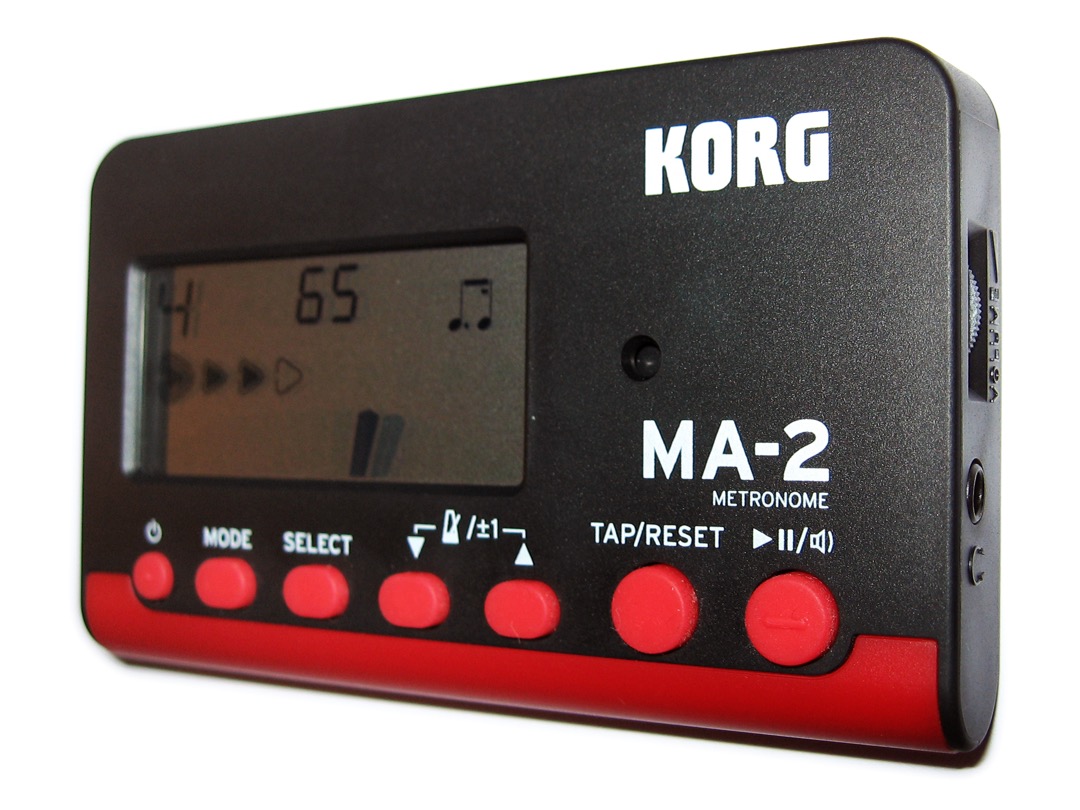
- Digital. A small box with a continuous tempo range, time signatures, subdivisions and usually a headphone jack. Many clip-on tuners include a metronome too, so you may already own one: several models in our roundup of the best guitar tuners have a built-in click.
- Apps and browser metronomes. Free, always with you, and the most feature-rich of the three. The one caveat is that a phone speaker vanishes under a strummed acoustic or a drum kit, so use headphones.
Accuracy is no longer a differentiator: anything you are likely to use, our browser tool included, is steadier than your playing. Pick whichever one you will actually switch on.
Reading the Numbers: BPM and Time Signatures
BPM stands for beats per minute, and it is the only tempo number you need. At 60 BPM the metronome clicks once per second; at 120 BPM, twice. Double the BPM, halve the gap. The usable range runs from about 20 BPM, slower than most people can count without losing their place, up to 300 BPM, a fast bebop or punk pulse. Most of your practice happens between 50 and 140.
The time signature is the pair of stacked numbers you set separately. The top number is how many beats are in each measure. The bottom number says which note value counts as one beat: 4 means a quarter note, 8 an eighth note.
Worked example. Set the metronome to 4/4 at 80 BPM. You hear a repeating group of four clicks with the first of every four accented, usually a higher pitch or a louder tick. Count out loud with it: ONE two three four, ONE two three four. The accent is doing the real work. Without it you have a featureless stream of clicks and no way to know where the bar begins, which means no way to notice when you have dropped a beat. With it, a dropped beat is obvious immediately. Set 3/4 and the same 80 BPM gives you ONE two three, a waltz. The speed did not change, only the grouping.
Compound Time: 6/8, 9/8 and 12/8
Here is the thing nobody explains properly, and it causes more beginner confusion than anything else on this page. In compound meters, the click does not represent the bottom number.
A 6/8 bar contains six eighth notes, but you do not feel six beats. You feel two, with three eighth notes packed inside each. Each of those two main beats is a dotted quarter note, so a metronome set to 6/8 is counting dotted quarters, not eighths.
The arithmetic is the part that bites. 6/8 at 60 BPM means 60 dotted-quarter beats per minute, and each dotted quarter holds three eighth notes, so you are playing 180 eighth notes per minute. Likewise 9/8 has three dotted-quarter beats per bar and 12/8 has four, which is why a 12/8 blues shuffle feels like a four-beat bar with triplets inside it.
The practical consequence: set a gentle 6/8 ballad to 60 because that sounded like a sensible beginner tempo and you have just asked yourself to play three times faster than the song. Use 40 to 50 instead. And if you want to hear all six eighth notes while you learn the part, do not raise the tempo to get them. Turn on triplet subdivisions and leave the pulse where it is.
Tempo Markings to BPM
Sheet music often gives you an Italian word rather than a number. (Our free blank sheet music generator is handy if you are writing parts out and want somewhere to note your working tempo.) These are the ranges you will see most:
| Marking | Feel | Approximate BPM |
|---|---|---|
| Largo | Broad, very slow | 40 to 60 |
| Adagio | Slow, at ease | 66 to 76 |
| Andante | Walking pace | 76 to 108 |
| Moderato | Moderate | 108 to 120 |
| Allegro | Fast, bright | 120 to 168 |
| Presto | Very fast | 168 to 200 |
Treat these as neighbourhoods rather than addresses. Editions and eras disagree by ten BPM or more, and an Allegro in a Haydn quartet is not an Allegro in a film score. If the score gives you an actual number, that number wins.
Setting Up Your First Practice Session
Tune first. A session that starts out of tune teaches your ear the wrong thing, which is the argument I make at length in our guide to tuning a guitar.
Then pick a starting tempo. For most beginners on most material, 60 to 80 BPM is the window, and 60 is the safer end. For a genuinely hard passage, go lower without hesitation. The honest test: the right starting tempo is the fastest one at which you can play the passage correctly three times in a row, with no stumbles and no pauses to reposition your hand. If that is 44 BPM, start at 44.
Now the habit students skip most often: listen for four bars before you play a note. Start the click, count four full measures out loud, and only then come in. It lets your body lock onto the pulse instead of chasing it from the first beat, and it forces you to enter on a downbeat you predicted rather than one you reacted to. Players who start the instant they hit the button spend the whole exercise a fraction behind, then conclude that metronomes are stressful.
Keep sessions short and specific. Ten focused minutes on two bars beats an hour of running the whole piece. If you are still assembling fundamentals, our beginner’s guide to playing guitar and the first eight chords are what I would put under a click first, because chord changes are where timing problems live.
The Tempo Ladder: How You Actually Get Faster
Speed is a by-product of accuracy. You do not practise fast to get fast. You practise clean, repeatedly, and let the tempo rise underneath you. The tempo ladder is the mechanism.
- Set the click below your clean speed. Not at it, below it. The passage should feel easy and slightly boring.
- Play it three times in a row, cleanly. Every note sounded, every change on the beat, no rush through the easy bar, no pause to find the next shape.
- Only then go up by four to six BPM. Not ten, not twenty. The small increment is what makes the jump invisible to your hands.
- Fail twice at the new tempo and drop back ten to fifteen BPM below the previous rung, then climb again. The drop clears out the tension that crept in.
- Stop while it is still clean. Ending on three good reps beats pushing to failure, because the last version you played is the one that consolidates overnight.
Two things to expect. You will hit a wall, and it will almost always be one specific transition rather than the whole passage: isolate the two beats either side of it, loop that alone, and bring it up separately. And tomorrow’s comfortable tempo will often be slower than today’s finishing tempo, which is normal consolidation rather than backsliding.
A looper is an underrated ladder partner, because a recorded loop is unforgiving of drift in a way a click is not: your part either lines up with itself on the next pass or it does not. Our roundup of the best looper pedals covers the options, and most include a click of their own.
Subdivisions: Eighths, Sixteenths and Triplets
A subdivision setting fills the space between main beats with quieter clicks. In 4/4, turning on eighths gives you “one-and-two-and-three-and-four-and” instead of four bare clicks. Sixteenths give you four ticks per beat. Triplets give you three.
This is the most diagnostic feature on any metronome and the one beginners use least. Rushing almost never happens on the beat. It happens in the gap between beats, where nothing checks you: you play four sixteenth notes, arrive at the next click slightly early, and quietly compress the space to hide it. With subdivisions on, that space has markers in it and the compression is audible immediately. Players are routinely shocked the first time they hear how uneven their sixteenths are.
Use it two ways. Diagnostically, when a passage feels fine but sounds wrong. Developmentally, when you are learning anything with a triplet or shuffle feel, because triplet subdivisions fix a swung-versus-straight ambiguity faster than any amount of explaining. Then turn them off. Subdivisions are a scaffold, and if you can only play a passage with them running, you have learned to follow rather than to keep time.
Advanced Drills: Beyond the Basic Click
Once the basics are comfortable, these four drills build genuine internal time, and they are what separates a player who can follow a click from a player other musicians enjoy playing with. All four work with our browser metronome: set the tempo and time signature, then follow along.
Click on 2 and 4 only. Halve your tempo and hear the remaining clicks as beats 2 and 4 rather than 1 and 3. A part written at 100 BPM becomes a metronome set to 50, with you counting one on the silence before the first click. You are now generating the downbeat and the click is confirming it. In jazz, blues, soul and most rock, 2 and 4 are where the snare lives, so this puts you inside the groove instead of on top of a grid. Expect a disorienting first week.
Click on the upbeat. Same halved tempo, but hear every click as the “and” between beats. Harder than 2 and 4, and the fastest way I know to expose a shaky internal pulse, because there is no downbeat anywhere in the reference.
Click once per measure. One click on beat one of each bar and nothing else, which in 4/4 means dividing your tempo by four. You now have three beats of silence to fill accurately before the next click tells you whether you were right.
Click every other measure (the disappearing click). The graduation exercise. One click every two bars, then every four. Anyone can hold time for two beats; holding it through eight beats of silence and landing exactly on the click is real internal time. Land consistently early and you rush, consistently late and you drag. Both are fixable once you know which one you are.
Recording yourself to a click is the honest version of all of this, because playback removes every excuse. If you are setting up at home, our guide to the best audio interfaces covers what you need, and playing to a click track is a skill every studio assumes you already have.
The Mistakes That Keep Players Stuck
Rushing, especially on the easy bars. Counterintuitive but near-universal: people expect to rush the hard parts, but hard parts slow you down. It is the comfortable bar right after a difficult one where you relax and accelerate.
Tuning the click out instead of listening to it. If the metronome has become background noise, you have stopped using it. Aim at the click with the goal of hiding it: when your note lands exactly on the beat it masks the click and the sound seems to briefly disappear. That vanishing is the target.
Starting too fast. The most common failure by a wide margin, usually because a slow tempo feels like an admission of something. A passage learned at 50 BPM and laddered up will be faster in three weeks than the same passage started at 100 and never cleaned.
Only ever practising with the click. A metronome builds time, not feel. Spend part of every session without it and check yourself by recording. If you only ever play to a grid, you learn to depend on one.
Blaming the metronome. When your playing and the click separate, the click is right. It is always right. That sounds harsh, but it is the most useful line on this list, because the instant you stop arguing with it you start hearing the actual problem, usually a transition two beats before the point where things fall apart.
Notes for Your Instrument
The method above is instrument-agnostic, but a few things are worth calling out.
Guitar. Put the click on your chord changes, not your strums. The change is where beginners lose time, because they stop strumming to reposition. Practise it alone: strum the last beat of the bar, move, land the new chord exactly on the next click, nothing else. Our easy guitar songs for beginners are ideal ladder material, and the best beginner acoustic guitars and best beginner electric guitars are playable enough not to sabotage the exercise.
Bass. Timing is the job. Practise against a click on 2 and 4 early and often, and watch note length as much as attack, because a bass note that ends late blurs the groove as much as one that starts late. Our best bass guitars for beginners roundup is a reasonable starting point.
Drums. Work the click against the hi-hat, then the kick, then nothing but the snare on 2 and 4. Most electronic drum sets have a built-in metronome with a headphone mix, and even a kids drum set benefits from clapping to a click before the sticks come out.
Keys. Hands separately first, each to the click, then together. The hand not carrying the melody is almost always the one that drifts. Our circle of fifths tool pairs well with slow metronome work on chord movement.
The Click Is a Mirror
The metronome is uncomfortable because it tells you the truth, and most practice tools do not. It has no opinion about how hard the passage is, how tired you are, or how well it went yesterday. It marks the time and lets you compare.
That is why it works. Two weeks of honest ladder work will do more for how you sound than two months of playing a piece from the top at a tempo you cannot control. And the goal is not to need it forever: after enough sessions the pulse is yours, the click becomes confirmation rather than instruction, and you can walk into a room with other players and simply be where everyone expects you to be.
Start at 60. Listen for four bars. Play it clean three times, then go up by five. That is the entire method, and our free metronome is waiting.
Frequently Asked Questions
What BPM should a beginner start a metronome at?
What does 4/4 mean on a metronome?
How do I set a metronome for 6/8 time?
How much should I increase the tempo each practice session?
Why would a metronome click on 2 and 4 instead of every beat?
Related Articles
How to Read Guitar Tabs: A Complete Beginner's Guide
guitars
How to Play Guitar: A Beginner's Guide
guitars
10 Best Guitar Tuners of 2026 (Clip-On, Pedal, Strobe & More)
accessories-care
Guitar Chords for Beginners: The First 8 Chords to Learn (and How)
guitars
How to Tune a Guitar: A Complete Beginner's Guide (Standard EADGBE)
accessories-care
About the Reviewer

Julian Reyes, MM, Berklee
M.M. Performance, Berklee College of Music
Julian Reyes is a multi-instrumentalist with a Master of Music from Berklee College of Music and over a decade gigging on guitar, bass, and keys. Before founding House of Octave, he spent years as a gear buyer for an independent music retailer, evaluating hundreds of instruments and audio products for the sales floor. He started House of Octave in 2026 to give players honest, hands-on reviews — judged by how gear actually sounds and holds up on stage and in the studio, not by spec sheets or sponsorships.