35 Easy Guitar Songs for Beginners (in the Order You Should Learn Them)
Berklee-trained teacher Julian Reyes (MM) picks 35 easy guitar songs for beginners, grouped from 2-chord to 4-chord, with the exact chords for each, why every song is easy to play, and the order to learn them so your first song sounds like music, not homework.
Updated
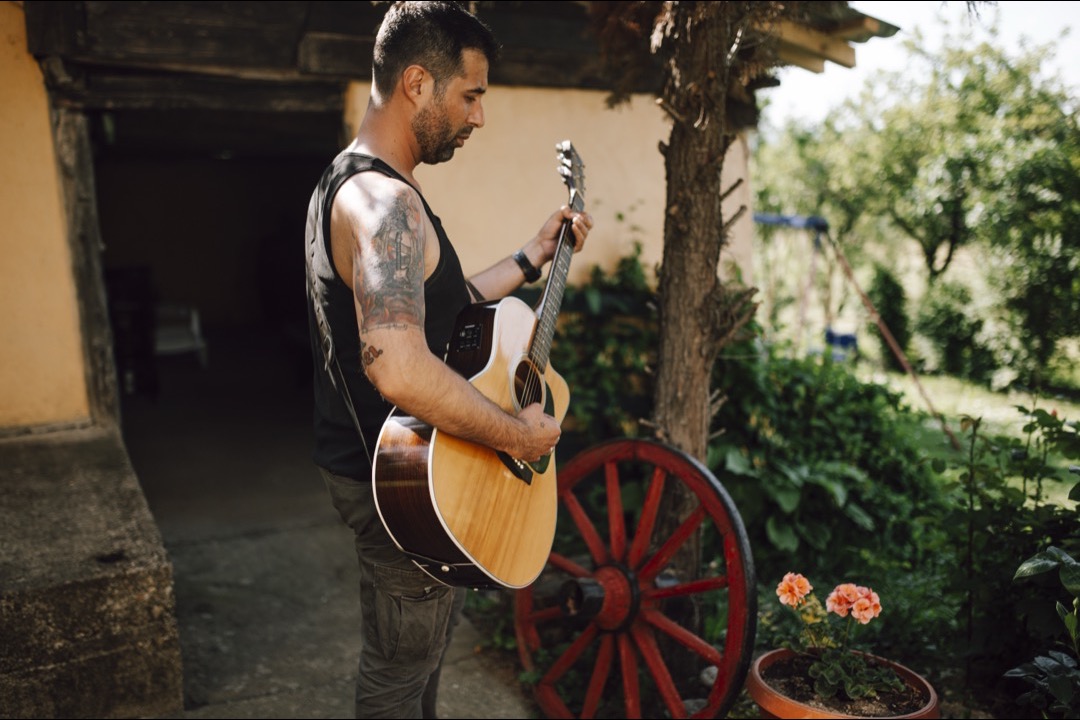
A student once brought a printed list of forty “easy” songs to his first lesson, proud that he’d found it online. Every song on it needed at least four chords, two of them barre chords, and he’d concluded after a frustrating week that he “just wasn’t coordinated enough.” He was wrong about that. The list was the problem, not his hands. A genuinely easy song is not one you like — it’s one built from a small number of forgiving shapes, played slowly enough that you have time to move between them. Two weeks after I traded his list for three songs he could actually play, he sent me a video of himself strumming through “Three Little Birds,” grinning.
I’ve taught hundreds of beginners, and the fastest path to sounding like a real musician is almost embarrassingly short: a handful of open chords, in the right order, applied to songs that were basically designed to be easy. This guide gives you 35 of those songs, sorted from two chords up to four, with the exact chords for each, an honest note on why each one is easy, and — the part most lists skip — the order to actually learn them in. If you’re still getting your first chords under your fingers, start with our guide to the first eight guitar chords for beginners; if you don’t yet own a guitar, our roundup of the best beginner acoustic guitars walks through what to look for. Everything below assumes only that you can fret a few open chords and strum.
What Makes a Guitar Song “Easy”?
Before the list, it helps to know what you’re actually looking for, because “easy” isn’t about the genre or how famous the song is. Four things make a song beginner-friendly, and the best first songs have all four:
- Few chords. Two or three open chords means less to memorize and fewer switches to fumble. Every song in the first two sections below lives here.
- Open chords, not barre chords. Open chords use open strings and only two or three fingers. Barre chords — where one finger presses down every string — demand hand strength you won’t have for a month or two, so any song that needs them isn’t a beginner song yet.
- A slow or forgiving tempo. Slow songs give your hand time to move between chords. A steady reggae or ballad feel also hides the small timing hiccups that a fast punk song would expose.
- A repeating progression. If the same four chords cycle through the whole song, you only have to learn one loop and then you can play the entire thing. Most of the songs below are exactly this.
There’s a fifth trick that unlocks even more songs: the capo, a clamp that clips onto the neck and lets you play in a song’s original key using easy shapes you already know. More on that below — it’s the single reason a “hard” song and an “easy” one can be the same song.
How to Use This List
Don’t read this like a menu and jump to your favorite. Learn the songs roughly in the order they appear, because they’re sequenced to add exactly one new skill at a time — a wider stretch, a new chord, a slightly faster change. Here’s the practice method I give every student, and it works for any song on this page:
- Learn each chord on its own first. Get every chord in the song ringing cleanly before you try to play them in sequence. A buzzy chord played fast is just fast buzzing.
- Drill the two hardest-to-switch chords as a pair. Pick the change that trips you up, set a slow tempo, and switch back and forth for sixty seconds counting the clean changes. Our free 120 BPM metronome is perfect for this — slow it down to start, then nudge it up as the change gets smoother.
- Anchor and pivot your fingers. When two chords share a finger on the same string and fret, leave it there and let it guide the move. This “anchor finger” trick is the difference between a clumsy full-hand reset and a smooth pivot, and it’s why some four-chord songs are easier than some three-chord ones.
- Play slowly, with a steady count, all the way through. Speed is the last thing to add, and it arrives on its own once the changes are clean. A song played slowly and accurately sounds finished; the same song rushed sounds like a mistake.
If your chords buzz no matter what you do, the culprit is often the guitar, not you — high string action from the factory makes clean fretting genuinely hard. A fresh set of quality strings and a basic setup fixes most of it; our guide to the best acoustic guitar strings covers what to put on. And if you’re not yet confident your guitar is even in tune, run through how to tune a guitar first, because nothing sounds “easy” on an out-of-tune instrument.
Two-Chord Songs: Your First Wins
Start here. Two chords means the only skill you’re building is a clean switch between two shapes — the foundation everything else stands on. These songs sound like the real record within a day or two of practice, which is exactly the confidence you want early.
| Song | Artist | Chords |
|---|---|---|
| A Horse With No Name | America | Em, D6/9 |
| Eleanor Rigby | The Beatles | Em, C |
| Achy Breaky Heart | Billy Ray Cyrus | A, E |
| Jambalaya (On the Bayou) | Hank Williams | C, G |
| Feelin’ Alright | Traffic | C, F |
| For What It’s Worth | Buffalo Springfield | E, A |
Why these are the easiest songs on the page: “A Horse With No Name” is the one I reach for first, because its two chords are essentially the same grip moved to different strings — your fingers keep their shape and just slide, so there’s almost no real chord change to fumble. “Eleanor Rigby” pairs Em (the single easiest chord on guitar, two fingers side by side) with C, giving you an early rep on a slightly wider reach in a very slow song. “Achy Breaky Heart” swaps between A and E, two neighboring open chords that share the same fret region, so your hand barely travels. The common thread: minimal hand movement, slow tempos, and shapes you can already make. Play any one of these until you can loop it without looking, and you’ve built the exact switching muscle the next section needs.
Three-Chord Songs: The Big Unlock
This is the section that changes everything. Almost every three-chord song is built from one of two families — G, C, D or A, D, E — and once you own either set and can change between the shapes cleanly, you can strum through an astonishing amount of music. This is not an exaggeration: entire careers were built on three chords. Learn one family, and dozens of songs open at once.
| Song | Artist | Chords |
|---|---|---|
| Three Little Birds | Bob Marley | A, D, E |
| Wild Thing | The Troggs | A, D, E |
| Stir It Up | Bob Marley | A, D, E |
| Bad Moon Rising | Creedence Clearwater Revival | D, A, G |
| Sweet Home Alabama | Lynyrd Skynyrd | D, C, G |
| Louie Louie | The Kingsmen | A, D, Em |
| What’s Up? | 4 Non Blondes | G, Am, C |
| Blowin’ in the Wind | Bob Dylan | G, C, D |
| Ring of Fire | Johnny Cash | G, C, D |
| Bad Case of Loving You | Robert Palmer | A, D, E |
Why these work: “Three Little Birds” is the most-recommended beginner song there is, and it earns it — A, D, and E sit close together on the neck so your hand moves very little, and the relaxed reggae feel gives you generous time on every change. Learn it, and you’ve simultaneously learned “Wild Thing” and “Stir It Up,” which use the identical three chords. The G-C-D family (“Bad Moon Rising,” “Ring of Fire,” “Blowin’ in the Wind”) is the other great unlock — those three chords are the backbone of folk and country, and the change from G to C shares an anchor finger you can pivot on instead of resetting. If you want to understand why these three-chord families recur everywhere, our beginner chord guide breaks down how the shapes relate. This is also the point where a lot of players want to plug in — if you’re learning on an electric, our picks for the best beginner electric guitars and a small practice amp make these riffs a lot more fun to play loud.
Four-Chord Songs: The Progression That Plays a Thousand Songs
Here’s the famous secret: a huge share of pop, rock, and folk songs use the same four chords in the same order — some arrangement of G, D, Em, and C (music teachers call it the I–V–vi–IV progression). Learn that one loop and you can play a genuinely staggering number of songs, often by ear. Four chords is only slightly harder than three; the songs feel bigger and more complete, which is why this section is where beginners start to feel like real players.
| Song | Artist | Chords |
|---|---|---|
| Knockin’ on Heaven’s Door | Bob Dylan | G, D, Am, C |
| Good Riddance (Time of Your Life) | Green Day | G, C, D, Em |
| With or Without You | U2 | G, D, Em, C |
| Wagon Wheel | Old Crow Medicine Show | G, D, Em, C |
| Zombie | The Cranberries | Em, C, G, D |
| Ho Hey | The Lumineers | C, G, F, Am |
| Brown Eyed Girl | Van Morrison | G, C, D, Em |
| Wonderwall | Oasis | Em, G, D, A (capo 2) |
| Riptide | Vance Joy | Am, G, C, F |
| Perfect | Ed Sheeran | G, Em, C, D (capo 1) |
| No Woman No Cry | Bob Marley | C, G, Am, F |
| Free Fallin’ | Tom Petty | D, A, Dsus4 (capo 3) |
| Stand By Me | Ben E. King | C, Am, F, G (capo) |
| Viva la Vida | Coldplay | C, D, G, Em |
| Radioactive | Imagine Dragons | Am, C, G, D |
Why these are still beginner-friendly: “Knockin’ on Heaven’s Door” is the gentlest introduction — four chords, but they change slowly and predictably, and the whole song is one repeating loop. “Good Riddance (Time of Your Life),” “With or Without You,” and “Wagon Wheel” all use the exact G-D-Em-C loop, so learning one hands you the others nearly free. The reason these four-chord songs often feel easier than some three-chord ones is the anchor-finger trick: moving between G, C, Em, and D lets you keep a finger planted and pivot, so your hand never fully resets. A couple of these — “Wonderwall,” “Riptide,” “Free Fallin’,” “Stand By Me” — are marked with a capo, which brings us to the one concept that quietly doubles the number of songs you can play.
The Capo: Why One Song Has Two “Correct” Chord Sets
If you’ve searched for a song’s chords and found two different answers, you’re not going crazy — you’ve run into the capo. A capo is a small clamp that presses across all the strings at one fret, effectively moving the guitar’s nut up the neck. Its superpower for beginners: it lets you play a song in its original recorded key while using only the easy open-chord shapes you already know, instead of the barre chords the “real” key would demand.
That’s why “Stand By Me” shows up as both A, F#m, D, E (hard — two of those need barres) and C, Am, F, G with a capo (much friendlier). Same song, same sound, but the capo version uses shapes your hand can already make. When a song looks like it needs scary chords, your first move should always be to check for a capo version — there almost always is one. Our chord transposing tool shows you exactly which easy shapes to use at each capo position, so you can turn almost any barre-chord song into an open-chord one. A capo is genuinely one of the highest-value few dollars a beginner can spend.
Bonus: Riff-Only Songs (No Chord Changes)
Not ready to strum-and-switch chords yet? You can still play instantly recognizable music by learning a single-string riff — one note at a time, no chords at all. These are pure confidence builders and a great way to practice fretting cleanly while your chord hand catches up.
| Song | Artist | What you play |
|---|---|---|
| Seven Nation Army | The White Stripes | Single-string riff (one string, a few frets) |
| Smoke on the Water | Deep Purple | Two-string power-chord riff |
| Come As You Are | Nirvana | Single-string riff |
| (I Can’t Get No) Satisfaction | The Rolling Stones | Three-note riff |
These are written in tablature rather than chord charts — a simple number-and-line system that tells you which fret to press on which string, in order. If you’ve never read it, our guide to reading guitar tabs makes it click in about five minutes, and then the entire universe of guitar riffs opens up. “Seven Nation Army” in particular is the fastest “I can play something people recognize” win on the whole page.
A Realistic Order to Learn These Songs
Most lists dump 30 songs on you and wish you luck. Here’s the actual sequence I’d have you follow, each step building the specific skill the next one needs:
- “A Horse With No Name” — build your first clean two-chord switch with almost no hand movement.
- “Eleanor Rigby” — add a slightly wider reach (Em to C) while staying at two chords.
- “Three Little Birds” — your first three-chord song, with the close-together A-D-E family and a slow, forgiving feel.
- “Bad Moon Rising” — move to the G-C-D family and practice the anchor-finger pivot from G to C.
- “Knockin’ on Heaven’s Door” — your first four-chord song, with slow, predictable changes.
- “Good Riddance (Time of Your Life)” — lock in the G-D-Em-C loop that plays a thousand other songs.
- “Wonderwall” (with a capo) — learn to use a capo and unlock the entire capo-song catalog.
Play each one until you can get through it slowly without your hand freezing, then move on. By song seven you’ll have every core open chord, both major chord families, the anchor-finger technique, and the capo — which is genuinely most of what recreational guitar playing requires. From there, our full beginner’s guide to playing guitar maps out strumming patterns and the four-week practice plan that takes you the rest of the way.
A Note for Left-Handed Players
Almost every chord chart and tab you’ll find online is written for right-handed guitars, and this trips up new lefties. You have two good options: play a genuine left-handed guitar (strung and built as a mirror image, so the diagrams are flipped for you — you’ll mentally reverse the charts), or learn on a standard right-handed guitar, which many left-handed players do comfortably since the strumming hand does the rhythmic heavy lifting. There’s no wrong answer, but decide before you buy, because restringing and re-setting a guitar to switch handedness later is a hassle. Every song on this list works identically once your instrument matches your hands — the chord shapes are the same, just mirrored.
Gear That Makes Learning Songs Easier
None of this requires expensive equipment, but a few things genuinely lower the difficulty of your first songs. A guitar that’s set up well and holds its tuning removes the “is it me or the guitar?” question — see our roundups of the best beginner acoustic guitars and, if you’re going electric, the best beginner electric guitars. A reliable clip-on tuner means you always start in tune, which matters more than beginners realize — an out-of-tune guitar makes every “easy” song sound wrong no matter how clean your fretting is. A fresh set of the right strings lowers the effort it takes to fret cleanly and takes the ache out of those first weeks. And if you’ve caught the bug and want to move up, our guide to the best acoustic guitars covers instruments worth growing into. The goal is simple: remove every obstacle between you and the sound, so the only thing left to work on is your hands — and those get better every single day you play.
The best beginner song is the one you’ll actually pick up the guitar to play. Start with two chords, take one song all the way to the finish line, and let the wins stack. Six weeks from now, “I’m not musical” will sound as wrong to you as it did to every student who ever said it to me.
Frequently Asked Questions
What is the easiest guitar song for a beginner to learn?
What is a good 3-chord song for a beginner guitar player?
What is a good first song to learn on guitar?
How many songs should a beginner learn at once?
Do I need a capo to play easy guitar songs?
Related Articles
About the Reviewer

Julian Reyes, MM, Berklee
M.M. Performance, Berklee College of Music
Julian Reyes is a multi-instrumentalist with a Master of Music from Berklee College of Music and over a decade gigging on guitar, bass, and keys. Before founding House of Octave, he spent years as a gear buyer for an independent music retailer, evaluating hundreds of instruments and audio products for the sales floor. He started House of Octave in 2026 to give players honest, hands-on reviews — judged by how gear actually sounds and holds up on stage and in the studio, not by spec sheets or sponsorships.