11 Best Cheap Classical Guitars of 2026
Julian Reyes, MM (Berklee), picks the 11 best cheap classical guitars of 2026, with nut widths, body sizes and honest notes on which ones need a setup before they play properly.
Updated
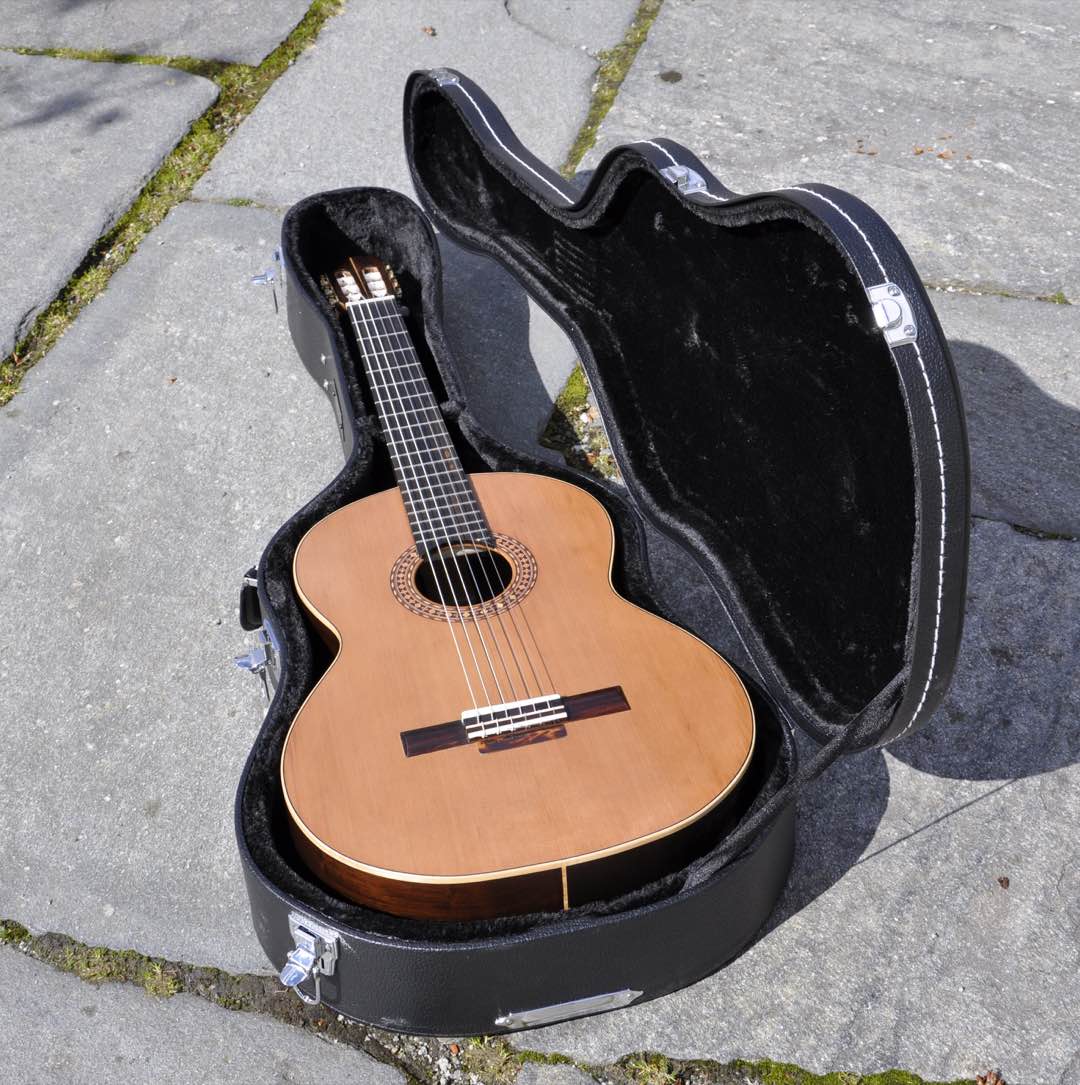
I have spent twenty years teaching guitar and several of them buying gear for a retail floor, and nylon-string guitars are where I watch the most beginners quit. The irony is that almost everyone starts on one for the right reason. Nylon strings really are kinder to untoughened fingertips than steel, and a classical guitar really is the honest way into fingerstyle playing. What nobody warns people about is the fingerboard, which is roughly a centimetre wider than any steel-string acoustic, and the action, which on a cheap instrument is frequently high enough to make a first barre chord feel impossible.
That is the frame for this page. Under three hundred dollars the differences between these guitars are not about tonewood poetry, they are about whether the thing arrives playable and whether it fits the hands of the person who will be holding it. Every guitar below was checked live on Amazon for stock, condition and current price rather than pulled from a spec sheet, and where a listing contradicts itself I have said so rather than quietly picking the flattering version.
If you are still deciding whether nylon is even the right choice, our classical vs acoustic guitar comparison covers that decision properly, and the best cheap acoustic guitars page is the steel-string equivalent of this one.
| Product | Price | Buy |
|---|---|---|
| Yamaha C40II Classical Guitar, Full SizeBest Overall | $199.99 | View on Amazon |
| Winzz 4/4 Size Beginner Classical Guitar, BlueburstBudget Pick | $93.30 | View on Amazon |
| Cordoba C3M Classical GuitarPremium Pick | $299.99 | View on Amazon |
| Fender CN-60S Concert Nylon String Acoustic GuitarRunner-Up | $229.99 | View on Amazon |
| Cordoba C1M Classical Acoustic Nylon String Guitar, Protege SeriesRunner-Up | $229.99 | View on Amazon |
| Yamaha CGS102AII Half-Size Classical GuitarRunner-Up | $169.99 | View on Amazon |
| Hola! Music 36-inch 3/4 Classical GuitarRunner-Up | $129.99 | View on Amazon |
| ADM Full Size Classical Nylon String Acoustic Guitar Starter BundleRunner-Up | $139.99 | View on Amazon |
| Cordoba C1M-CE Cutaway Nylon String Acoustic-Electric Guitar, Protege SeriesRunner-Up | $299.99 | View on Amazon |
| Ortega Left-Handed Student Series Full Size Nylon Classical Guitar RSTC5M-LRunner-Up | $189.99 | View on Amazon |
| TARIO 39-inch Thin Body Cutaway Classical GuitarRunner-Up | $139.99 | View on Amazon |
Find the Best Cheap Classical Guitar for Your Need
Jump to the player or the use case you are actually shopping for.
- Overall best cheap classical guitars
- Best classical guitars for beginners
- Best cheap classical acoustic-electric guitars
- Best 3/4 size classical guitars
- Best full-size 4/4 classical guitars
- More use cases and sizes
How I Chose These Cheap Classical Guitars
I set the ceiling first. Above roughly three hundred dollars a nylon-string guitar stops being cheap and starts being inexpensive, and that is a different conversation with different instruments in it. Within that ceiling I weighted three things: how consistently a model arrives set up well enough to play, how deep its owner-review base runs, and whether the size and nut width are published clearly enough to match a guitar to a person before buying rather than after.
Review depth carries more weight at the bottom of this market than anywhere else in guitars, because the variance between individual units is the actual risk. A guitar with a thousand ratings is telling you something about quality control that a guitar with twelve ratings cannot, however good those twelve are. Two picks here carry thin review bases, and I have said so plainly in both cases rather than burying it, because they earned their place by being the only real option in their niche rather than by being proven.
Best Cheap Classical Guitars Overall
Here is every guitar in full, ordered by how confidently I would hand it to a student rather than by price.
Best Overall: Yamaha C40II
The C40II has been the default answer to this question for long enough that it is worth asking whether it still deserves to be, and having handled a lot of them, it does. The argument is not the specification, which is ordinary: laminate spruce over laminate meranti, a nato neck, a rosewood fingerboard, nothing clever anywhere. The argument is that it arrives playable, and it arrives playable every time.
That matters more than it sounds. The dominant failure mode of a cheap nylon-string guitar is not bad wood, it is a saddle left too tall and a nut left uncut, which puts the action high enough that a beginner’s fretting hand gives out before their interest does. Yamaha’s factory setup standard is the reason teachers keep specifying this model rather than something newer and shinier, and it is why the deepest review base in this category sits on a design that has barely changed in years.
What it is not is a guitar that grows. The laminate top means what you hear today is what you hear in five years. For a first instrument that is entirely reasonable, and if the player is still going in a year, the Cordoba C3M further down is what the upgrade looks like.

Yamaha C40II Classical Guitar, Full Size
by Yamaha
The default recommendation for good reason: it arrives playable, it plays like every other one that leaves the factory, and more than a thousand owners agree.
Pros
- It arrives closer to properly set up than anything else in this price band, and that is the whole argument for it: the action is low enough to fret cleanly out of the box, where most cheap nylon-string guitars need a saddle taken down before a beginner can hold a barre chord without pain
- Yamaha's build consistency is the reason teachers keep recommending this model rather than a newer one -- the unit you receive plays like the unit the shop demo played, which is the single least reliable thing about every budget brand it competes with
- It has the deepest owner-review base of any classical guitar in this band, which on a budget instrument is the most useful signal there is: it tells you quality control holds across more than a thousand units rather than across the handful a reviewer happened to be sent
- It sells through Yamaha's authorised dealer network rather than an anonymous marketplace seller, so the warranty is one somebody will actually honour and the guitar is the one Yamaha built rather than a lookalike
Cons
- Nothing is included, so a gig bag, a clip-on tuner and a footstool are three separate purchases on top -- the ADM kit further down bundles all of that for less money, at the cost of the build consistency
- The meranti back and sides are laminate and so is the top, which means the tone you hear in week one is the tone you hear in year five; only the solid-top Cordoba C3M and Fender CN-60S on this page escape that
- The stock tuning machines drift noticeably while the nylon settles, which is normal for new nylon strings but lasts longer here than on guitars with better geared tuners
Best Budget: Winzz 4/4 Blueburst
I am recommending this on evidence rather than enthusiasm, and on one specification that the rest of the sub-hundred-dollar market gets wrong. Almost everything at this price is a 36-inch body sold to adults who then spend a year fighting a scale length that does not match anything their teacher demonstrates. This is a genuine full-size 4/4 instrument at a price where that is close to unique.
The construction is basswood throughout, including the top, and that is the honest limitation. Basswood is a neutral, quiet wood, and on a classical guitar the top does most of the acoustic work, so this is flatter and less resonant than anything else here. What you get in exchange is a correctable neck, thanks to a dual-action truss rod that almost nothing at this price carries, and fret ends that have actually been dressed rather than left sharp.
Treat the factory strings as packaging. A fresh set of normal-tension nylon transforms what this guitar sounds like, and it is the difference between an instrument that sounds cheap and one that sounds plain.

Winzz 4/4 Size Beginner Classical Guitar, Blueburst
by Winzz
The honest floor of the category: a full-size body, a correctable neck and dressed fret ends, at a price where most rivals give you a shrunken body and sharp frets.
Pros
- It is the only genuinely full-size classical guitar here under a hundred dollars, which matters more than it sounds: the cheap end of this category is full of 36-inch bodies sold to adults who then find the scale length fights everything they learn
- It carries a dual-action truss rod, which is close to unheard of at this price -- it means the neck can be corrected if it moves, rather than the guitar becoming firewood the first time a season changes
- The fret ends are dressed rather than left sharp, and that is the detail that decides whether a cheap guitar is unpleasant to play or merely plain; sharp fret ends are the most common complaint on budget nylon-string guitars and they are absent here
- The owner-review base is deep for something at the floor of the market, which is the only quality signal available when a brand has no reputation to trade on
Cons
- It is basswood throughout with no spruce anywhere, and that shows up as a flatter, less resonant voice than every other guitar on this page -- basswood is a neutral, quiet wood and the top is where most of a classical guitar's sound comes from
- The factory strings are low-tension budget nylon and several owners replaced them straight away; budget a fresh set as part of the purchase rather than an upgrade
- The tuners hold pitch adequately rather than well, which means retuning between pieces rather than between sessions
Upgrade Pick: Cordoba C3M
This is one of only two guitars on this page with a genuinely solid top, and the only one built on a traditional Spanish classical body, which is why it sits at the top of the price band rather than in the middle of it. A solid cedar top is one piece of wood moving as a unit. It is louder to begin with, it is warmer, and it keeps improving for years as the cellular structure settles into being played. Almost every other top on this page is layers of veneer bonded together, which is stable, cheap, and acoustically finished the day it leaves the factory.
Cedar rather than spruce is the other deliberate choice, and it suits the buyer this guitar is aimed at. Spruce is brighter and takes months of playing to open up; cedar arrives warm and immediate, which flatters the classical and fingerstyle repertoire a student will actually be assigned. The traditional Spanish fan bracing underneath is a real construction difference from the simplified bracing used lower down the market, and it shows up as sustain rather than as marketing.
The caveat is setup. The critical reviews on this model cluster around necks needing a truss-rod adjustment on arrival rather than around the instrument itself, so budget for a professional setup and treat it as part of the price. Done properly, this is a guitar a player keeps rather than replaces.

Cordoba C3M Classical Guitar
by Cordoba
The guitar you keep. A solid cedar top over mahogany with traditional fan bracing, and a guitar whose tone will be better in five years than it is today.
Pros
- Its top is solid cedar, one of only two solid tops on this page and the only one on a traditional Spanish classical body, and that is the one specification that changes how an instrument ages -- a solid cedar top vibrates as a single piece, gets louder and rounder over years of playing, and is why players keep this guitar rather than trading up from it
- Cedar rather than spruce gives it a warm, immediate, slightly darker voice that suits fingerstyle and classical repertoire from the first note, where spruce takes months of playing to open up
- It uses traditional Spanish fan bracing rather than the simplified ladder bracing common below three hundred dollars, which is a real construction difference rather than a cosmetic one and shows up as sustain
- Cordoba backs it with the longest warranty of anything here, which is a meaningful signal on the one guitar you might still own in a decade
Cons
- It carries one of the lower star averages on this page, and the recurring theme in the critical reviews is factory setup rather than the instrument -- several owners needed a truss-rod adjustment on arrival, so budget for a setup
- It sits at the very top of what anyone means by cheap, and at this money expectations climb faster than the guitar does; if the player might stop in six months, the Yamaha is the more rational bet
- Amazon's spec table lists a pickup configuration for this model, which contradicts the title and the product bullets -- it is a data error, and there are no electronics in this guitar
Best for Steel-String Players: Fender CN-60S
Fender built this for a specific person: someone who already plays a steel-string acoustic or an electric, wants nylon-string tone, and does not want to relearn how their hand works. Three decisions make that happen. The fingerboard has a 12-inch radius, meaning it curves gently like a steel-string neck rather than lying dead flat like a traditional classical fingerboard. The nut is 43 mm, close to a steel-string acoustic’s, rather than the 52 mm classical standard. And the body is a concert shape, a little smaller and shallower than a Spanish classical body.
Underneath that is a solid spruce top, which at this money is genuinely unusual and is the reason this guitar rewards being kept. A solid top opens up with playing; the laminate tops on most of this page do not. Fender’s two-year warranty is longer than most of this category offers, and Fender’s acoustic line runs to a published neck profile and fret-dress standard, which is why the twisted necks that plague anonymous factory brands are rare here.
The tradeoff is authenticity. A classical student working through a syllabus should take the Cordoba C1M or the Yamaha instead, because the radiused board and the smaller body are exactly what their teacher is not describing. For everyone else crossing over, this removes most of the friction.

Fender CN-60S Concert Nylon String Acoustic Guitar
by Fender
A solid spruce top and a radiused fingerboard at a price where neither is normal, aimed squarely at the player crossing over from steel strings.
Pros
- Fender specifies a solid spruce top here, which at this money is genuinely unusual -- it is the cheapest route on this page to a top that opens up with playing rather than staying where it started
- The walnut fingerboard has a 12-inch radius and a 43 mm nut rather than the dead-flat, 52 mm-wide fingerboard a traditional classical guitar uses, which makes it markedly less alien to anyone arriving from a steel-string acoustic or an electric
- It holds the same star average as the Yamaha C40II while costing meaningfully more, which is the harder thing to do -- expectations climb with price, so a high average at the top of a budget band is a stronger signal than one at the bottom
- Fender's two-year warranty is longer than most of this category offers, and Fender's acoustic line runs to a specified neck profile and fret-dress standard, so the twisted necks that plague anonymous factory brands are rare here
Cons
- The concert body is slightly smaller and shallower than a traditional Spanish classical body, so a student who needs a standard classical instrument for lessons or exams should take the Yamaha or the Cordoba instead
- It is noticeably heavier than the other picks here, which is worth knowing if the player is small or plays standing
- Amazon files it under steel-string acoustics in its own category ranking, which is simply a miscategorisation -- the title, bullets and string-material field all confirm nylon
Best for Students: Cordoba C1M Protege
Cordoba built the Protege line for teaching studios, and the proportions are the point. Standard classical nut width, standard 650 mm scale, standard body depth. A student learning on this is learning the instrument their teacher is describing, with the string spacing their method book assumes, which sounds obvious until you watch someone try to follow a classical syllabus on a narrow-necked crossover guitar.
The specification that genuinely surprises here is the adjustable truss rod. Traditional classical guitars at any price frequently have no truss rod at all, which means a neck that moves is a permanent and expensive problem. Having one on a guitar at this price is real long-term insurance, and it is the reason this survives a few humid summers better than its neighbours.
It ships with Savarez strings already fitted rather than the anonymous nylon everything else in this band arrives with, which quietly removes the first upgrade most owners make. The honest caveat is that it is a laminate-top guitar at a price where the Fender offers a solid one, so this is a purchase about proportions and a correctable neck rather than about tone per dollar.

Cordoba C1M Classical Acoustic Nylon String Guitar, Protege Series
by Cordoba
Built for teaching studios, with a correctable neck and genuinely standard classical proportions, which is exactly what a student following a syllabus needs.
Pros
- It has an adjustable truss rod, which most traditional classical guitars at any price simply do not -- classical necks are usually fixed, so a neck that moves is a permanent problem, and this one can be corrected
- Cordoba built the Protege line specifically for teaching studios, and it shows in the proportions: standard classical nut width, standard scale, standard body, so a student who learns on it is learning on the real thing
- It ships with Savarez strings already fitted rather than the anonymous factory nylon everything else in this band arrives with, which removes the single most common first upgrade
- The review base is deep for a mid-tier model, and the distribution is tight rather than polarised, which is what you want to see on a guitar bought mostly by beginners who cannot diagnose their own setup problems
Cons
- It is a laminate-top guitar at a price where the Fender offers a solid top, so if tone that improves with age is the priority the CN-60S is the better buy at the same money
- It is close enough in price to the C3M that a buyer who can find another seventy dollars gets a solid cedar top, which is a much bigger jump than anything between this and the Yamaha
Best Half-Size: Yamaha CGS102AII
The children’s end of this category is mostly toys with strings, which is what makes this one worth singling out. It gets the same factory setup attention as Yamaha’s full-size guitars, and it is the only small-body classical guitar I have found with a quality record deep enough to actually rely on rather than hope about.
Yamaha also publishes the full spec sheet, which almost nobody does at this size: 25.6-inch scale, body depth stated, nut width stated. Those are precisely the numbers a parent needs to size a child properly, and their absence everywhere else is why so many children end up on instruments that do not fit them. The nut is full 52 mm classical width on a half-size body, which sounds contradictory but is correct. A child learning classical technique needs the string spacing their teacher describes, just on a shorter scale.
The tradeoff is money. This costs more than several full-size budget guitars on this page, for an instrument a child will outgrow within a few years. That is a real and slightly uncomfortable calculation, and the answer depends entirely on whether there is a younger sibling behind them.

Yamaha CGS102AII Half-Size Classical Guitar
by Yamaha
The one small-size classical guitar with a real quality record behind it, published specs a parent can size against, and Yamaha's setup standards.
Pros
- It shares the highest star average on this page, and its review base runs several times deeper than any other small-body option here, which is a rare combination in a size class normally served by toys
- Yamaha publishes the full spec sheet for it -- scale length, body depth and nut width are all stated -- which almost no manufacturer bothers to do at the children's sizes, and those are exactly the numbers a parent needs to size a child correctly
- It gets the same factory setup attention as Yamaha's full-size guitars, so it arrives fretting cleanly rather than with the high action that makes small hands give up first
- The 52 mm nut is full classical width on a half-size body, which sounds counterintuitive but is right: a child learning classical technique needs the string spacing their teacher is describing, just on a shorter scale
Cons
- It costs more than several full-size budget guitars on this page, which is a genuine and slightly painful tradeoff for a guitar a child will outgrow in a few years
- Nothing is included, and a child-size guitar really does need a bag, so factor that in
Best for Small Hands: Hola! Music 36-inch 3/4
This is here for one number. The nut is 45 mm, well under the classical standard, and on a classical guitar nut width is the specification that decides whether a hand physically fits. The classical standard is 52 mm, and for a child or a small-framed adult that is the difference between a first-position chord being a stretch and being impossible.
It also has a real spruce top, and it is the cheapest spruce-topped guitar here — the only instrument on this page that costs less is an all-basswood build, which is the trade you make at the very bottom of the range. That gives it noticeably more voice than the price suggests, and a padded gig bag is included. That combination is why it doubles as the sensible travel instrument here: it is small, it is bagged, and losing it on a trip would not be a disaster.
The listing is not entirely consistent with itself, calling the body engineered wood in the spec table while the bullets claim mahogany, and I would treat the mahogany claim as unconfirmed. The other honest limitation is inherent to the size rather than the guitar: a shorter scale gives up genuine low-end resonance, and a full-grown adult should take a 4/4.

Hola! Music 36-inch 3/4 Classical Guitar
by Hola! Music
A 45 mm fingerboard and the cheapest spruce top on this page, bagged and ready to carry, which makes it the sensible pick for a small player.
Pros
- The 45 mm nut is far narrower than the 52 mm classical standard, and that is the specification that actually decides whether a small hand can reach across the fingerboard -- most classical guitars sit at 52 mm and simply do not fit a child or a small-framed adult
- It has a real spruce top, and it is the cheapest spruce-topped guitar on this page -- the only instrument here that undercuts it is an all-basswood build, which is exactly the trade you make at the very bottom of the range
- A padded gig bag is included, so it is genuinely ready to carry to a lesson without a second purchase -- unusual at this price and the reason it works as a travel instrument
- Hola! publishes both the nut width and the body length, which makes it one of the few guitars in this class you can size someone against before buying rather than after
Cons
- The shorter scale gives up real low-end resonance against a full-size guitar, which is inherent to the size rather than a fault, but a full-grown adult should take a 4/4 instead
- Amazon's spec table calls the body engineered wood while the bullets claim mahogany, and that inconsistency is unresolved -- treat the mahogany claim as unconfirmed
Best Starter Kit: ADM Full Size Bundle
Bundles usually deserve suspicion, because the accessories are typically a way to make a weak guitar look like more value. This one earns its place for a duller and better reason: it includes a footstool. Classical technique rests the guitar on the raised left leg, a footstool is how that happens, and it is the accessory nobody thinks to buy and everybody eventually needs. Bag, clip-on tuner, footstool, stand and capo are all in the box.
The evidence base is the other argument. This carries one of the two deepest owner-review counts on this page, which at the bottom of the market is the only quality signal that means anything, because the real question is never whether the guitar is remarkable but whether it arrives playable.
Two honest flags. ADM’s own bullets claim a solid spruce top, and on a budget instrument from an OEM brand that claim is not independently verifiable, so do not pay a premium for it and do not expect the guitar to open up the way the Cordoba will. And it ships untuned with strings that need several days of stretching, which the listing itself warns about and which first-time buyers routinely mistake for a fault.
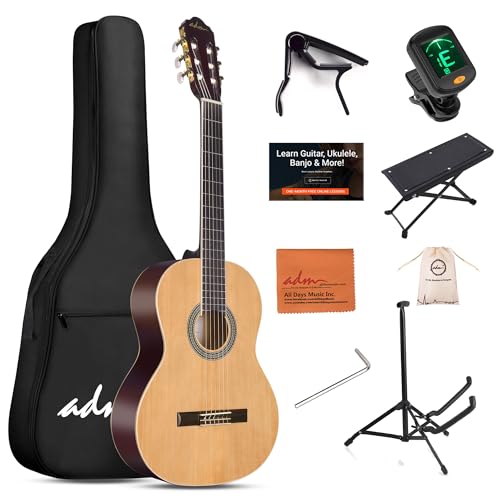
ADM Full Size Classical Nylon String Acoustic Guitar Starter Bundle
by ADM
The complete-in-one-box option, validated by one of the two largest owner-review bases here, and the only kit that remembers the footstool a classical player genuinely needs.
Pros
- It has one of the two deepest owner-review bases on this page, which is the only argument that carries weight at the bottom of the market: the question is never whether the guitar is remarkable, it is whether it arrives playable, and a very large number of owners answering yes is a real answer
- The kit is genuinely complete rather than padded out -- gig bag, tuner, footstool, stand, capo and cloth are all things a beginning classical player actually needs, and the footstool in particular is the accessory nobody thinks to buy and everybody needs
- It carries a dual-action truss rod, so the neck is correctable, which is not a given anywhere near this price
- Buying one box instead of five removes the decision fatigue that stops a lot of gift purchases dead, and for a parent or a gift-buyer that is worth real money
Cons
- ADM's own bullets claim a solid spruce top, and on a budget instrument at this price that claim is not independently verifiable -- treat it as a manufacturer claim rather than a confirmed specification, and do not pay a premium for it
- It ships untuned and the strings need several days of stretching before they hold pitch, which the listing itself warns about; this is normal for new nylon but surprises first-time buyers
- Batteries for the included tuner are not in the box
Best With a Pickup: Cordoba C1M-CE
If the player needs to be audible at a recital, a church service or a lesson in a room with a drummer in it, a quarter-inch output jack is the difference between being heard and not, and no amount of acoustic volume substitutes. The C1M-CE is the Cordoba C1M Protege from earlier on this page with a cutaway and a factory-fitted pickup and preamp, which makes it the simplest way to get a traditional classical guitar that plugs in.
Everything that makes the C1M a good teaching instrument carries over. The body is a full Protege classical body rather than a thin crossover, the neck has an adjustable truss rod, and it ships with Savarez strings fitted. The nut is 50 mm, a touch slimmer than the 52 mm standard but still a proper classical neck, and the cutaway opens up the frets above the twelfth that a traditional body blocks.
The caveats are about evidence and paperwork. The review base is modest, so there is less proof of how consistently it arrives than there is for the Yamaha. The listing names two different pickup systems in different places, so treat the exact electronics as unconfirmed until it is in your hands. And at this money the Cordoba C3M offers a solid cedar top instead, so this is a purchase about being heard rather than about tone that improves with age. No cable is included.

Cordoba C1M-CE Cutaway Nylon String Acoustic-Electric Guitar, Protege Series
by Cordoba
The teaching-studio Protege with a cutaway and electronics, for the player who has to be heard at a lesson, a recital or a service without giving up a traditional classical body.
Pros
- It is the Protege C1M with a cutaway and a factory-fitted pickup and preamp, so it plugs straight into an acoustic amp or a PA without a clip-on microphone, which is the difference between being audible at a recital or a church service and not
- It keeps a full traditional classical body rather than a thin crossover shape, so unplugged it still sounds and sits like the classical guitar a teacher is describing
- It carries the same adjustable truss rod and fitted Savarez strings as the C1M, so the neck can be corrected if it moves and the most common first upgrade is already done
- The 50 mm nut is a touch slimmer than the 52 mm classical standard without becoming a crossover neck, and the cutaway opens up the frets above the twelfth
Cons
- The review base is modest next to the Yamaha and the ADM, so there is less evidence about how consistently it arrives -- check it while the return window is open
- The listing names two different pickup systems in different places, so treat the exact electronics as unconfirmed until the guitar is in your hands
- No cable and no bag are included, and at this money the Cordoba C3M offers a solid cedar top instead, so this is a purchase about being heard rather than about tone that improves with age
Best Left-Handed: Ortega RSTC5M-L
Left-handed classical guitars barely exist under two hundred dollars, and the reason this one matters is that it is properly built left-handed rather than a right-handed guitar restrung backwards. The difference lives at the saddle. A classical saddle is angled to compensate for the different thicknesses of the six strings, and reversing the strings on a right-handed instrument puts that compensation exactly the wrong way round, which makes the guitar play out of tune with itself the further up the neck you go. No setup fixes that.
Ortega also gave it a laminated cedar top, whose warmth suits the classical repertoire a student will be assigned, and published the full spec sheet: 650 mm scale, 52 mm nut, 19 frets and the wood for every part. That is more disclosure than most right-handed guitars here manage.
The honest caveat is the same shape as the Cordoba C1M-CE’s but sharper. This has the thinnest review base on the page by a wide margin, and it sells slowly, which means quality-control problems surface slowly too. I am recommending it because it is the best left-handed option that exists in this price range, which is a genuinely different and weaker claim than saying it is proven. Inspect it carefully while the return window is open.

Ortega Left-Handed Student Series Full Size Nylon Classical Guitar RSTC5M-L
by Ortega
The only genuinely left-handed nylon-string guitar in this price range from a guitar-specialist brand, with a cedar top and a published spec sheet.
Pros
- It is a properly built left-handed instrument rather than a right-handed guitar restrung backwards, which matters most at the saddle: a classical saddle is angled to compensate string length, and reversing the strings on a right-handed guitar puts that compensation exactly the wrong way round
- It has a laminated cedar top, and cedar's warmth suits the classical repertoire a student will actually be assigned
- Ortega publishes the full spec sheet (650 mm scale, 52 mm nut, 19 frets, and the wood used for every part), which is more than most right-handed guitars at this price disclose
- Ortega lists a mahogany neck and a walnut fretboard and bridge, so the parts that take the most wear are named woods rather than unstated substitutes
Cons
- The review base is by far the thinnest on this page, so it cannot be recommended on evidence the way the Yamaha can -- it is recommended because it is the best left-handed option that exists in this price range, which is a different and weaker claim
- It sells slowly, which means quality-control problems surface more slowly too; check it carefully on arrival while the return window is open
Best Thin Body: TARIO 39-inch Cutaway
Body depth is the thing nobody mentions when an electric player picks up a classical guitar for the first time and immediately dislikes it. A traditional classical body is deep, and that depth pushes the picking arm to an angle that feels wrong to someone used to a slim electric. This is the only thin-body nylon-string guitar I found in this price range, and it exists specifically to remove that.
The nut is 48 mm, narrower than the 52 mm classical standard but still well short of an electric’s, which is the right compromise: it closes part of the gap without going so narrow that classical fingerstyle becomes cramped. The cutaway gives real access above the twelfth fret, which a traditional classical body denies completely, and the built-in tuner and four-band EQ mean it plugs in and stays in tune without a clip-on cluttering the headstock.
Read the caveats properly. The review base is very thin, the brand has no track record beyond this listing, and the return window is thirty days rather than the multi-year warranties every established name here offers. This is a recommendation about a specification that nothing else in the price range offers, not about a proven instrument.

TARIO 39-inch Thin Body Cutaway Classical Guitar
by TARIO
A thin cutaway body and a narrower neck, built for the electric player who wants nylon-string tone without relearning how to hold a guitar.
Pros
- It is the only thin-body nylon-string guitar in this price range, and body depth is the physical thing that makes a classical guitar feel wrong to someone arriving from an electric -- a traditional classical body is deep enough that the picking arm sits at an unfamiliar angle
- The 48 mm nut is narrower than the 52 mm classical standard, which closes part of the gap toward an electric neck without going so narrow that classical fingerstyle becomes cramped
- It includes a built-in tuner and a four-band EQ preamp, so it plugs in and stays in tune without a clip-on tuner cluttering the headstock
- The cutaway gives real access above the twelfth fret, which a traditional classical body denies completely and which a crossover player will miss immediately
Cons
- The review base is very thin and the brand has no track record beyond this listing, so this is a recommendation about a specification rather than about a proven instrument
- The return window is thirty days rather than the one- and two-year warranties every established brand here offers, so inspect it properly on arrival
- At 48 mm the neck is still much wider than an electric guitar's, so it narrows the adjustment rather than removing it
Best Classical Guitars for Beginners
A first classical guitar has one job, which is to still be getting played in month three. That makes arrival condition and completeness matter more than tonewood. These three cover the three honest ways to start: the safest instrument, the most complete box, and the cheapest sensible entry.
| Product | Price | Buy |
|---|---|---|
| Yamaha C40II Classical Guitar, Full SizeBest beginner classical guitar overall Arrives set up well enough to fret cleanly, which is the single thing that decides whether a beginner keeps going | $199.99 | View on Amazon |
| ADM Full Size Classical Nylon String Acoustic Guitar Starter BundleBest beginner kit Bag, tuner, footstool, stand and capo in one box, so nothing else has to be ordered before the first lesson | $139.99 | View on Amazon |
| Winzz 4/4 Size Beginner Classical Guitar, BlueburstCheapest sensible beginner guitar A genuine full-size body under a hundred dollars with a correctable neck, if the budget will not stretch further | $93.30 | View on Amazon |
Best Cheap Classical Acoustic-Electric Guitars
Fitted electronics normally push a nylon-string guitar out of the cheap bracket. These two are the exceptions, and they solve different problems: one is a traditional classical body that happens to plug in, the other is a thin crossover body built around plugging in.
| Product | Price | Buy |
|---|---|---|
| Cordoba C1M-CE Cutaway Nylon String Acoustic-Electric Guitar, Protege SeriesBest cheap classical acoustic-electric overall A traditional full-size Protege classical body with a cutaway, a factory pickup and preamp, and an adjustable truss rod | $299.99 | View on Amazon |
| TARIO 39-inch Thin Body Cutaway Classical GuitarBest thin-body acoustic-electric Thin cutaway body, narrower neck and a built-in tuner with 4-band EQ, aimed at electric players adding nylon tone | $139.99 | View on Amazon |
Best 3/4 Size Classical Guitars
Fractional sizes are about reach rather than height. The question is whether the fretting hand can make a first-position stretch without the wrist folding, and that is governed by scale length and nut width together. These two cover the range from roughly six to twelve years old.
| Product | Price | Buy |
|---|---|---|
| Hola! Music 36-inch 3/4 Classical GuitarBest 3/4 size classical guitar A 45 mm nut, the narrowest of any small-body guitar here, plus a spruce top and an included gig bag, for roughly ages eight to twelve and small-framed adults | $129.99 | View on Amazon |
| Yamaha CGS102AII Half-Size Classical GuitarBest half-size classical guitar Yamaha setup standards and a fully published spec sheet in a half-size body, for roughly ages six to ten | $169.99 | View on Amazon |
Best Full-Size 4/4 Classical Guitars
Full size means a 650 mm scale and a 52 mm nut, and it is what most players from about age twelve upward should be on. Buying down a size to save money changes the string tension and the spacing a teacher will be describing, so it is a false economy for an adult.
| Product | Price | Buy |
|---|---|---|
| Yamaha C40II Classical Guitar, Full SizeBest full-size classical guitar overall The most consistent factory setup in the category and the deepest review base on this page | $199.99 | View on Amazon |
| Cordoba C1M Classical Acoustic Nylon String Guitar, Protege SeriesBest full-size guitar for classical students Standard teaching-studio proportions plus an adjustable truss rod, which classical necks usually lack entirely | $229.99 | View on Amazon |
| Fender CN-60S Concert Nylon String Acoustic GuitarBest full-size guitar for steel-string players A radiused fingerboard and a concert body that feel familiar to anyone arriving from steel strings, over a solid spruce top | $229.99 | View on Amazon |
Best Cheap Classical Guitars by Use Case
Everything else worth calling out, one pick per situation.
| Product | Price | Buy |
|---|---|---|
| Yamaha C40II Classical Guitar, Full SizeMost proven pick in the category The most proven instrument in the category, with the most consistent factory setup and the deepest review base here | $199.99 | View on Amazon |
| Cordoba C3M Classical GuitarBest long-term keeper A solid cedar top on a traditional classical body, and a guitar worth keeping for a decade | $299.99 | View on Amazon |
| Hola! Music 36-inch 3/4 Classical GuitarBest for small hands and travel A 45 mm nut and a 36-inch bagged body, light enough to take anywhere | $129.99 | View on Amazon |
| Ortega Left-Handed Student Series Full Size Nylon Classical Guitar RSTC5M-LBest cheap left-handed classical guitar Properly built left-handed with a correctly angled saddle rather than restrung backwards, though the review base is thin | $189.99 | View on Amazon |
| TARIO 39-inch Thin Body Cutaway Classical GuitarBest thin-body crossover guitar A thin cutaway body and a 48 mm neck for players coming off an electric | $139.99 | View on Amazon |
| ADM Full Size Classical Nylon String Acoustic Guitar Starter BundleBest complete starter kit Bag, tuner, footstool, stand and capo included, so nothing else needs ordering | $139.99 | View on Amazon |
Buyer's Guide
A cheap classical guitar is a different purchase from a cheap steel-string acoustic, and the specifications that matter are not the same ones. Nylon strings are gentle on fingers but unforgiving of a bad setup, the fingerboard is wider than anything a steel-string player has met, and the sizes are not decoration. These are the six things that actually decide whether the guitar gets played.
Solid top versus laminate top
This is the only specification that changes how a guitar ages. A solid top is one piece of wood that vibrates freely, gets louder and rounder over years of playing, and develops a voice; a laminate top is thin layers bonded together and sounds the same in year five as in week one. Below about two hundred dollars, laminate is effectively universal in this category. The Cordoba C3M and the Fender CN-60S are the solid-top options on this page, and they are the two you would still be playing in a decade. Be sceptical of solid-top claims on very cheap guitars from brands with no reputation to protect, because nobody audits them.
Nut width, and why nobody publishes it
Nut width is the distance across the strings at the top of the neck, and on a classical guitar it is the single most important comfort specification. The classical standard is 52 mm, which is far wider than a steel-string acoustic at around 43 mm and enormous next to an electric at about 42 mm. That width exists so the fingers can plant between strings for fingerstyle, and it is also the reason so many players bounce off classical guitar in month one. The Fender CN-60S is 43 mm, close to a steel-string neck, the Hola! Music 3/4 is 45 mm, the TARIO is 48 mm and the Cordoba C1M-CE is 50 mm; everything else here is at or near the 52 mm standard. Most roundups omit this number entirely. If a small-handed player is buying, it is the number to check first.
Getting the size right
Full size means a 650 mm scale and a 52 mm nut, and it suits most players from roughly age twelve upward. A 3/4 guitar is usually a 36-inch body on a shorter scale and fits children around eight to twelve and small-framed adults. A half-size guitar suits roughly ages six to ten. Size is not about the player's height alone, it is about whether the fretting hand can reach a first-position stretch without the wrist collapsing. Adults should not buy down a size to save money; a short scale changes the string tension and the spacing a teacher will be describing.
The factory strings are the cheapest upgrade you will ever make
Almost every guitar in this price band ships with anonymous low-tension nylon, and a fresh set of normal-tension strings from a real string maker is the single biggest improvement available for under twenty dollars. It changes volume, sustain and intonation immediately. The Cordoba models are the exception here, arriving with Savarez strings already fitted. Budget a set with the guitar rather than treating it as a later upgrade, and expect any new nylon set to need two or three days of stretching before it holds pitch.
Setup and action out of the box
High action is the number one reason beginners quit, and on a cheap classical guitar it is almost always a setup problem rather than a guitar problem. Yamaha has the best reputation in this band for arriving playable; the Cordoba C3M is the model here whose critical reviews most often mention needing a truss-rod tweak. Treat forty to sixty dollars for a professional setup as part of the purchase price on anything you are unsure about. A cheap guitar that has been set up properly outplays an expensive one that has not, and the difference is obvious within a single practice session.
Bundle or bare guitar
A kit only saves money if the accessories are ones you would have bought anyway. For a classical player, a gig bag, a clip-on tuner and a footstool are genuinely necessary, and the footstool is the one nobody thinks of and everybody needs, because classical technique rests the guitar on the raised left leg. The ADM bundle covers all three. A capo and a spare stand are nice rather than necessary. Compare the bare guitar price against the kit price and ask what the difference actually buys, because on the Yamaha and Fender every dollar went into the instrument instead.
How to Choose the Best Cheap Classical Guitar for You
Work in this order and the decision resolves itself quickly. First, fix the size, because it is the only thing you cannot correct later. Measure the player rather than guessing from age, and if a hand is small, check the nut width before anything else. Second, decide whether you need electronics, because retrofitting a pickup to a cheap nylon-string guitar costs more than buying one that already has it. Third, decide whether a solid top matters, which really means asking whether this instrument is a trial or a keeper.
Only then look at price. If the answer to the third question is trial, the Yamaha C40II is the rational purchase and there is very little argument against it. If the answer is keeper, the Cordoba C3M is the pick, because its solid cedar top will sound better in five years than it does now, and the Fender CN-60S does the same on a neck that suits steel-string players. If a child is involved, buy the size right and accept that you are renting rather than buying.
Whatever you choose, plan for two things the listings will not tell you. New nylon strings need two or three days of constant retuning before they settle, which is normal and which first-time buyers reliably mistake for broken tuners. And a setup is worth budgeting for on anything you are unsure about, because high action is what makes people quit. Our guides on how to tune a guitar and how to restring a guitar cover both, and a decent clip-on tuner is the first accessory to buy if one did not come in the box.
Final Verdict
The Yamaha C40II remains the right default, and after twenty years of watching students arrive with cheap classical guitars I would still rather they arrived with this one than with anything else at the price. It is not the best-sounding guitar here and it never claimed to be. It is the one that reliably arrives ready to play, which is the specification that actually predicts whether someone is still playing in six months.
Spend up to the Cordoba C3M if this is a real commitment rather than an experiment, because a solid top is the one upgrade on this page that keeps paying. Take the Fender CN-60S if you already play steel strings and want the transition to be painless. Buy the Hola! Music or the Yamaha CGS102AII if the player is small, and check the nut width rather than trusting the age ranges on the box. And if you are still weighing nylon against steel before any of this, the best beginner acoustic guitars page is the other half of that decision.
Frequently Asked Questions
How much should you spend on a cheap classical guitar?
Can you buy a cheap left-handed classical guitar?
Can you add a pickup to a classical guitar, or should you buy one with electronics?
Do cheap classical guitars need a professional setup?
Is a classical guitar easier to learn than a steel-string acoustic?
Related Articles
About the Reviewer

Julian Reyes, MM, Berklee
M.M. Performance, Berklee College of Music
Julian Reyes is a multi-instrumentalist with a Master of Music from Berklee College of Music and over a decade gigging on guitar, bass, and keys. Before founding House of Octave, he spent years as a gear buyer for an independent music retailer, evaluating hundreds of instruments and audio products for the sales floor. He started House of Octave in 2026 to give players honest, hands-on reviews — judged by how gear actually sounds and holds up on stage and in the studio, not by spec sheets or sponsorships.